



A citizen from Mburucuyá, Corrientes, photographed an unprecedented animal last year: the first albino anteater documented in Argentina. Now, science has investigated it.
The finding represents the fourth case of this genetic anomaly in South America for the species Tamandua tetradactyla.
The sighting occurred in a peri-urban area of Mburucuyá, when a local resident captured with his mobile phone an adult specimen of albino anteater walking by a lagoon.
The photographs show total depigmentation in the animal’s limbs and tail.
A photo and a scientific study: the CONICET analysis of the unprecedented albino anteater
Following this discovery, a team of researchers from CONICET, the National University of the Northeast (UNNE), and National Parks analyzed the images and confirmed the condition.
Dr. Verónica L. Romero, a researcher with 17 years of experience in regional mammals, led the study published in the scientific journal Mammalogy Notes.
“The photographs clearly show a loss of pigmentation in the limbs and tail, so we can confirm the condition of albinism,” the researchers explained in the scientific article.

What is albinism and how does it affect wildlife
Albinism is a genetic condition that causes the absence of the pigment melanin in skin, hair, and eyes.
This anomaly differs from leucism, a partial depigmentation where animals retain normal coloration in eyes and limbs.
Albino individuals face greater predation risks due to lack of camouflage and vulnerability to solar radiation.
They may also have reduced visual capacity and lower reproductive success.
However, the nocturnal and cryptic behavior of the silky anteater could mitigate these effects.
This could explain how some specimens with chromatic anomalies manage to reach adulthood in the wild.
“This finding enriches the knowledge about chromatic variation within the Xenarthra,” highlights the study published in the scientific journal.
Moreover, the case “highlights the importance of citizen participation in biodiversity monitoring.”
The anteater, a threatened species in Argentina
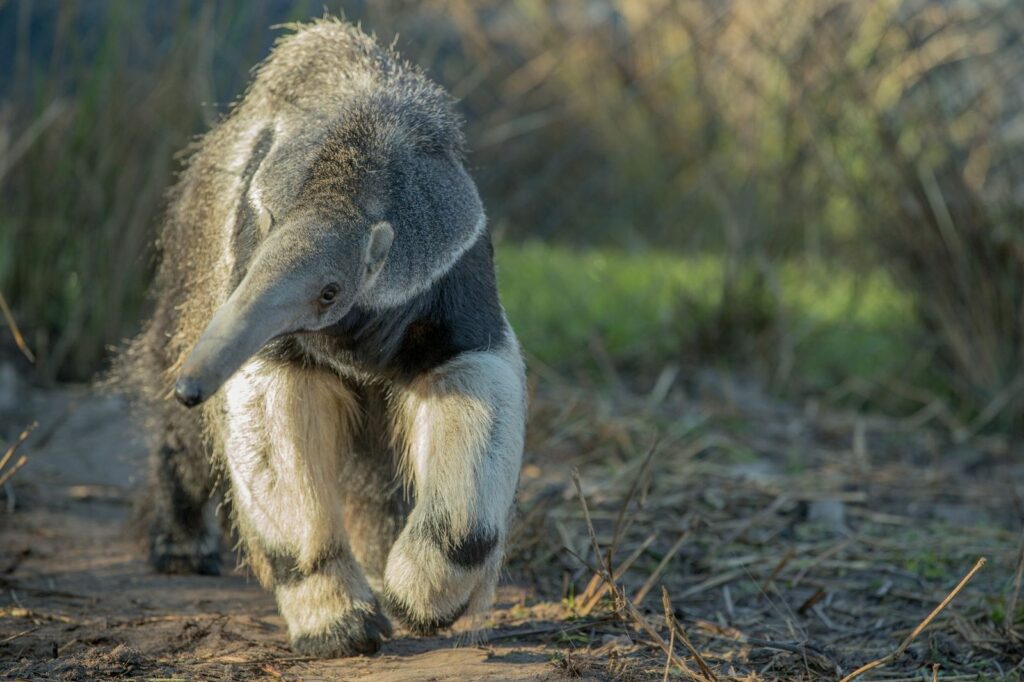
The Tamandua tetradactyla is a medium-sized anteater, or silky anteater, weighing between 3.6 and 6 kg.
It is characterized by its elongated snout, prehensile tail, and limbs with powerful claws adapted for digging ant and termite nests.
The International Union for Conservation of Nature (IUCN) classifies the species as of “Least Concern” globally.
However, in Argentina, it is classified as “Near Threatened” due to the population decline recorded in the last 15 to 20 years.
The main threats include:
- forest fires,
- habitat loss and fragmentation,
- roadkill incidents,
- attacks by domestic dogs,
- poaching.
The species has records in 14 Argentine provinces and 21 protected natural areas.
The scientific context of the discovery
This is the fourth record of an albino silky anteater in South America, adding to previous cases in Ecuador, Brazil, and Paraguay.
The study also clarifies that chromatic anomalies are recorded more frequently in the order Pilosa (sloths and anteaters) than in armadillos.
The study was conducted by Verónica L. Romero and Félix Ignacio Contreras (CONICET-UNNE), Daniel Barasoain (IANIGLA, CONICET-UNCUYO) a specialist in Xenarthra, and Carlos A. Gómez from Mburucuyá National Park.
The discovery, the specialists highlight, enriches the knowledge about chromatic variation in Argentine fauna.
Additionally, it reinforces the importance of protecting the Corrientes wetlands as a habitat for vulnerable species.



