



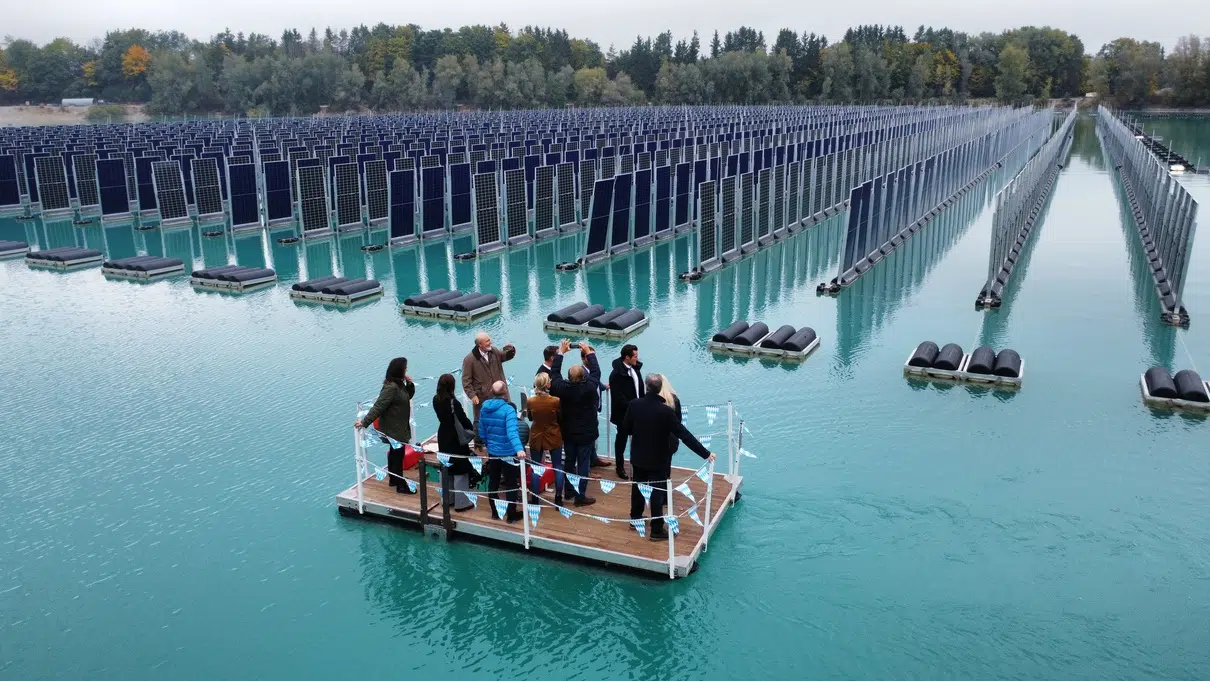
The German company SINN Power GmbH inaugurated the world’s first vertically installed floating photovoltaic plant, based on the patented SKipp technology. The pilot project was installed in the Starnberg gravel pit, with 2,500 vertical panels totaling 1.87 MW and partially supplying a nearby industry.
What is revolutionary is that the modules are arranged east to west, generating energy in two peaks: morning and afternoon, coinciding with the times of highest domestic and industrial consumption.
Technical Advantages of the Innovation
- Double peak curve: the east face captures morning light and the west face captures afternoon light, reducing the need for batteries.
- Albedo effect: the lake reflects light towards the underside of the bifacial modules, increasing production by up to 30%.
- Passive cooling: the water and air circulation keep the panels at a lower temperature, prolonging their lifespan.
- Wind stability: each floating unit has a 1.6-meter keel and high-strength cables that allow controlled deflection, similar to modern skyscrapers.
Environmental and Economic Impact
Although the initial investment is higher than in land installations, the efficiency and lifespan offset the costs. Additionally, the plant functions as a living laboratory to study the ecological impact on lakes:
- A 4-meter separation is maintained between modules to allow the passage of light and oxygen.
- Scientists warn that years of monitoring will be needed to evaluate effects on nutrients and aquatic ecosystems.
Redefining Solar Energy
Traditionally, solar panels are installed tilted southward to maximize midday radiation. However, this peak does not coincide with actual demand. The Bavarian plant demonstrates that vertical arrangement can align generation and consumption, offering a more efficient and sustainable alternative.
Global Context of Floating Solar Energy
The installation in Germany adds to a growing trend: the use of floating solar panels to take advantage of water bodies in dams, lakes, and quarries. Countries like Japan, China, and the Netherlands are already experimenting with similar projects, although with conventional inclined panels. The German innovation marks a new direction by combining flotation with verticality.
Furthermore, the coincidence between real generation and consumption could be key to reducing pressure on urban electrical grids and decreasing dependence on costly storage systems.
SINN Power’s innovation opens a new chapter in the energy transition: floating vertical solar panels that produce energy just when it is most needed. This model could be replicated in other regions, combining efficiency, sustainability, and adaptation to the challenges of climate change.



