



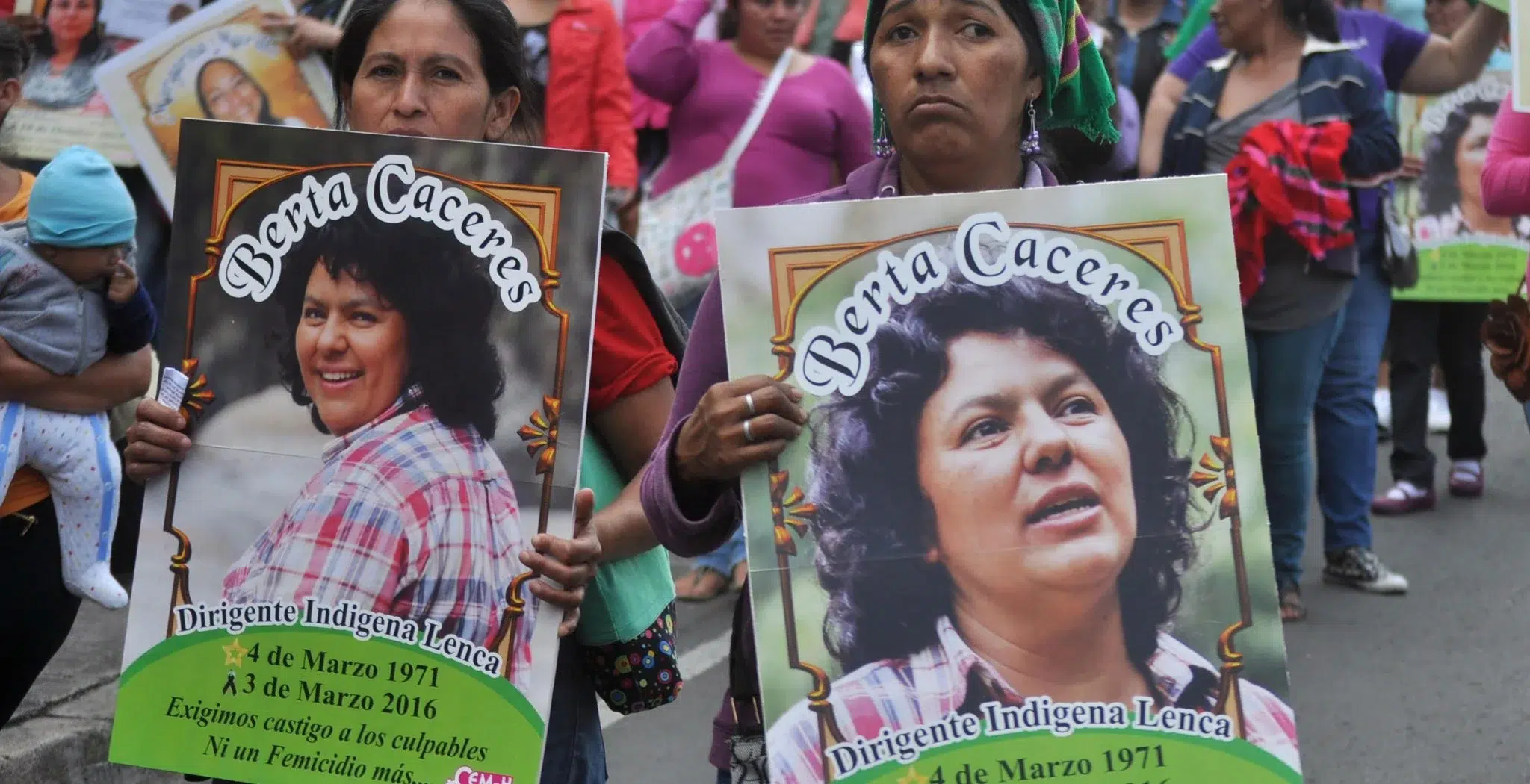
On March 4, 2026, marking ten years since the murder of Honduran environmentalist Berta Cáceres, the streets of Tegucigalpa were filled with chants of justice and memory. In front of the Supreme Court of Justice and the Public Prosecutor’s Office, her daughters Bertha and Laura Zúniga led demonstrations to demand the prosecution of the intellectual authors of the crime.
Dozens of people, mostly members of the Lenca community, human rights defenders, and foreign citizens, joined the mobilizations. The event was also a tribute to other murdered defenders, such as Juan López, who was killed in September 2024.
Family’s Demands
Bertha Zúniga emphasized that the execution of a prosecutorial requirement against members of a prominent business family accused as the intellectual author of the murder is still pending. “That is the concrete request we have at the Public Prosecutor’s Office,” she stated.
The family denounces that, despite the convictions of seven people in 2018 and the ratification of sentences in 2024, the judicial process is incomplete. For them, impunity remains open.
Berta Cáceres’ Trajectory
- Foundation of COPINH (1993): co-founded the Civic Council of Popular and Indigenous Organizations of Honduras to defend the Lenca territory against mining and illegal logging.
- Agua Zarca Project: led the resistance against the hydroelectric dam on the Gualcarque River, considered sacred by her community. Her struggle led the world’s largest dam builder to withdraw from the project.
- Awards: in 2015, she received the Goldman Environmental Prize, known as the “Green Nobel.”
Murder and Consequences
Berta Cáceres was murdered in her home in La Esperanza, Intibucá, in the early hours of March 2, 2016, after years of threats and persecution. The attack also attempted to take the life of Mexican activist Gustavo Castro, the sole witness.
In 2021, Roberto David Castillo, executive president of the company DESA, was found guilty as a co-intellectual author. However, organizations like Amnesty International denounce that the entire power structure behind the crime has yet to be sanctioned.
GIEI Honduras Report
A report by the Interdisciplinary Group of Independent Experts (GIEI), presented in January 2026, concluded that the murder was “predictable and preventable”.
The Honduran state had concrete information about its planning but did not act to prevent it.
Collective Justice and Memory
During the protest, the demonstrators performed a symbolic act of “collective justice”, denouncing the lack of political will to set a historical precedent in Honduras and the region.
Berta Cáceres’ name has become a global symbol of environmental and indigenous rights defense, reminding that the struggle for territory and nature remains alive in Latin America.
Ten years after her murder, Berta Cáceres’ case continues to be an emblem of indigenous and environmental resistance. The demand for full justice, including the intellectual authors, reflects the need to confront impunity and ensure the protection of those who defend natural resources in Honduras and throughout the region.


