



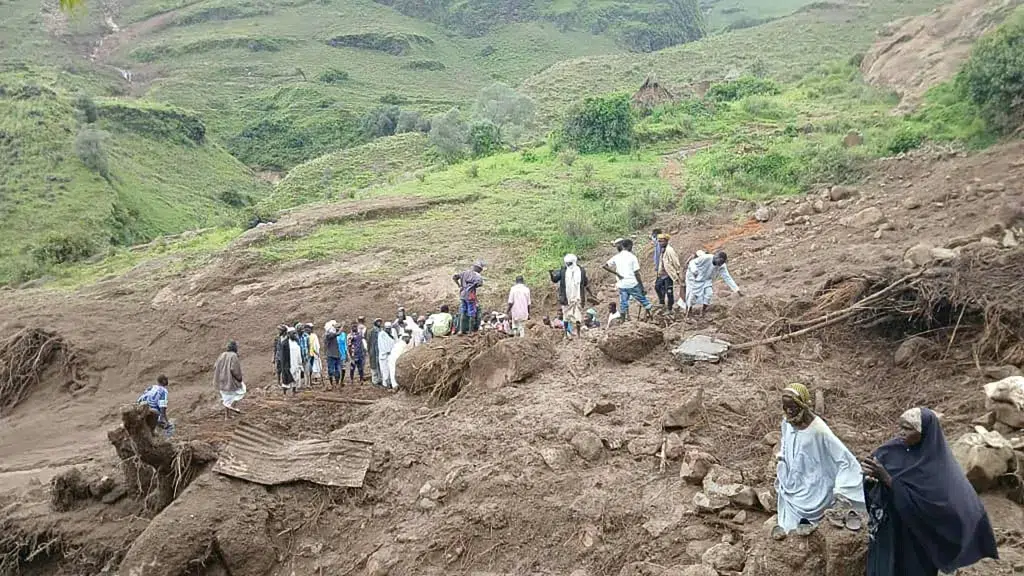
A massive landslide struck the village of Tarsin, located on the border between Central Darfur and South Darfur, leaving a preliminary death toll of up to a thousand fatalities. The collapse occurred after several days of intense rainfall that saturated the soils of the Jebel Marrah mountain range, one of the areas hardest hit by armed conflict in Sudan.
The landslide destroyed homes, crops, and roads, leaving the population isolated and in a situation of extreme vulnerability. Humanitarian authorities pointed out that the magnitude of the tragedy is exacerbated by the lack of safe access to the region, where thousands of people were already displaced due to violence.
The disaster was described as one of the most lethal episodes in the country’s recent history. The affected families now face the loss of loved ones, the destruction of their livelihoods, and the risk of diseases, in an environment without sufficient infrastructure to respond to an emergency of such scale.
The disaster also highlights how natural phenomena, combined with contexts of war and food crisis, intensify the effects on fragile communities. The need for urgent humanitarian access and preventive measures against environmental risks becomes increasingly evident.
The factors that cause this natural disaster
A landslide is the result of a combination of natural factors and, sometimes, human activities. Firstly, the presence of steep slopes in mountainous areas creates terrain susceptible to mass movement of earth. When intense rainfall saturates the soil, water reduces the cohesion of particles and promotes sliding.
To these elements, deforestation is added. The lack of vegetation prevents roots from retaining the soil and stabilizing it, making it easier for large masses to move quickly. Human activities such as mining, road construction, or poor agricultural practices further increase the risk.
The triggering factor is usually heavy rainfall or an earthquake, although sudden temperature variations or snow accumulation can also cause a collapse. Once started, the landslide gains speed and volume, turning into an unstoppable force that drags soil, rocks, trees, and human structures.
The devastation is explained by the energy released. The landslide not only destroys what it encounters but also permanently alters the landscape: blocking rivers, burying entire villages, and altering complete ecosystems. The speed at which it develops leaves little room for communities to react.

A risk that requires prevention
The tragedy in Darfur reminds us of the need for early warning systems that allow the evacuation of populations at risk. Monitoring soil moisture, controlling deforestation, and planning settlements away from unstable slopes are key measures to reduce the impact of these events.
In contexts of war and displacement, as in Sudan, vulnerability is even greater. Families take refuge in high-risk areas without safe alternatives, multiplying the likelihood of tragedies. Therefore, humanitarian access and international cooperation are essential to assist affected communities and strengthen local resilience.
Landslides, even though they are natural disasters, highlight the relationship between the environment and society. When extreme climatic factors combine with environmental degradation and humanitarian crises, their effects become deadly. Being prepared, preventing, and restoring ecosystems is the way to ensure that these catastrophes do not result in irreparable losses.


