



Every so often, the rains awaken an explosion of life in the world’s driest desert. This year, the flowering desert has already begun to spread its mantle in the Atacama Region, with patches of vegetation covering extensive areas of Vallenar, Copiapó, and surroundings, attracting visitors and scientists alike.
“We could have a peak of flowering from mid-October onwards,” anticipated Gabriela López, in charge of Protected Areas at Conaf Huasco.
Endemic species and extreme adaptation
The desert plants possess unique mechanisms to survive in hostile conditions.
According to researcher Cristian Delpiano, from the University of La Serena, the regions of Atacama and Coquimbo host the greatest diversity of plants in Chile, many of them in a state of dormancy when it doesn’t rain.
They remain as seeds, bulbs, or underground roots, waiting for the right conditions to bloom.
“The desert is very much alive, even though that life sleeps when it doesn’t rain,” explains Delpiano.
Cistanthe longiscapa: the flower that could revolutionize agriculture
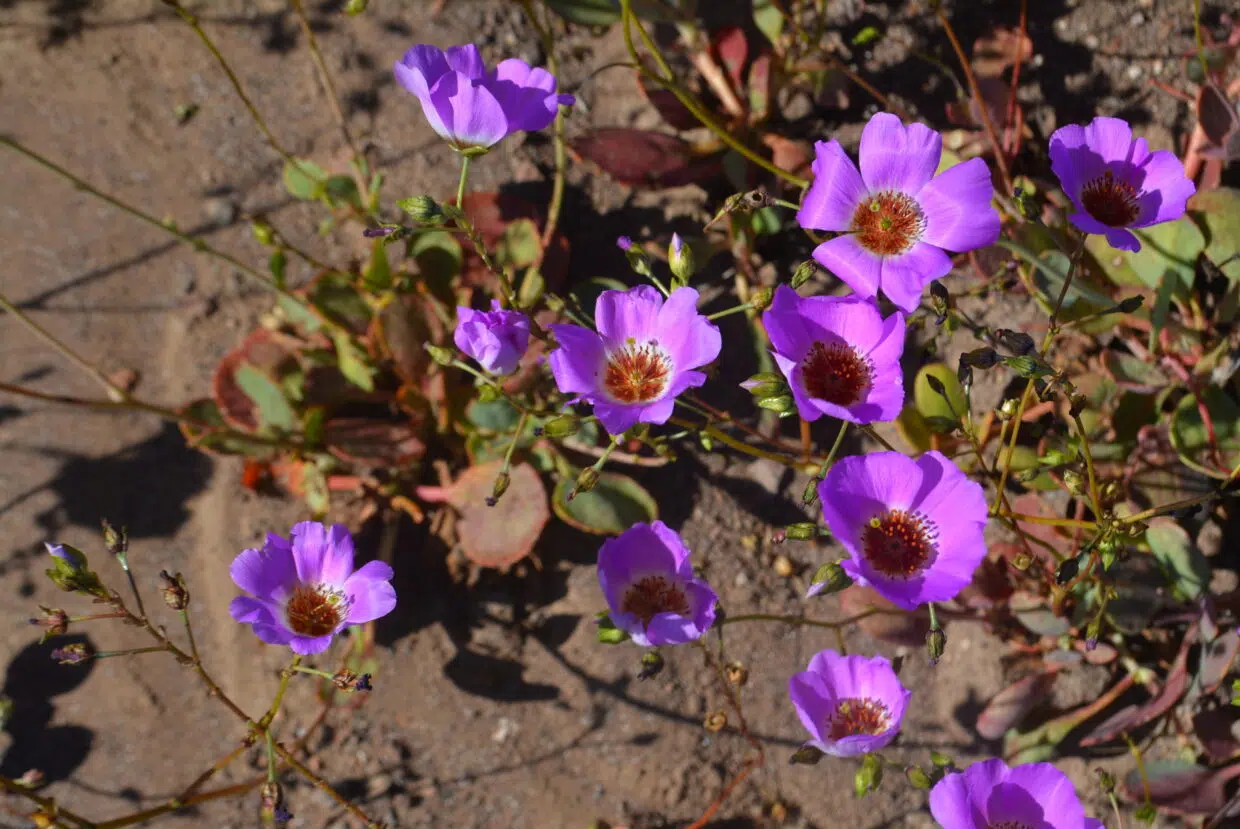
Among the most emblematic species of the flowering desert is Cistanthe longiscapa, known as “pata de guanaco”, which possesses an extraordinary metabolic plasticity. In extreme conditions, it activates the CAM mechanism, opening its stomata only at night to minimize water loss. When the environment improves, it returns to C3 photosynthesis, more efficient in temperate climates.
“This flexibility makes it a unique model to study how genes control the switch between photosynthetic modes,” notes Ariel Orellana, director of the Plant Biotechnology Center at Andrés Bello University.
Plant biotechnology and food security
Orellana’s team managed to cultivate specimens in the laboratory, allowing them to analyze the genes that regulate the metabolic “switch” and its relationship with water stress and solar radiation.
Chile, one of the countries with the highest water stress in the world, projects extreme droughts by 2050 in the central valley. In this context, the functional adaptation of the pata de guanaco could inspire new agricultural strategies.
“Our goal is to turn this species into a model plant for the study of extreme environments,” states Orellana.
A natural phenomenon with global impact
The flowering desert not only dazzles: it also offers clues to tackle climate change.
The flowering of Atacama is more than a visual spectacle. It is a manifestation of ecological resilience, an opportunity to educate, research, and conserve. And amidst its fuchsia and yellow colors, a small flower could hold the genetic key to ensuring future food security on an increasingly dry planet.


