



The Amazon presented its first unified visual identity, designed directly from the shapes of its rivers. The project, developed in Brazil, aims to position the region on the international stage with a narrative that reflects its geography, culture, and environment.
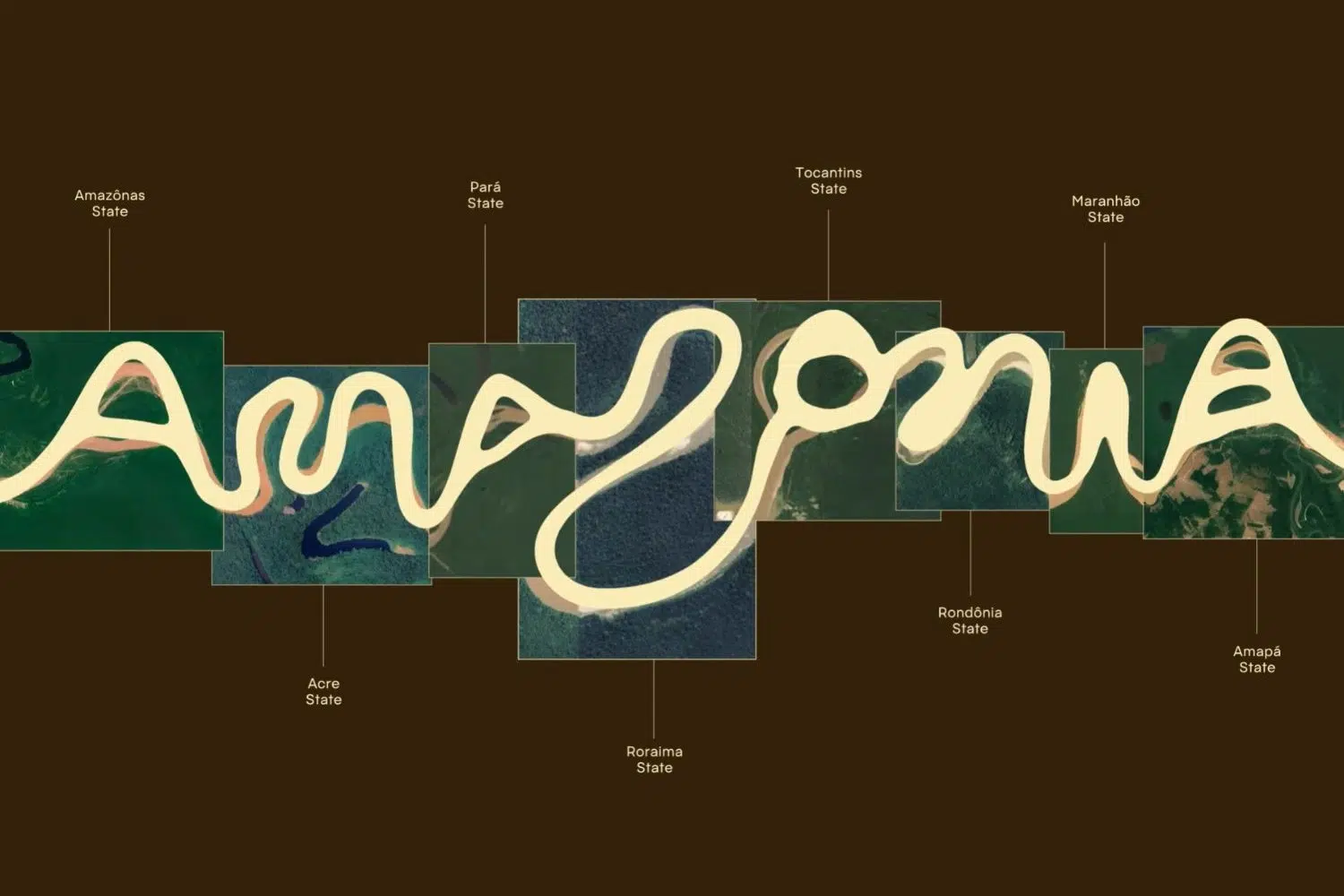
The core of the proposal is a typography created from satellite images: curves, bifurcations, and natural courses of the rivers were transformed into letters. The result is an alphabet without straight lines or artificial structures, where each form responds to the dynamics of water.
A language of the territory itself
The rivers, essential for the functioning of the Amazonian ecosystem, also become the visual language that represents the region.
The initiative avoids abstract symbols or external aesthetics and relies on elements inherent to the landscape, functioning as a unifying element in a diverse and complex region.
Global and environmental strategy
The visual identity is not just a communication tool but part of a broader strategy to position the Amazon on the global stage. The Brazilian rainforest, which houses 60% of the Amazon, is critical for stabilizing the global climate, acting as a carbon sink, and preserving unique biodiversity.
The proposal seeks to convey that political and environmental dimension, moving away from simplified or stereotypical images, and marking a turning point in how images of territories with significant environmental weight are constructed.
Importance of the Brazilian Amazon
The conservation of this ecosystem is vital for:
- Global climate regulation, storing between 90 and 140 billion tons of carbon.
- Unique biodiversity, with 10% of the planet’s known species.
- Flying rivers, which generate moisture and crucial rains for South American agriculture.
- Cultural sustenance, home to over 470 indigenous peoples and traditional communities.
- Economic and social impact, as deforestation affects water production, local climate, and the health of millions of people.
Threats and actions
Deforestation has increased in the last decade, endangering biodiversity and human rights. Initiatives like the ARPA Communities program, supported by WWF, aim to protect millions of hectares. Strategies for forest monitoring, bioeconomy, and legal defense of territories are essential to face the challenges.
The new visual identity of the Brazilian Amazon is more than a design: it is a political and environmental statement. By building its image from the rivers, the region bets on an authentic representation that reinforces its role as the climatic and biological heart of the planet, at a critical moment of the global crisis.



