



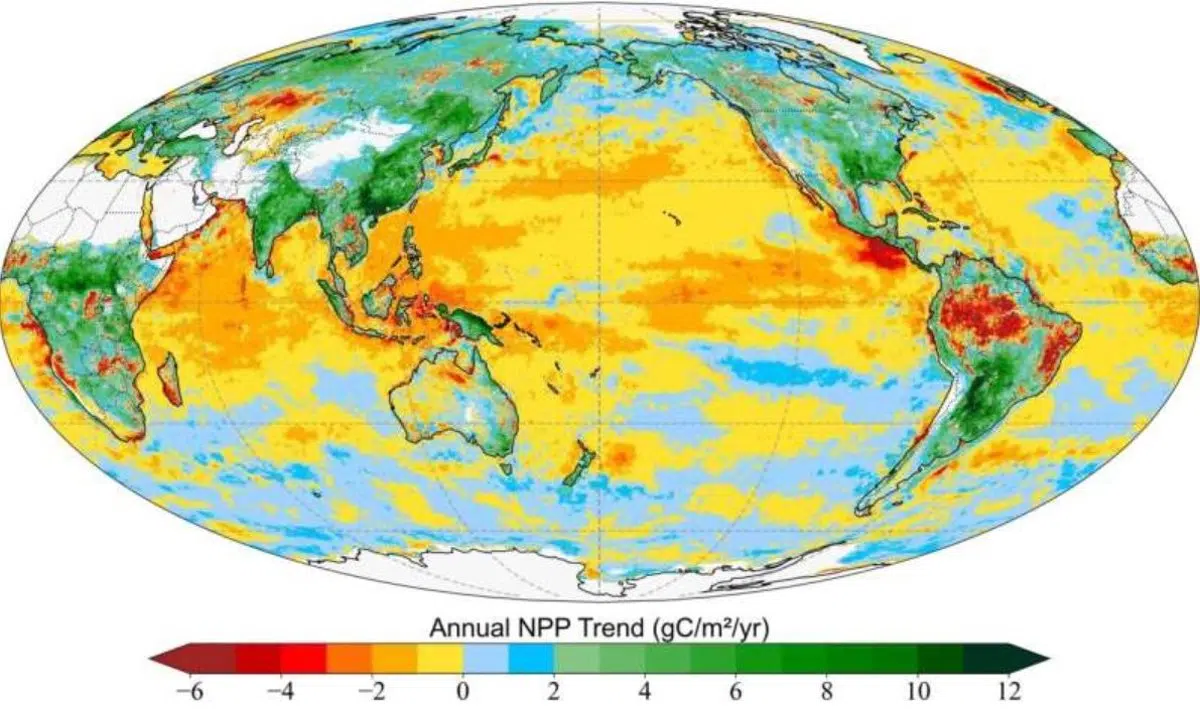
Between 2003 and 2021, the **global net primary production** —the amount of carbon captured by organisms and their photosynthesis minus what they release through respiration— **significantly increased**, driven by **terrestrial plants**.
This was concluded by a study led by the **Nicholas School of the Environment at Duke University**, published in **Nature Climate Change**.
## What is net primary production?
**Photosynthetic organisms** —plants, algae, and phytoplankton— convert **atmospheric carbon into organic matter** through **photosynthesis**, but also release carbon through **autotrophic respiration**. The difference between these processes is called **net primary production (NPP)**.
“NPP determines the energy available to sustain life, mitigate carbon emissions, and stabilize the climate,” explained **Yulong Zhang**, the study’s lead author.
## An integrated approach: land and ocean under scrutiny
**The study combines six sets of satellite data to evaluate global trends**.
Unlike previous works focused on terrestrial or oceanic ecosystems separately, this study analyzed **global NPP** by combining:
– Three sets of terrestrial data
– Three sets of oceanic data
– Satellite observations of chlorophyll and surface greenness
– Models integrating temperature, light, nutrients, and precipitation
## Increase on land, decrease at sea
Between 2003 and 2021:
– **Terrestrial NPP** increased by **200 million metric tons of carbon per year**, especially in **high latitudes and temperate zones**
– **Oceanic NPP** decreased by **100 million metric tons per year**, with steep declines in **tropical and subtropical oceans**
Overall, **global NPP** grew at a rate of **100 million metric tons of carbon per year**.
## Environmental factors behind the trends
According to the researchers:
– On land, **increased temperatures in high latitudes** extended growing seasons
– In temperate zones, **local humidification**, **forest expansion**, and **agricultural intensification** also contributed
– In the ocean, **surface warming** reduced **nutrient mixing**, affecting **phytoplankton** productivity
“Warm waters can stratify and block access to essential nutrients,” explained **Nicolas Cassar**, a study co-author.
## The role of extreme climate events
The **interannual variability** of NPP was more pronounced in the ocean than on land. Events like **El Niño and La Niña** significantly altered marine productivity.
“A series of La Niña events reversed the downward trend in oceanic NPP after 2015,” noted **Shineng Hu**, a climate dynamics specialist.
## Implications for environmental management and climate change
The findings provide an integrated view to enhance **models and mitigation strategies**. “Assessing planetary health requires considering both terrestrial and marine ecosystems,” affirmed Cassar.
This study offers an **updated reference** on **global photosynthesis**, crucial for:
– Improving climate projections
– Designing ecosystem-based mitigation strategies
– Guiding conservation policies and sustainable land and ocean use.



