



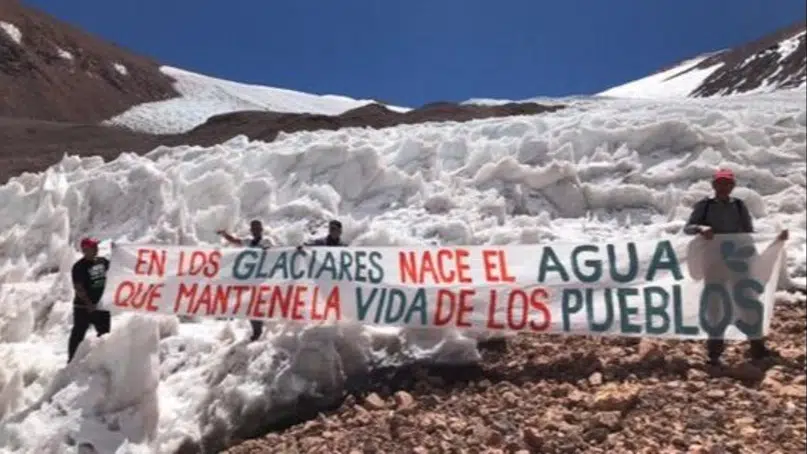
More than 25 organizations from different parts of the country expressed their concern about the possible modification of Law 26.639, a central tool for the protection of Argentine glaciers.
The entities emphasize that the current regulation guarantees essential protection levels for strategic ecosystems. They warn that any relaxation could enable high environmental impact activities in extremely vulnerable areas.
Enacted in 2010, the Glacier Law consolidated a technical, scientific, and social consensus on the need to preserve fundamental freshwater reserves for the country. These areas support the water supply in arid and semi-desert regions, where access to water conditions life and production.
The glaciers and the periglacial environment form a system that stores, regulates, and distributes water for basins, wetlands, and mountain localities. Therefore, the organizations believe that unprotecting them would increase environmental and social vulnerability in large regions of the country.
The current regulation and its importance for water management
Law 26.639 prohibits activities that could alter the natural dynamics or the integrity of glaciers. Among the prohibitions are mining and hydrocarbon exploration and exploitation in areas covered by ice or permafrost. Infrastructure works that imply their displacement or physical degradation are also restricted.
The Argentine Institute of Snow, Glaciology and Environmental Sciences (IANIGLA) is responsible for the national glacier inventory. The organizations emphasize the need to strengthen its capabilities to ensure long-term monitoring and conservation. The institute constitutes the technical basis on which the implementation of the law is sustained.
The entities assert that the regulation does not impede economic growth but frames it within reasonable ecological limits. The goal is to avoid interventions in areas where the damage would be permanent and where water fulfills essential functions. They argue that retreating from these standards would imply social and economic costs in the long term.
The principle of non-regression and legal risk
The Escazú Agreement, in force in Argentina, establishes the prohibition of regressing in terms of environmental protection. Modifying the Glacier Law in a less restrictive sense is considered a breach of that commitment.
The organizations warn that a regressive reform would be contrary to the basic principles of environmental law. The loss of strategic water reserves would affect populations, producers, and mountain ecosystems.
The impact would reach entire basins that depend on the glacial contribution to maintain their balance. Nationally, it would mean weakening one of the most important policies to face the climate crisis.

What is the Glacier Law and why would its modification be detrimental?
What does Law 26.639 consist of?
- It protects glaciers and the periglacial environment as strategic water reserves.
- It defines areas where human activities are restricted due to their ecological fragility.
- It mandates a national inventory and permanent monitoring of these formations.
What is sought to be modified?
Projects promoted by extractive sectors aim to:
- Limit the scope of the protected periglacial environment.
- Allow mining or hydrocarbon activities in currently prohibited areas.
- Reduce the area considered of strategic water value.
Why would it be detrimental to the environment?
- It would enable interventions that can destroy ice, permafrost, and associated watercourses.
- It would put at risk the supply in regions dependent on meltwater.
- It would weaken the country’s ability to face droughts, glacier retreats, and extreme weather events.



