



On Tuesday, October 14, the Agriculture and Livestock and Natural Resources committees of the Chamber of Deputies began an informative session to discuss the Minimum Environmental Protection Budget Law for the Application of Phytosanitary Products that would allow spraying activities up to 10 meters (File 5621-D-2025).
The promoter of the project, Deputy Atilio Benedetti (UCR, Entre Ríos), presented it as an initiative to “provide a framework for an activity that needs regulation” and highlighted the need to reconcile agricultural production with health.
However, the project is based on discussions held by the so-called Good Agricultural Practices Commission, which is made up of producers, exporters, and chambers linked to agricultural technology, but lacks representatives from the health sector, researchers, or populations affected by spraying activities.
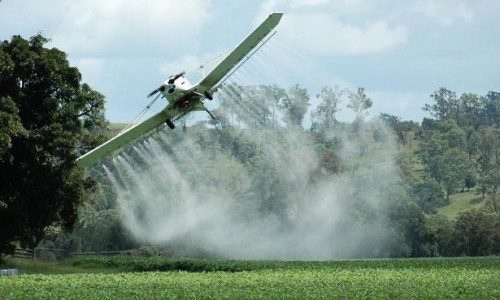
Indeed, there is no minimum national safeguard to protect the so-called “sprayed towns” or the rural workers affected by the use of agrochemicals, within the framework of the dominant production model: agribusiness. According to Benedetti himself, 9 out of 10 hectares of production use agrochemicals.
In this sense, communities and socio-environmental organizations have been requesting and fighting to achieve palliative measures in the face of the approval of more and more agrochemicals. However, the presented law establishes very limited protection.
Sectors of the agribusiness also intend for this “protection” not to be the floor of the debate, but its ceiling, which generates even more concern for the populations that have managed, after years of struggle, broader exclusion zones and safeguards.

What does the project enabling spraying activities say?
The text declares “national interest” in the so-called “good agricultural practices” and defines them as: “a harmonious set of applicable techniques and practices that must be considered when deciding on the use of phytosanitary products, aimed at ensuring that the product can express its maximum therapeutic capacity for which it was designed, minimizing the risk of the occurrence of any of the different forms of drift and thus avoiding possible emerging risks for health and the environment.”
This definition is already controversial, as it assumes that there is a “good way” to apply poisons, accepting that this model has a “sustainable” way of being carried out. On the contrary, the “possible emerging risks” of socio-environmental health are a fact, since these practices have been used for two decades to justify the massive use of glyphosate, atrazine, and other pesticides banned in several countries. As territorial organizations say, the only good practice is not using poisons.
On the other hand, Articles 9 and 10, which set the application parameters, raised concerns. They establish:
- 10 meters for ground applications and with drones.
- 45 meters for aerial applications.
These distances would apply from the limit of “sensitive zones” —homes, rural schools, bodies of water— towards productive areas.
For the affected communities, this represents a true historical regression. The Plurinational Network of Sprayed Peoples, the Institute of Socio-Environmental Health (InSSA), and the Association of Environmental Lawyers denounced that the project was tailored to suit agribusiness corporations.
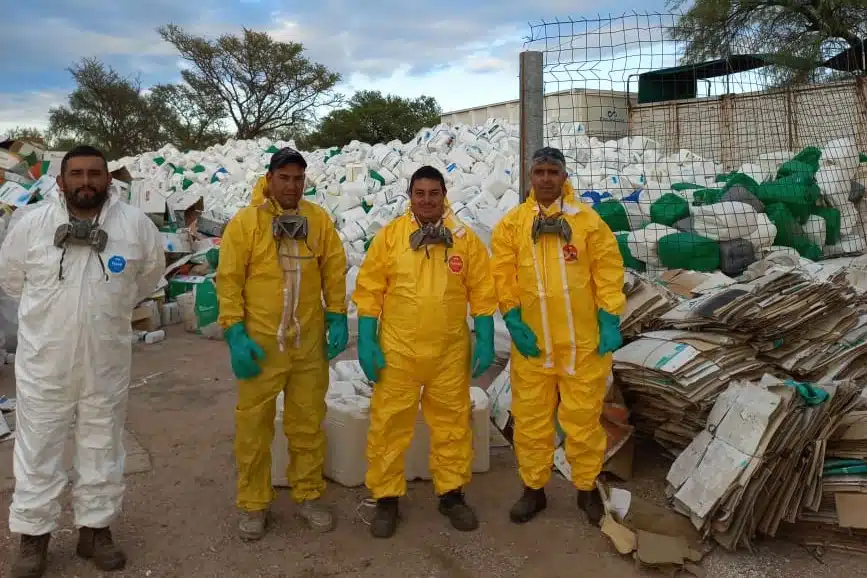
Only the name “minimum budgets” remains
According to Article 7, if another regulation is established, not even the exclusion zones truly prohibit the use of agrochemicals. The project states: “Art. 7 Prohibition of applications in sensitive and exclusion zones.
Within sensitive and exclusion zones, applications of phytosanitary products cannot be carried out except those that are due to reasons of public health, those carried out in agricultural product storage and storage plants, ports, and those that the provincial or municipal authority, as appropriate, defines by a legal norm.”
In other words, if the provincial or municipal authority decides otherwise, this general regulation becomes ineffective.
Nevertheless, there are representatives of agribusiness who are not satisfied. The leading voice was that of the Secretary of Agriculture and Natural Resources of the Ministry of Bio-Agroindustry of Córdoba, Marcos Blanda, who bluntly stated that it is not a law of minimum budgets, but “an operational law that regulates a process” and that the project “does not have environmental criteria to appropriate” (sic).

Furthermore, Blanda rejected the already limited Article 9 on exclusion zones. “The dist
Compartí esta nota

Latest news
Te pueden interesarTe pueden interesar
Argentina is on track to fail its climate commitments

Weather in Buenos Aires: 16°C temperature, cloudy skies and no rain for Friday, 12°C at night
Southwest wind brings cold and sun to Mar del Plata: highs of 13°C and intense waves on the coast and the Port
Impact of Agribusiness in Suriname: The Soy Dilemma and the Loss of 94.5% of Tropical Forest
