



In the community of Tusaquillas, in Jujuy, Franco Vedia lives alongside other families that make up one of the 38 communities in the Salinas Grandes and Laguna de Guayatayoc basin. There, livestock and agriculture sustain daily life in a fragile environment that could be at risk due to lithium extraction in the Puna.
However, the advancement of lithium mining strains this ancestral relationship with the land. In Salinas Grandes, a portion of the Puna resists the arrival of new extractive projects.
The local worldview recognizes hills, rivers, and water springs as living entities. Therefore, respect for nature is a central part of the cultural identity.
Nonetheless, the high Andean wetlands concentrate more than half of the world’s lithium. Consequently, international pressure on these ecosystems continues to grow.

Lithium and wetlands: strategic wealth and water fragility
Lithium, considered key for the energy transition, is essential for batteries and renewable energies. Therefore, its global demand is steadily increasing.
In northern Argentina, the main high Andean wetlands are located in Catamarca, Salta, and Jujuy. There, extraction is primarily carried out from underground brines.
This process involves the intensive pumping of water in semi-arid regions. Consequently, local communities warn of impacts on water availability. The region is part of the so-called “Lithium Triangle”, shared with Bolivia and Chile. Additionally, there are already six operational mines in Argentina and two in Chile.
Although projects must undergo technical and environmental assessments, the debate persists. Communities demand free, prior, and informed consent according to the ILO Convention 169.
Environmental governance and institutional tensions
Organizations like the Fundación Ambiente y Recursos Naturales support communities in Salinas Grandes and Laguna de Guayatayoc. Their work aims to strengthen consultation processes and wetland protection.
Argentina adhered to the Ramsar Convention in 1992 and has 24 protected sites. However, the designation does not prevent extractive activities in all cases.
Meanwhile, companies like Rio Tinto lead investments in lithium. The sector maintains that there are dialogue tables and participatory monitoring.
However, community leaders denounce a lack of effective listening. Thus, the conflict exposes tensions between economic development and territorial rights.
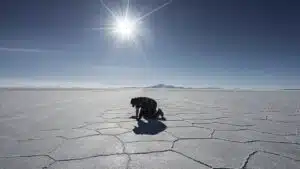
The benefits and dilemmas of lithium extraction in northern Argentina
Lithium exploitation generates foreign exchange, employment, and infrastructure in NOA provinces. Additionally, it positions the country as a key player in global decarbonization. It can also boost value chains linked to batteries and technology. This opens industrial opportunities in a context of energy transition.
However, the benefits must be balanced with the protection of unique ecosystems. The high Andean wetlands regulate water, capture carbon, and sustain biodiversity.
The recent registration of indigenous territories as “Territory of Life” in the TICCA Registry sets a precedent. It reinforces the community’s role as an environmental custodian in the face of demand from the Global North.
Ultimately, the challenge is not only to extract a strategic mineral. It consists of ensuring water, biodiversity, and rights in a region where every drop counts.


