



After the success of the first CONICET streaming at the seafloor, where a live expedition in the submarine canyon of Mar del Plata was shown, the organization now returns with a new scientific proposal.
This time it is another broadcast by the national scientific entity, but this time of a paleontological campaign in Patagonia: the Cretaceous Expedition I.
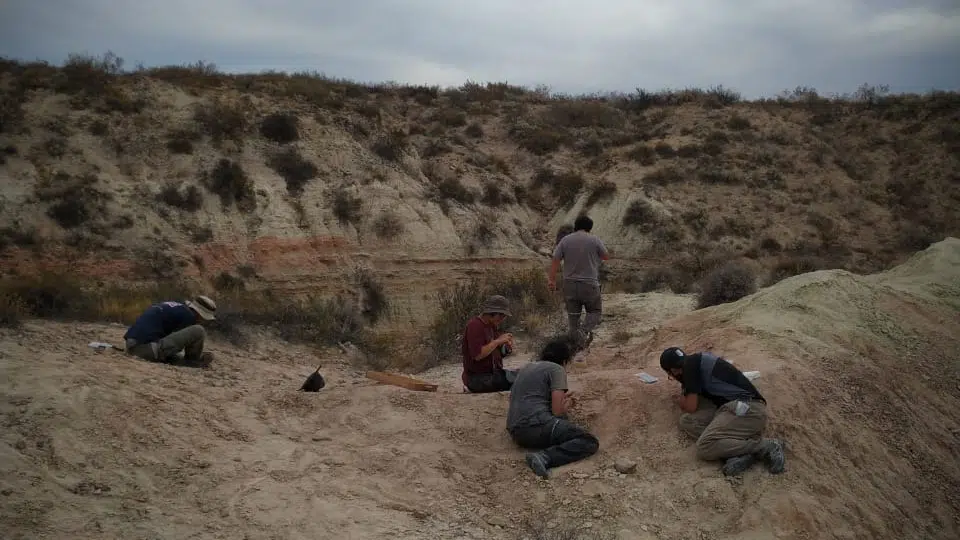
The new streaming will show how 14 researchers from CONICET carry out excavations in the province of Río Negro to recover the remains of Bonapartenykus ultimus, the Argentine dinosaur discovered in 2024.
The expedition can be watched live on YouTube or Instagram between Monday, October 6 and Friday, October 10, with real-time tracking.

New CONICET streaming: showing the search for an unpublished dinosaur in Argentina
The team led by Federico Agnolín, the scientific leader of the expedition from the Argentine Museum of Natural Sciences “Bernardino Rivadavia,” returns to the nearby site near General Roca.
This area is one of the most valuable paleontological sites in the country, where some of the most important discoveries in Argentina in the field have been made in recent years.
“We are going back to a key site, where at least ten new species of animals not yet named were identified years ago, including amphibians, reptiles, mammals, and a carnivorous dinosaur,” explains Agnolín, scientific leader of Cretaceous Expedition I.
In particular, the scientists aim to “continue the work interrupted during the last day of the previous campaign in 2024.”
It is because, last year, a historic discovery was made there: CONICET found the claw of a dinosaur never before known, named Bonapartenykus ultimus.
“We believe that new fossil elements will appear, live and in direct discoveries of dinosaur fossils,” Agnolín hopes.
On the other hand, Matías Motta, a CONICET fellow, highlights the peculiarities of the area under analysis: “It’s historic, it’s a quarry that has always given us information about the past, fossils that are rare finds.”
What CONICET is looking for in Patagonia
Now, the goal of Cretaceous Expedition I is to “recover key pieces not only from one, but from two carnivorous dinosaurs.”
In previous years, Motta explained, the team found claws and tail bones of these specimens.
Now, they seek to “know them better, see if they are new species, and understand their value within this ecosystem.”
Live fossil discoveries for everyone thanks to streaming
From yesterday, Monday 6, until Friday 10, the campaign will be broadcast live at two daily times: from 11 to 12:30 and from 17 to 18:30.
This is possible thanks to high-speed satellite internet installed at the campsite. This allows watching how scientists surgically extract fossils from rocks and interact with them in real time.
“For years, we wanted to do a new type of scientific communication. We had thought about filming a live campaign, but we hadn’t found the means or ways to do it,” Agnolín comments.
However, the researcher mentions that the Falkor campaign carried out by CONICET underwater inspired them, with almost 18 million views.
“Our streaming will be different from the seafloor one, because our journey is not geographical, we are not going to a new world, but we are going to a temporal world,” detailed the paleontologist.
And he added: “Through the bones we find, we will show a new world through time.”
One of the most promising moments of the broadcast will be during the “great excavation,” when “live discoveries” are expected.
The scientist emphasizes the importance of capturing the moment of discovery: “I think we will be able to capture that moment of excitement that overwhelms us paleontologists when a new


