



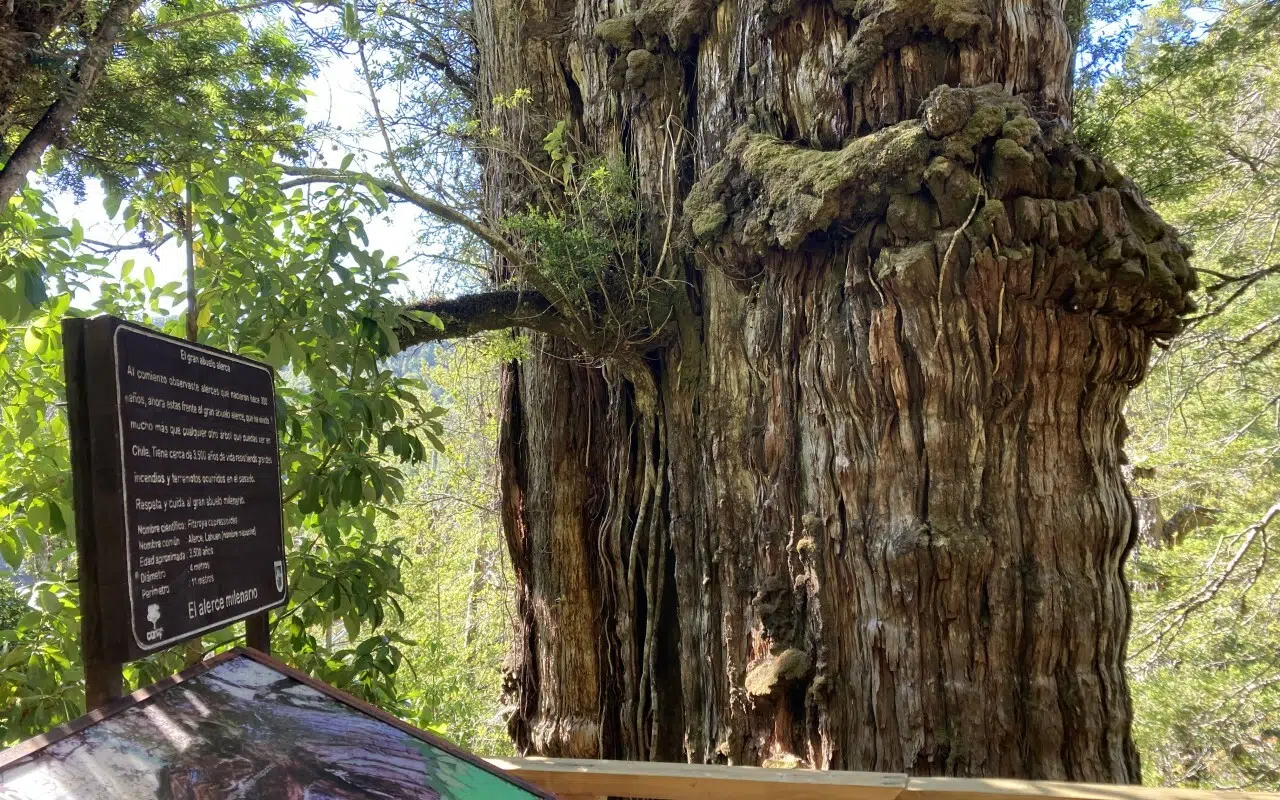
In the Coastal Alerce National Park, in the Los Ríos region (Chile), stands “The Great Grandfather”, an alerce (Fitzroya cupressoides) nearly 5,500 years old, considered the oldest living tree in the world.
Its age surpasses the mythical Methuselah in California (4,854 years) by more than six centuries, placing Chile at the center of international attention and reclaiming the ancestral Mapuche Williche territory where this specimen sprouted.
The scientific research
The calculation of its age was led by Jonathan Barichivich (Austral University of Chile) and dendrochronologist Antonio Lara. Due to the tree’s dimensions—30 meters in height and 11 in perimeter—it was not possible to extract a complete core. With a sample covering 40% of the trunk, they recorded 2,400 rings and statistically projected an age of 5,484 years.
This tree was born approximately when bronze was discovered in Egypt and the pyramids did not yet exist, while the first signs of writing emerged in Sumeria. For Barichivich, 80% of its current organism has endured five millennia of climatic changes, eruptions, and human activity, becoming a living time capsule.
A cultural and ancestral symbol
Beyond the biological, “The Great Grandfather” represents the ancestral memory of WilliMapu for the Mapuche Williche people. Its existence transcends the botanical and becomes a symbol of the relationship between nature and indigenous territories.
International media such as BBC, National Geographic, Al Jazeera, DW, and Reuters have spread its story, consolidating its cultural and scientific value.
Conservation history
The alerce species suffered intensive logging between the early and mid-20th century, bringing it to the brink of extinction. In Chile, it was declared a natural monument in 1977, prohibiting the felling of living specimens. In Argentina, the province of Chubut protected the alerces through Law No. 5015 of 2003. Currently, CONAF only authorizes the use of dead wood.
International longevity comparison
Other notable millennial trees in the world include:
- Methuselah (California, USA): bristlecone pine, over 4,850 years.
- Sarv-e Abarqu (Iran): Persian cypress, ~4,000 years.
- Llangernyw Yew (Wales): between 3,000 and 4,000 years.
- Olive tree of Vouves (Greece): over 3,000 years and still produces olives.
- Alerce Abuelo (Argentina): specimens over 2,600 years in Los Alerces National Park.
- Old Tjikko (Sweden): Norwegian spruce with cloned roots of 9,550 years, although its current trunk is young.
A call from science
“The Great Grandfather” invites reflection on the resilience of life in the face of environmental crises. For Barichivich, who was introduced to the tree by his great-grandfather, “it is a grandfather watching over us.” In times of climate change, this natural monument not only measures the past but also warns about the future of the southern temperate forests.
With nearly 5,500 years, “The Great Grandfather” stands as a planetary symbol of resistance and memory. Its international recognition not only celebrates a biological record but also reclaims the relationship between nature, indigenous peoples, and conservation. Thus, Chile becomes the guardian of the oldest living record on the planet, a legacy that challenges humanity on the need to protect forests and their millennial stories.



