



For decades, the Spanish coastline advanced towards the sea by force of concrete. However, after increasingly intense storms, some municipalities began to reverse course to protect their beaches.
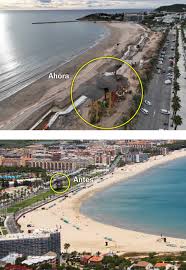
Thus, instead of building walls, they chose to remove infrastructures and return space to the beach as a natural barrier.
This change is still minor, but it is already observed on the coasts of Tarragona, Pontevedra, Castellón, Girona, and Alicante.
Deconstructing to adapt to the climate
In these coastal areas, local authorities understood that urban rigidity amplifies wave damage. Therefore, removing promenades, parking lots, or artificial fills became a defensive strategy.
By freeing sand and dunes, the sea dissipates its energy before reaching inhabited areas. In this way, the beach resumes its protective function. Additionally, this measure reduces the need for costly repairs after each storm.
Local experiences with visible results
On the coast of Tarragona, the partial removal of structures allowed a natural recovery of the beach profile. Over time, the sand redistributed itself more stably.
Meanwhile, in Pontevedra, the removal of fills favored the regeneration of dune systems. This strengthened the coast against recent swells.
In Castellón, Girona, and Alicante, similar initiatives demonstrated that less concrete can mean greater coastal resilience.
The ecological impact of giving space back to the beach
From the environmental point of view, coastal deconstruction has immediate positive effects. By recovering dunes and intertidal zones, key habitats for flora and fauna are restored.
Furthermore, these areas act as ecological corridors and improve coastal biodiversity. Birds, invertebrates, and adapted vegetation return to colonize lost spaces.
Additionally, natural beaches filter water better and reduce erosion, favoring the stability of the marine-coastal ecosystem.
A measure against climate change
The rise in sea level and the increased frequency of storms make it unfeasible to continue defending the coast solely with hard structures. In this context, nature-based adaptation is gaining ground.
Giving space back to the sea allows the coastline to move without causing severe structural damage. Thus, the exposure of populations and infrastructures is reduced. Therefore, this strategy is not only ecological but also a way of managing climate risk.

Obstacles and pending debates
Despite its benefits, coastal deconstruction faces social and economic resistances. Losing urban or tourist land generates local conflicts.
However, the costs of inaction are often greater in the long run. Each extreme storm leaves losses that exceed the preventive investment. Therefore, these experiences open a necessary debate on how to inhabit the coastline in a changing climate.
A grain of sand with strategic value
Although they are still exceptions in a hyper-urbanized coastline, these initiatives mark an alternative course. They do not seek to dominate the sea, but to coexist with it.
In a country accustomed to gaining ground from the water, giving up space becomes a bet on resilience. Thus, returning sand today can mean conserving the coast tomorrow.



