



While El Bolsón, Río Negro, was going through an intense cold wave, a smoke spot surprised the firefighters from the Forest Fire Prevention and Fighting Service (SPLIF). In the area of Cerro Dedo Gordo, near Río Blanco, they detected an underground fire fueled by a layer of fossil charcoal.
The finding caught attention due to its uniqueness: the fire was not advancing through the forest, but burning underground, in contact with roots and geological material. The explanation came from the El Bolsón Geomuseum, where specialists indicated the presence of a tertiary mineral coal deposit.
The discovered coal, only 30 centimeters thick and at a shallow depth, is a fossil residue formed between 20 and 40 million years ago. During that period, the region hosted an inland sea with extensive coastal swamps, the origin of these carbon-rich sediments.
The area belongs to the ancient Ñirihuau Basin, shared by Río Negro and Chubut, recognized as one of the country’s most important coal basins.
The fossil fire: a silent threat and an environmental lesson
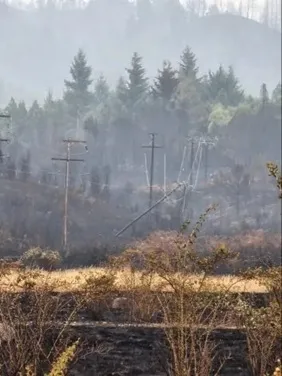
The detected spot did not arise by chance. According to specialists, it could be the underground reactivation of the forest fires from last summer, which affected more than 2,900 hectares. The heat would have reached deep roots, igniting the fossil charcoal.
These underground fires pose a threat because they can remain active for weeks or even months, without being visually detected. Additionally, their extinction is complex as the fire spreads in an environment without direct oxygen.
The episode also reveals a little-known aspect of the interaction between fire, soils, and geological history. In Patagonia, formations of peat, gas, or coal can be reactivated under certain conditions, showing that the risks associated with fires go beyond the surface.
 Forest fires affected four times the Patagonian forests in the last season. (Photo: Marcelo Martínez- Greenpeace).
El Bolsón: unique nature and latent risks
Located in the Andean region of southern Río Negro, El Bolsón stands out for its environmental richness and its geography transitioning between forests, mountains, and steppes. Surrounded by Cerro Piltriquitrón and the Quemquemtreu River Valley, it combines remarkable biodiversity with a natural environment vulnerable to climate change and human activities.
The cold temperate climate and variable precipitation generate ecosystems where lenga, cypress, and coihue forests coexist. However, the presence of soils rich in organic matter and fossil remains like peat or coal enhances the risk of underground fires.
This discovery confirms that, besides its natural beauty, El Bolsón holds geological remnants that can trigger unexpected phenomena. Therefore, environmental monitoring and prevention are essential to protect both biodiversity and the safety of its inhabitants.



