



In the midst of the national discussion over a clarifying law of the Glacier Law, the province of San Juan—one of the jurisdictions with the largest ice surface in the country—presented a decisive scientific analysis: a provincial glacier map developed after 15 years of studies and updates.
The work was presented by Magister Silvio Pastore, coordinator of the Geology, Glaciology, Snow Science, and Climate Change cabinet at the National University of San Juan (UNSJ), who also pointed out the technical deficiencies that, in his view, the current regulations present. His observations coincide with the claims of the provincial government and mining sectors, which seek greater precision in regulation.
San Juan Glacier Inventory: Updated Data
San Juan is the only Argentine province that has built its own provincial glacier inventory, updated periodically. The numbers presented by Pastore are compelling:
- 2017 Inventory (San Juan River basin): 5,530 glaciers, less than 500 km².
- 2018 Provincial Inventory: 6,174 glaciers in total, with an area of 596.8 km².
- 2022 Update (San Juan River basin): 3,912 glaciers, 471.59 km².
These data position San Juan as the third province with the largest glacier area in the country, with almost 11% of the national total, behind Santa Cruz (≈60%) and Mendoza (≈21.5%).
Moreover, 74% of the solid water in the province comes from the glacier environment, while 26% corresponds to the periglacial environment, where debris glaciers are found.
Alert Over Ice Retreat
Pastore was emphatic in warning about glacier dynamics and the speed of deterioration due to climate change:
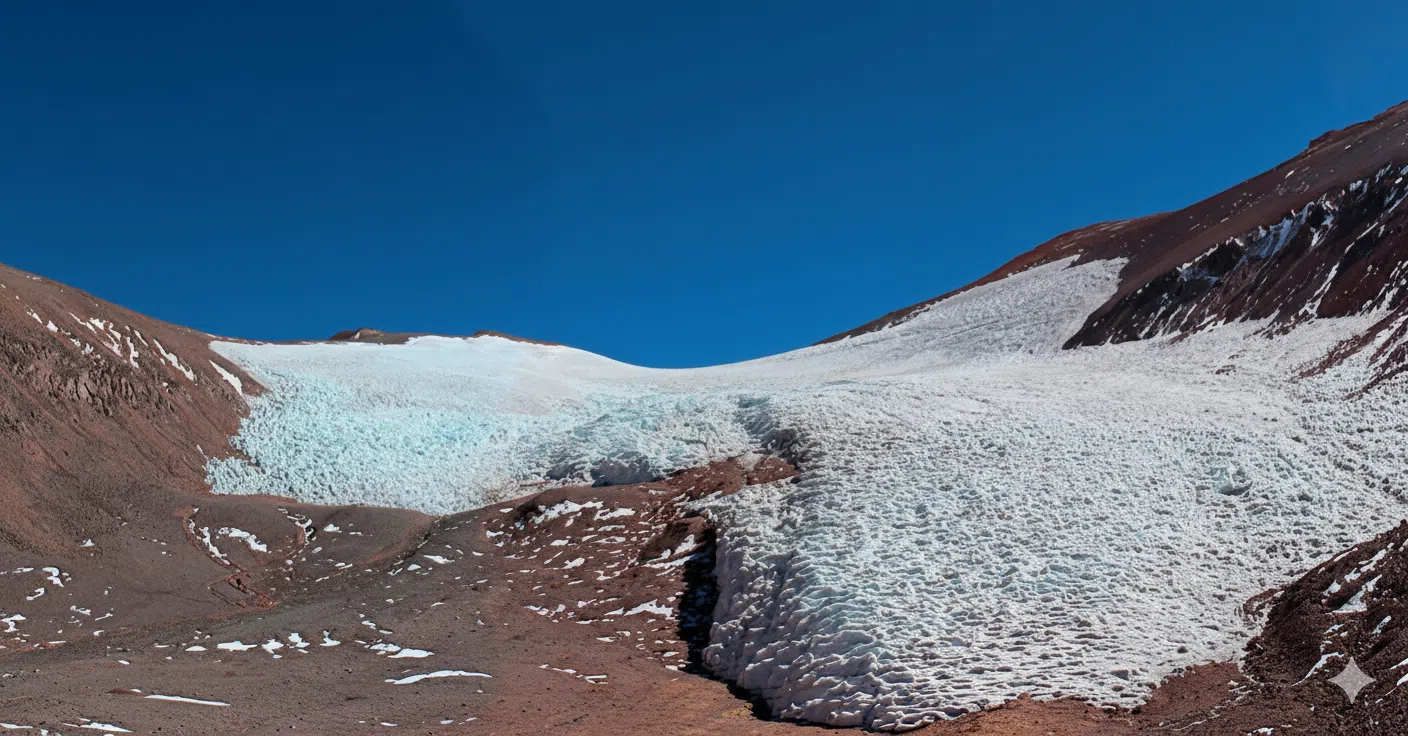
“In just five years, the province has lost more than 50% of the ice volume of the mountain glacier environment due to the current climate, an extremely alarming phenomenon in geological times.”
The expert emphasized that the accelerated reduction of the “white part” of the glaciers compromises the strategic water reserves of San Juan, essential for water supply in the region.
Technical Observations on the Glacier Law
At a time when the regulation is under national review, Pastore highlighted four critical points that affect both scientific research and productive activity:
- Delimitation of the periglacial environment: the law mandates its protection, but “there is no global technology to draw a line on a map that defines its boundary.”
- Definition of strategic water reserve: the central concept is empty, as the regulation prohibits activities in strategic areas without specifying what constitutes a reserve or who defines it.
- Inventory without clear update rules: although the regulation indicates reviews every five years, it does not establish how to add or remove disappeared bodies or how to reclassify with new technology.
- Regulatory ambiguities: technical failures hinder scientific research, environmental decisions, and productive projects in mountainous areas.
National Debate and Legislative Projection
The national government included the clarifying project of the Glacier Law in the agenda of extraordinary sessions of Congress, both in the House of Representatives and the Senate. Governors of mining provinces, led by San Juan, seek to promote more precise regulations that allow protecting the resource without blocking scientific or productive decisions.
The retreat of the ice, the magnitude of solid reserves, and the technical inconsistencies of the regulation—extensively studied in San Juan—will become key arguments when discussing how to balance environmental protection with productive development in the mountains.
San Juan positions itself as a central player in the national debate on the Glacier Law, providing unprecedented scientific data and environmental alerts that highlight the urgency of updating the regulation. The province concentrates almost 11% of the country’s glaciers and faces an accelerated retreat of its water reserves, making its experience a decisive input for legislators, researchers, and productive sectors.


