



Southwest Iceland once again became the scene of intense volcanic activity. In the early hours, a volcano located in the Reykjanes Peninsula erupted for the ninth time since late 2023, as confirmed by meteorological authorities.
Live images showed lava emerging from a fissure that opened in the ground. The main one stretches for 2.4 kilometers, while a smaller one reaches 500 meters in length.
Faced with the threat, the population of the region was asked to stay in their homes due to air pollution. The levels of harmful gases are considered dangerous to health, reinforcing preventive measures.
The fishing village of Grindavík, the closest to the volcano, was evacuated once again, along with the popular Blue Lagoon thermal spa. This is not the first time that both sites have had to be evacuated since the beginning of the eruptive cycle.
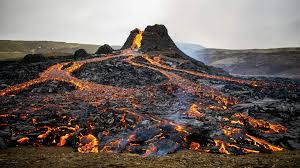 Reykjanes Volcano in Iceland. Photo: National Geographic.
A phenomenon marking a new geological stage
Since the first eruption recorded in March 2021, the volcanoes of Reykjanes broke a silence of over eight hundred years. Scientists believe the region has entered a new era of volcanic and seismic activity.
The residents of Grindavík, affected by constant threats, began to leave their homes by the end of 2023. Many properties were acquired by the State, while the population was relocated to safer areas.
Despite the local impact, authorities assured that this latest eruption did not affect international flights, avoiding a repeat of the 2010 crisis when another eruption paralyzed air traffic in Europe.
Iceland, with its 33 active volcanic systems, continues to be one of the most dynamic seismic zones on the planet, located on the Mid-Atlantic Ridge, where the Eurasian and North American tectonic plates collide.
 Reykjanes Volcano in Iceland. Photo: EFE Verde.
Reykjanes: a volcano with a dormant past and an active present
The Reykjanes volcano, located in a volcanically active region, remained dormant for centuries before reactivating in 2021. This peninsula concentrates a network of geological faults that facilitates the opening of fissures from where lava emerges.
Unlike other explosive volcanoes, Reykjanes volcanoes usually have fissure eruptions. This means that lava flows from cracks in the ground, advancing slowly but with a high volume, posing a prolonged risk to nearby communities.
Volcanic activity also generates toxic gases, such as sulfur dioxide, which affects air quality. Therefore, authorities maintain constant health alerts and environmental monitoring in the area.
The behavior of the Reykjanes volcano reaffirms the importance of scientific surveillance. These events are part of Iceland’s natural balance, but also a reminder of the need to respect and understand the Earth’s dynamics.


