



On Thursday, intense torrential rains and severe floods battered the Mid-Atlantic and Northeast United States, causing chaos along the Interstate 95 corridor and tragically leading to the death of a child in Maryland.
This event represents another serious flooding in a summer that has been particularly affected by this type of phenomenon.
The strong storms began to form in the afternoon and persisted until Thursday night. In the late afternoon, flash flood alerts were issued in several areas of Pennsylvania, New Jersey, Maryland, and Virginia, with forecasts of more torrential rains.
Which areas were affected by severe floods
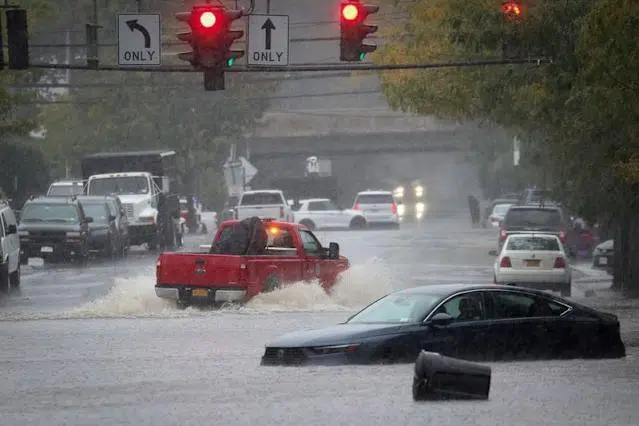 Streets flooded by intense rains
In both Maryland and Pennsylvania, the National Weather Service and local authorities reported numerous flooded roads and stranded vehicles.
In New York City, the copious precipitation paralyzed traffic on a major roadway that cuts across Queens from east to west, east of Manhattan.
A video recorded in the area showed cars and a tractor-trailer completely stranded in the water, with a man visibly waiting to be rescued from the roof of his own vehicle.
A law enforcement officer reported that at least two vehicles that had been submerged on the highway were successfully rescued from the waters.
Emergency teams managed to rescue two people from one of the cars, while the other vehicle was unoccupied, and no injuries were reported.
In the heart of Manhattan, videos captured inside Grand Central Terminal showed a Metro-North train drenched by the rain during Thursday morning.
A passenger described the experience of being inside the carriage as being in a “car wash.” Another previously released video showed accumulated water on the floor of an urban bus in Brooklyn.
More information has been requested from the Metropolitan Transportation Authority regarding reports of flooding in the New York City subway system.
 Completely flooded subway stations
Philadelphia was also affected
The severe floods also caused several leaks in SEPTA stations in Philadelphia, according to Andrew Busch, a spokesperson for the Southeastern Pennsylvania Transportation Authority. “The water level has decreased, and the teams are continuing to dry the station surfaces,” Busch stated.
Emergency declarations and urgent rescues
Given the seriousness of the situation, New Jersey declared a state of emergency early Thursday morning due to the possibility of intense rains and severe and sudden floods, according to a press release issued by acting governor Tahesha Way.
Meanwhile, Governor Kathy Hochul also declared a state of emergency for New York City and its surrounding counties due to the potential flooding. Mayor Eric Adams declared a local state of emergency for the city, which will be in effect until 8:00 a.m. this Friday.
Maryland Governor Wes Moore urged the residents of his state to prepare for possible severe and sudden floods. Harford County, located an hour north of Baltimore, recorded several water rescues between 1:00 p.m. and 3:00 p.m. on Thursday, according to a county spokesperson.
Tragically, a child in Maryland died after being swept away by a sudden flood into a drainage pipe, according to a spokesperson for the Mount Airy Volunteer Fire Company.
The child, whose age has not yet been revealed, was playing in the yard when a ravine, through which only a thread of water normally flows, quickly filled up to the waist of the rescuers. Alexander, the spokesperson: “The current pushed him towards this pipe, and the rescuers were battling against the current and everything else to get him out. We had to call for quite a bit of additional help, and we were finally able to retrieve him, but he drowned.”
Disruptions in air transport and climatic context due to severe floods
Late Thursday afternoon, air transport also experienced severe disruptions, with ground stops at several major airports, including the main ones in the New York and Washington areas, according to the Federal Aviation Administration (FAA).
John F. Kennedy International Airport in New York experienced average delays of approximately three hours. Thousands of flights within, to, and from the U.S. were canceled or delayed, according to FlightAware.com.
The severe floods were the result of a cold front that ended a prolonged and persistent heatwave that had kept the eastern part of the country with stifling temperatures during the day and warm nights.
After a summer characterized by frequent rains and floods, the ground simply could not absorb more water.
Flash floods are more common in summer, as the warmer air can hold more moisture, and intense daytime heat contributes to the formation of powerful storms.
However, torrential rains are becoming more frequent due to climate change, as rising global temperatures push weather conditions to extremes.
Hourly precipitation has increased in nearly 90% of large U.S. cities since 1970, according to a study by the non-profit organization Climate Central.
Precipitation in the Mid-Atlantic and Northeast has already exceeded normal levels this summer, especially in some areas of eastern Pennsylvania, central New Jersey, northern Maryland, and Washington suburbs.
This has left the soils saturated and prone to rapid runoff and flooding, even without extreme amounts of rainfall.
New Jersey has been particularly affected by floods this summer, including the deaths of at least two people two weeks ago. Some areas of Virginia have experienced multiple floods this season.
On July 19, the National Weather Service issued a flash flood emergency – the highest level of flood alert – for the Washington, D.C. area, with 25 to 50 mm of rainfall in 30 minutes, causing the swelling of rivers



