



A few simple coats of paint on roofs could become a cooling solution to tackle heat waves and water scarcity.
Researchers from the University of Sydney along with the startup Dewpoint Innovations developed a porous polymer coating capable of reflecting nearly 90% of sunlight. This way, it keeps surfaces up to 6°C cooler even under direct radiation.
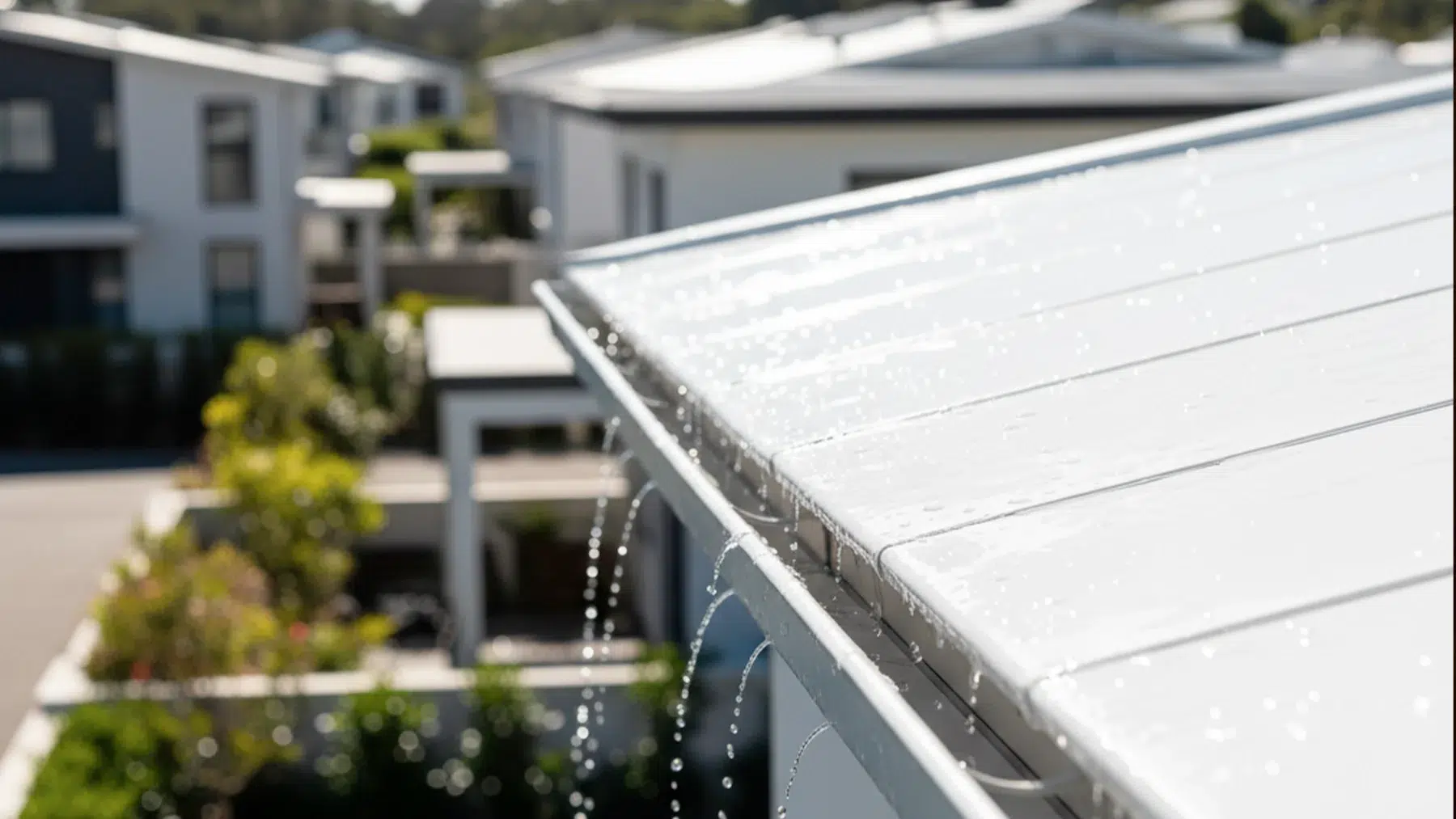
In addition to cooling buildings, the low temperature of the painted surface allows the water vapor in the air to condense, generating droplets ready to be collected, as happens on mirrors after a hot shower or on a car body overnight.
A scientific breakthrough with environmental impact
Professor Chiara Neto, lead author of the study published in Advanced Functional Materials, highlighted:
“This technology not only advances the science of cooling roof coatings but also paves the way for sustainable, low-cost, decentralized sources of fresh water, a critical need in the face of climate change and growing water scarcity.”
The coating is based on a fluorinated polymer PVDF-HFP, capable of achieving a “daytime radiative passive cooling” (PDRC) effect. Its high nanoporous nature gives it a 92% reflectivity, preventing the surface from heating up under the sun.
How passive cooling works
The polymer not only reflects solar radiation but also emits thermal radiation in the atmospheric window, a region of the infrared spectrum where the air is almost transparent. This allows the surface to be in direct thermal contact with outer space, at –270°C, achieving cooling below ambient temperature.
Under optimal conditions, the surface can remain between 3 and 6°C cooler than the surrounding air, enough to condense water vapor and produce a passive source of fresh water.
Study results
During six months of testing at the Sydney Nanoscience Hub, the coating demonstrated its ability to ensure a sustainable water supply even without rain.
- Production of up to 390 ml of water per square meter per day.
- In an area of 12 m², enough to cover the daily needs of one person.
- Reduction of roof temperatures by more than 25°C compared to black surfaces and even superior to conventional light-colored materials.
This effect helps reduce the urban “heat island effect”, a phenomenon that raises temperatures in cities up to 10°C more than in rural areas.
Potential applications
The cooling paint could become a versatile tool:
- Agricultural use: watering animals and crops.
- Energy industry: production of green hydrogen by electrolysis.
- Urban building: reducing energy consumption in air conditioning.
Its drop-in nature allows it to be applied directly to existing buildings without the need for structural modifications.
From the lab to the market
The crucial step will be to transfer the innovation to mass production. According to Neto, a cool roof paint has already been developed with the same cooling characteristics but using cheaper materials suitable for large-scale manufacturing.
It is a water-based paint, with a cost similar to other high-quality exterior paints. Upcoming studies will be conducted in different climatic contexts, including Mediterranean areas and regions where nocturnal dew is common.
The cooling paint developed in Australia represents an innovative and multifunctional solution to climate change: it cools buildings, reduces energy consumption, mitigates the heat island effect, and generates fresh water passively.
Its potential to scale towards urban, agricultural, and industrial applications makes it an example of how science and eco-design can offer concrete responses to the environmental challenges of the 21st century.



