



In Mendoza, two teachers and designers decided to transform agricultural waste into an opportunity for the planet. Gabriela Negri and Analía Funes, both professors at the Instituto General San Martín, created Bioeleven, a venture that produces biodegradable fabrics and bags from grape, tomato, and garlic waste, which led them to win a prestigious national contest.
It all began three years ago when both coincided in their interest to reduce the impact of the textile industry, one of the most polluting in the world. While Gabriela was finishing a master’s in research, Analía was taking a course in textile sustainability. This led them to join forces and start working on a new biomaterial.
The first fabrics were born in their home kitchens. With patience, they managed to perfect the formula and obtain certifications from the Instituto Nacional de Tecnología Industrial (INTI). Then, they made the leap to artisanal production and began acquiring machinery. Today, thanks to the award they received, they will be able to incorporate equipment to dry the sheets and increase their production capacity.
The name of the venture, “Bioeleven,” comes from the number of the test that finally worked. Each fabric sheet represents a step towards a cleaner industry, where agricultural waste stops being trash and becomes valuable raw material.
Innovation from waste: when waste becomes a resource
Each year, the wine, tomato, and garlic industries generate hundreds of thousands of tons of waste. Grape pomace alone accounts for about 400,000 tons annually; tomato pomace, 270,000; and garlic skins, 90,000. Much of it ends up being burned or in landfills, polluting the soil and air.
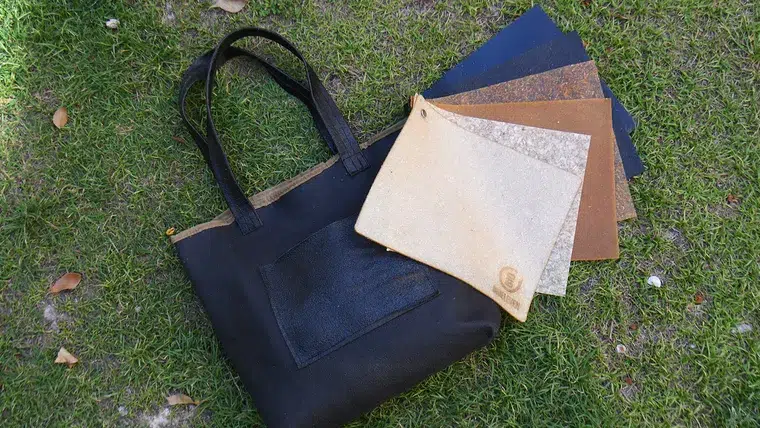
Bioeleven recovers these materials and transforms them into biodegradable fabrics with different textures, weights, and natural colors. The sheets measure between 30 and 80 centimeters and can be used in clothing, accessories, leather goods, gastronomy, packaging, and merchandising. Some models with organic mesh are even used in footwear manufacturing.
The versatility of the biomaterial is one of its greatest strengths: it can be sewn, engraved, glued, or laser-cut, maintaining its strength and durability. Additionally, it does not dry out or get damp, and retains its properties for at least a decade, just like the best eco-leathers on the market.
Thanks to its natural composition, the material not only replaces polluting products but also promotes a new form of circular production and responsible consumption.
Characteristics of biodegradable fabric bags
The bags created with Bioeleven fabrics are 100% biodegradable and compostable. They are made solely with plant-based components, without chemical additives or plastics. This allows them, at the end of their useful life, to disintegrate naturally and return to the earth’s cycle without leaving toxic residues.
The manufacturing process combines technological innovation with artisanal techniques. The plant fibers obtained from the waste are treated, ground, pressed, and dried to form a flexible and resistant sheet. This can be dyed with natural pigments, avoiding the use of synthetic dyes.
Another key aspect is that the bags are breathable and lightweight, making them ideal for transporting food or personal items. Their water resistance is moderate but sufficient for everyday use, and their texture varies depending on the base material: grape pomace bags are thicker, tomato ones are softer, and garlic ones are more elastic.
These bags offer a real alternative to plastic or synthetic fabric bags. Moreover, they significantly reduce the CO₂ emissions associated with traditional textile production. With each unit produced, Bioeleven prevents several kilos of agricultural waste from ending up polluting the environment.

From experimentation to international recognition
The creators’ effort was rewarded in the Diseño Argentino Exponencial-Creative Bootcamp program, organized by the Fundación Bunge y Born and the British Council. Bioeleven was one of the three winning ventures among fifteen finalists from across the country.
The prize, of $5,000, will allow them to expand production from 40 to 280 sheets per month through the purchase of a drying machine, optimizing time and quality. Additionally, the recognition includes mentorships, strategic training, and support for their international expansion.
The jury highlighted their contribution to the circular economy and their social impact by integrating scientific innovation with environmental commitment. For Gabriela and Analía, the goal is clear: to scale their production without losing the sustainable spirit that inspired them from the start.



