



The water coming out of a domestic washing machine doesn’t seem dangerous at first glance. However, each wash cycle releases tiny plastic fragments from synthetic garments. These microplastics, invisible to the human eye, end up accumulating from the water in soils, rivers, food, and even inside the human body.
To tackle this problem, a team from the University of Bonn developed a filter capable of intercepting these fibers before they escape into the environment. The innovation, inspired by the way certain fish filter water to feed, is already in the patent process and has demonstrated a efficacy of over 99% in capturing plastic fibers.
The impact of microplastics in domestic washing
In a household of four people, washing clothes can release up to 500 grams of microplastics per year into the water. Most end up in sewage treatment plants, adhered to the treatment sludge. That sludge, reused as fertilizer, spreads the fibers across agricultural fields. From there, wind, rain, and insects redistribute them, returning them to the water and the food chain.
Until now, available filters did not offer a practical solution: some clog easily, others let too many particles through. None managed to combine efficiency, self-cleaning, and low cost, essential conditions for integration into millions of washing machines.
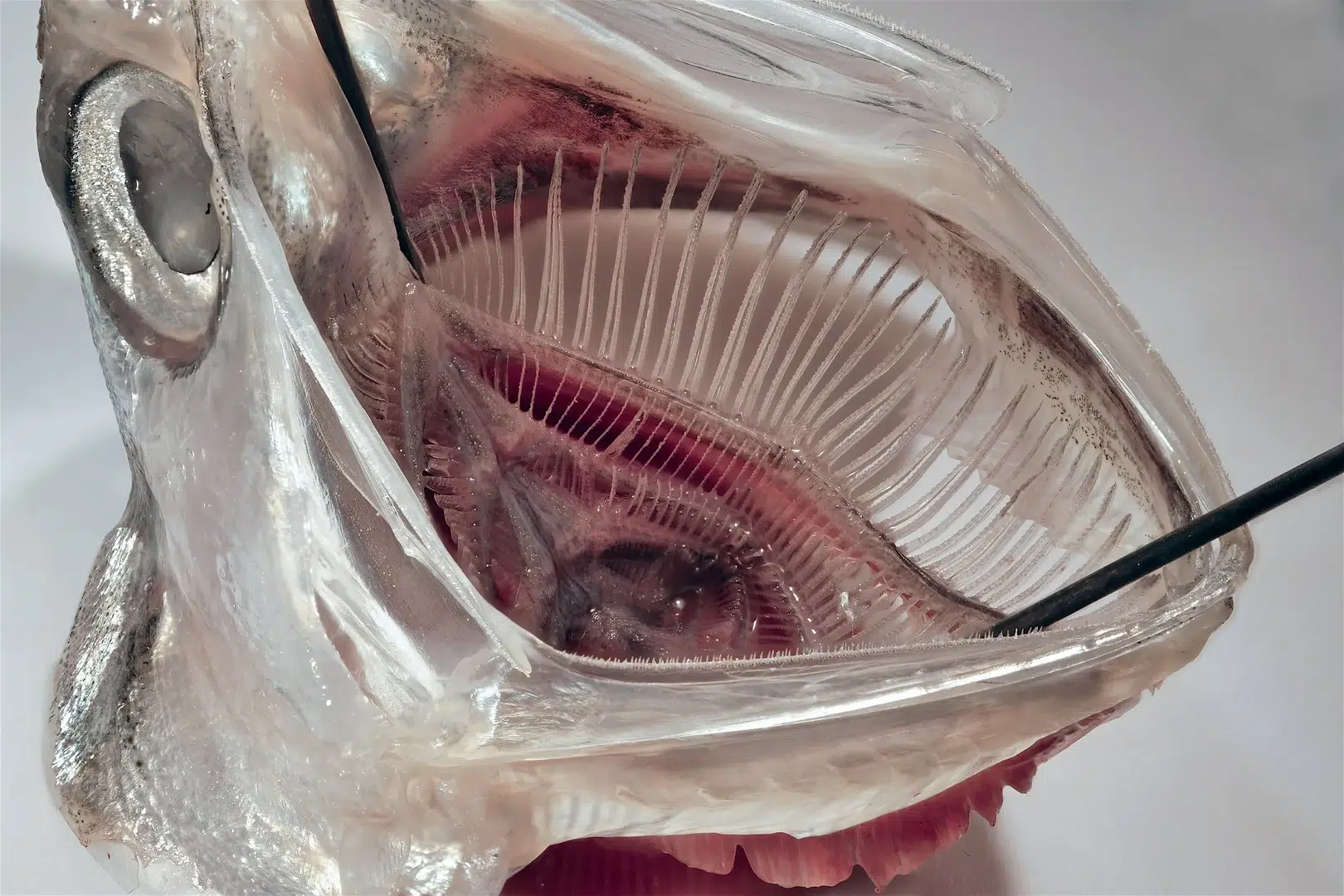
Inspiration from nature: filter-feeding fish
The team led by Dr. Leandra Hamann and Dr. Alexander Blanke reviewed what already works in nature. Species like sardines, mackerels, and anchovies rely on a refined filtration system: they swim with their mouths open, capture plankton, and expel clean water through their gills.
The key lies in the architecture of their system: a porous funnel, wide at the entrance and narrower towards the throat. The gill arches form a flexible mesh that retains particles without collapsing. The plankton slides and moves towards the fish’s throat, avoiding blockages.
That continuous movement was replicated by the Bonn team in a synthetic funnel with adjustable mesh and variable opening angles, capable of capturing almost all fibers without stopping the water flow.
Functioning of the prototype
The design does not require moving parts or complex mechanisms. The dirt is trapped at the filter’s outlet and is automatically vacuumed several times per minute. Subsequently, the mixture is compacted inside the washing machine, forming a solid pellet that the user empties every few dozen washes.
The simplicity of the system opens the door to its mass production. It can be manufactured with common polymers and adapted to the space that many modern washing machines already incorporate for internal filters.
Applications and future of the device
The team is working with Fraunhofer UMSICHT to ensure that the solution can be integrated into future generations of appliances and also as an accessory in existing washing machines.
In countries like France, legislation already promotes the installation of anti-pollution filters in new models. It would not be surprising if other European countries followed the same path, consolidating this innovation as a standard in the industry.
Potential environmental and social impact
If this type of filter becomes widespread, the impact could be significant:
- Serve as a transition while the textile industry moves towards less polluting fabrics.
- Reduce the microplastic load in sewage treatment plants and improve the performance of urban sanitation systems.
- Encourage regulations that require the integration of similar filters in new appliances.
- Promote the ecodesign of devices with repairable and replaceable components.
The biomimetic solution developed by the University of Bonn demonstrates that carefully observing nature remains one of the best sources of innovation. A small device in an appliance as common as a washing machine can become a key ally in reducing microplastic pollution in water and moving towards a more sustainable future.



