



The crisis over drinking water is one of the great challenges of the 21st century. According to the World Economic Forum, 72% of the world’s population faces water security issues and 8% lives in critical insecurity.
This means that millions of people do not have guaranteed access to drinking water, affecting health, food, and economic development. In this context, technological innovation becomes a key tool to find sustainable and accessible solutions.
The Water from Air device
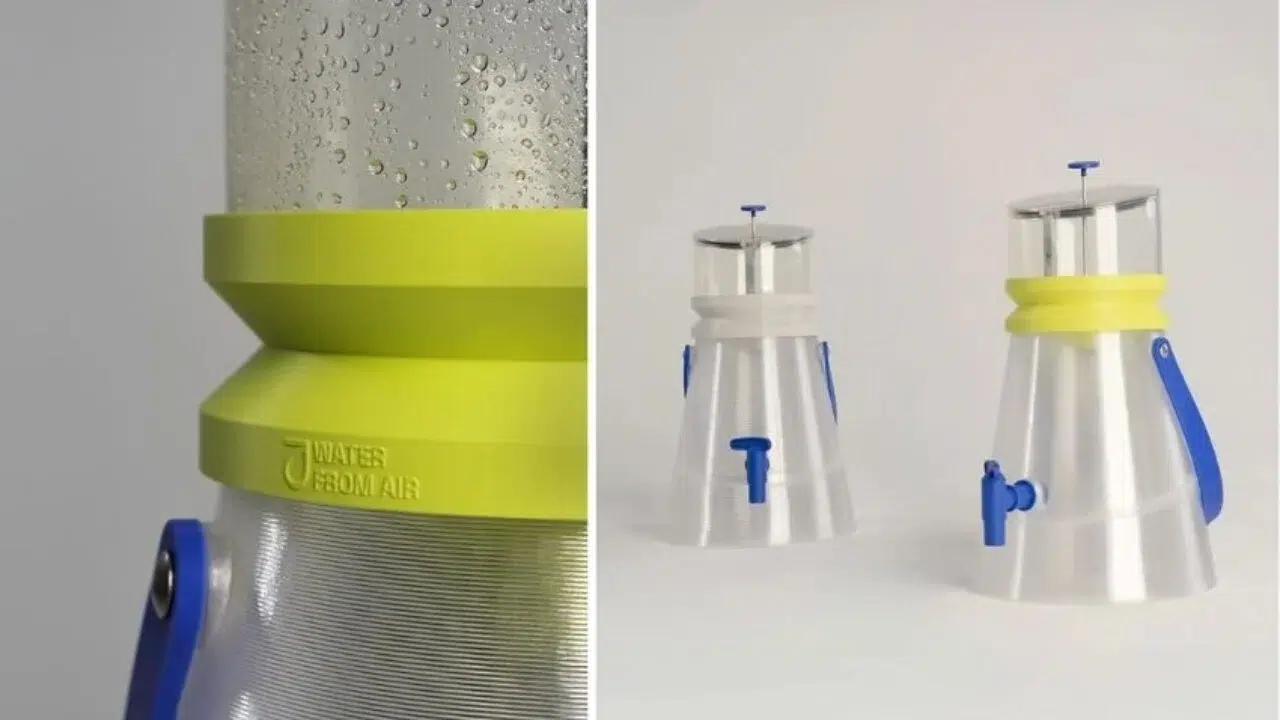
Two university graduates, Louisa Graupe and Julika Schwarz, designed a system named Water from Air, capable of producing six liters of drinking water a day from the air.
- The device condenses water through the phenomenon of atmospheric water generation (AWG).
- It is manufactured with 3D printing, using transparent PETG for the body and stereolithography (SLA) for the opaque lid.
- It can perform up to 12 condensation cycles daily, obtaining 500 ml every two hours.
The amount produced is enough to supply a family of four, considering an average of 1.5 liters of water per person for hydration.
Technological innovation and modular design
The system differs from other atmospheric collectors because:
- It is portable and affordable, compared to existing large and expensive equipment.
- It uses metal-organic structures and porous materials that act as microscopic sponges, attracting water molecules.
- It is modular, which facilitates cleaning and repair.
- 3D printing allows for rapid prototyping and flexibility in design, reducing costs and production times.
Environmental and social impact
The invention seeks to respond to the global water crisis, offering a sustainable and accessible alternative.
- It could be key in rural areas or vulnerable communities without access to drinking water.
- It reduces dependence on contaminated sources and avoids the use of energy-intensive systems.
- It promotes a model of circular economy, by integrating advanced materials and efficient processes.
- It contributes to the Sustainable Development Goals (SDGs), especially SDG 6: Clean water and sanitation.
Limitations and next steps
Although the prototype is promising, there are still aspects to be defined:
- Determine which components not 3D printed must be purchased separately.
- Evaluate the capacity of porous materials to maintain consistent performance in different climates.
- Scale production so that the device is accessible on a large scale.
- Integrate renewable energies to enhance its operation in regions with high demand.
The Water from Air represents a significant advance in the fight against water scarcity. By combining 3D printing, materials science, and atmospheric water generation, it offers a practical and sustainable solution for families and communities.
This type of innovation demonstrates how technology can become a vital tool to face the challenges of climate change and global water security.


