



The City of Buenos Aires began this Monday the pilot tests of its new 100% electric transportation system: the Trambus.
This promises to reduce travel times by up to 40% and connect the city with zero emissions technology.
This Monday, five electric units began circulating along the Juan B. Justo Metrobús corridor.
This is a testing phase that will evaluate the new modality and its technology.
A system designed for sustainability
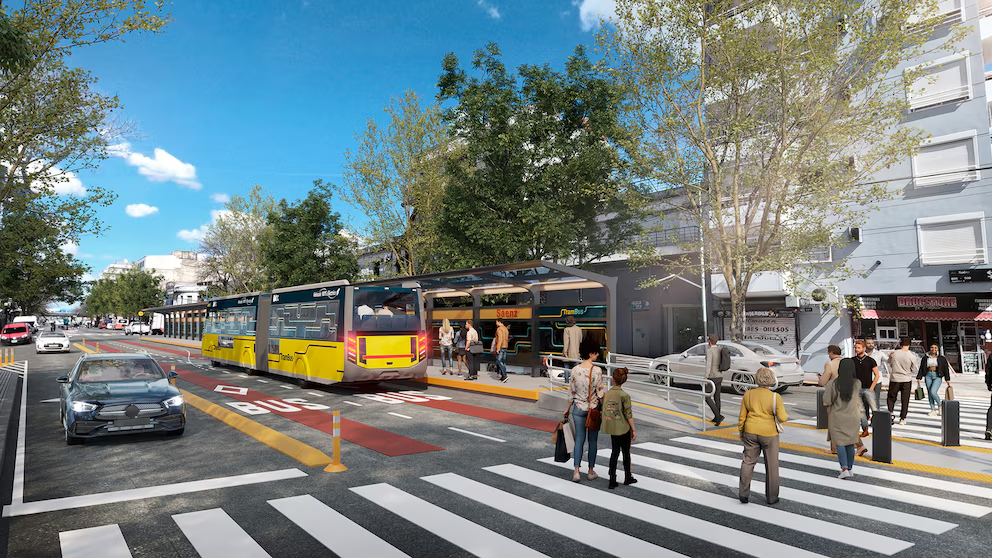
The Trambus in Buenos Aires uses 100% electric buses that combine cutting-edge technology with zero emissions of polluting gases.
The vehicles incorporate modern design and a technological package that guarantees road safety, comfort, and sustainability.
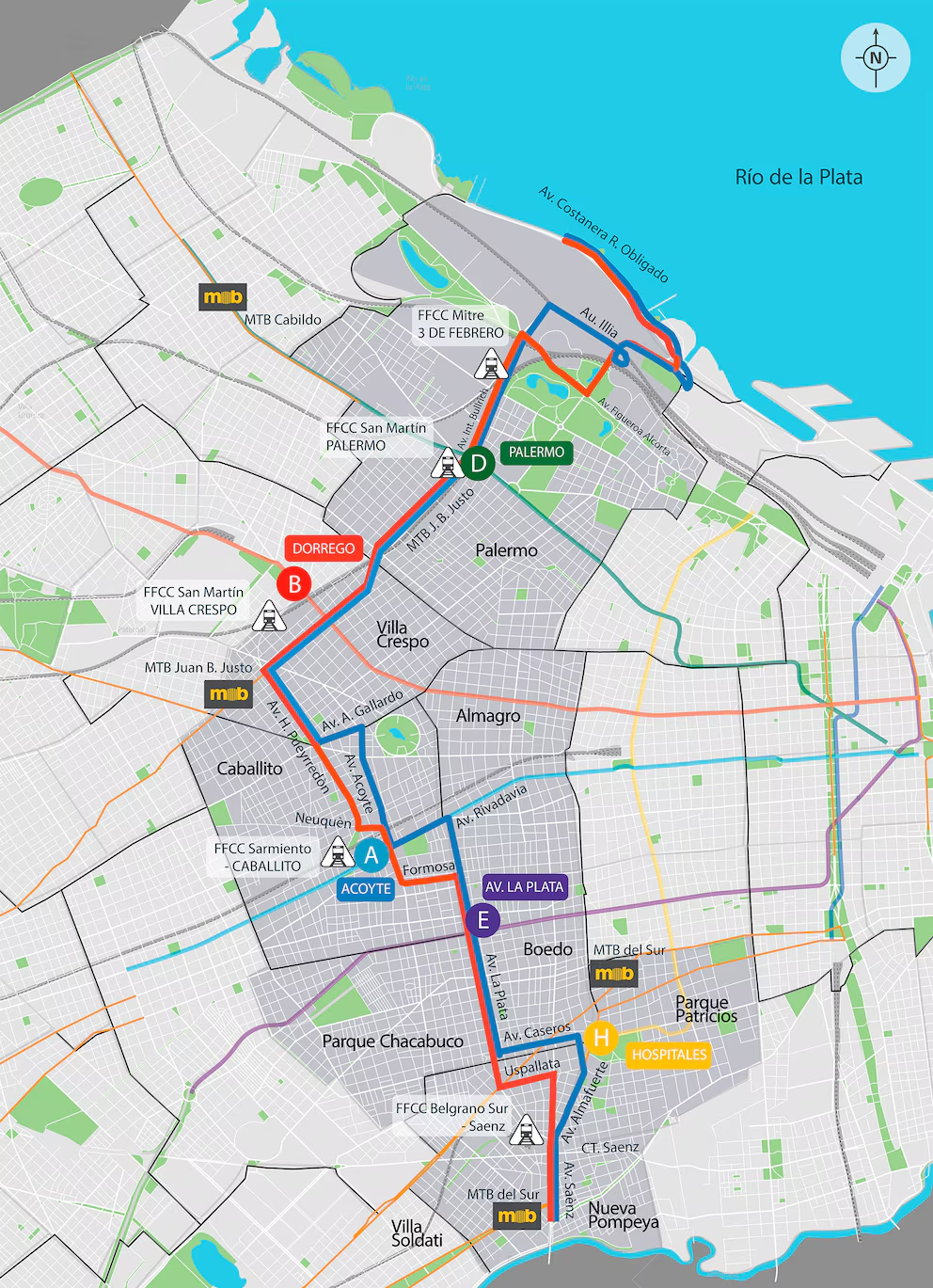
The first line will cover 12 kilometers in its initial phase and has a total projected route of 18 kilometers that will connect Liniers with Aeroparque.
From now on, an additional 4 to 5 units will be added per month, aiming to reach a fleet of twenty vehicles by February.
The system also includes specific infrastructure with:
- central or side stations;
- exclusive lanes;
- smart traffic lights: these will give priority to trambuses to optimize circulation at strategic crossings.
“The city will have enormous development from mobility,” said the Head of Government, Jorge Macri.
He added that “residents will be able to travel much better” with the incorporation of the Trambus in Buenos Aires.
The T1 line of the Trambus in Buenos Aires: south-north connection
After the pilot test of the Trambus in CABA, the idea is to create the T1 line.
This would be implemented by the end of 2026 with the aim of connecting the city from south to north, crossing all existing subway lines.
The route will start from Nueva Pompeya, at the Transfer Center on Avenida Sáenz, to Aeroparque.
For the T1, 71 stops will be built, 11 of them iconic. These will be located in key centers such as Caballito, Palermo, and Aeroparque.
These special stops will include:
- Spaces for bicycle storage;
- Lockers for logistics;
- Covered waiting areas;
- Universal accessibility.
The fleet of the Trambus in Buenos Aires will have more than 50 units with a minimum range of 270 kilometers.
The standard vehicles will measure approximately 12 meters and will have a capacity for more than 70 passengers.
The articulated units will reach 18 meters and can transport up to 120 passengers.
On the other hand, they will have spaces designated for people with reduced mobility.
All vehicles will be accessible, with low floors, pneumatic suspension, ramps, and air conditioning. Noise emission will be minimal, improving urban acoustic quality.
A collaboration between Argentina and the United Kingdom
The base of the Trambus is a chassis developed in Argentina by Agrale.
Meanwhile, the state-of-the-art electric motorization was developed in collaboration with the British company Equipmake LTD.
To integrate both technologies, a prototype bus was manufactured in Argentina and then traveled to the United Kingdom.
There, the motor, batteries, electrical systems, and software that control the vehicle were incorporated.
Thus, the units are equipped with these systems:
- DMS: driving monitoring.
- ADAS: forward collision warning, pedestrian crossing, and blind spot detection.
- Digital rearview mirrors (no external mirrors) and rearview camera.
- GPS for satellite positioning.
- Air conditioning, onboard WiFi, and USB connectors.
- Audio-visual information for passengers.

The Trambus in CABA, well connected
The Minister of Mobility and Infrastructure of Buenos Aires, Pablo Bereciartua, stated that “the Buenos Aires government seeks to enhance the intermodality of transportation in the City.”
The Trambus Buenos Aires will have connections with five subway lines (A, B, D, E, and H).
Additionally, it will also connect with five stations of the Mitre, Belgrano, San Martín, and Sarmiento railways.
Furthermore, each unit will have multi-payment validators to use debit, credit, or NFV cards.
And, to reinforce the use of electric mobility, those who combine the Trambus with the subway will receive a discount on their fare.
The stops will be located every 500 meters and a service is expected every 4 minutes during peak hours.
The initially benefited users will be 50,000 people daily.
In Buenos Aires, approximately 3.6 million people move daily, and 47% use public transportation.
Because of this, the Trambus in Buenos Aires represents a step towards sustainable mobility in one of the most populated cities in Latin America.



