



The company Uber announced a strategic alliance with Joby Aviation, a manufacturer of electric air taxis, to allow users to book helicopter flights directly from their app.
The service will be available in the most densely populated cities in the world, with a special emphasis on fast connections to airports, although specific routes and fares have not yet been confirmed.
Acquisition of Blade Air Mobility and service expansion
The integration will materialize after the acquisition of Blade Air Mobility by Joby, in a deal valued at USD 125 million, as reported by CBS News.
Blade transported 50,000 passengers in 2024 in areas like New York and Southern Europe, with average fares of USD 195 for routes between Manhattan and JFK and Newark Liberty airports. Currently, Blade operates with turbine helicopters, but plans to transition to electric eVTOL aircraft.
PED Technology: Distributed Electric Propulsion for Silent and Safe Flights
Redundancy, energy efficiency, and noise reduction as pillars of the new system.
Uber highlights Distributed Electric Propulsion (PED) as a key technology for its future air services. This system uses multiple electric rotors, enabling:
- Technical redundancy in engines, propellers, and batteries
- Operation up to 100 times quieter than conventional helicopters
- Lower maintenance costs and increased operational safety
Combined with lightweight composite materials, high-performance batteries, and advanced automation, PED enables efficient operation of eVTOL vehicles in dense urban environments.
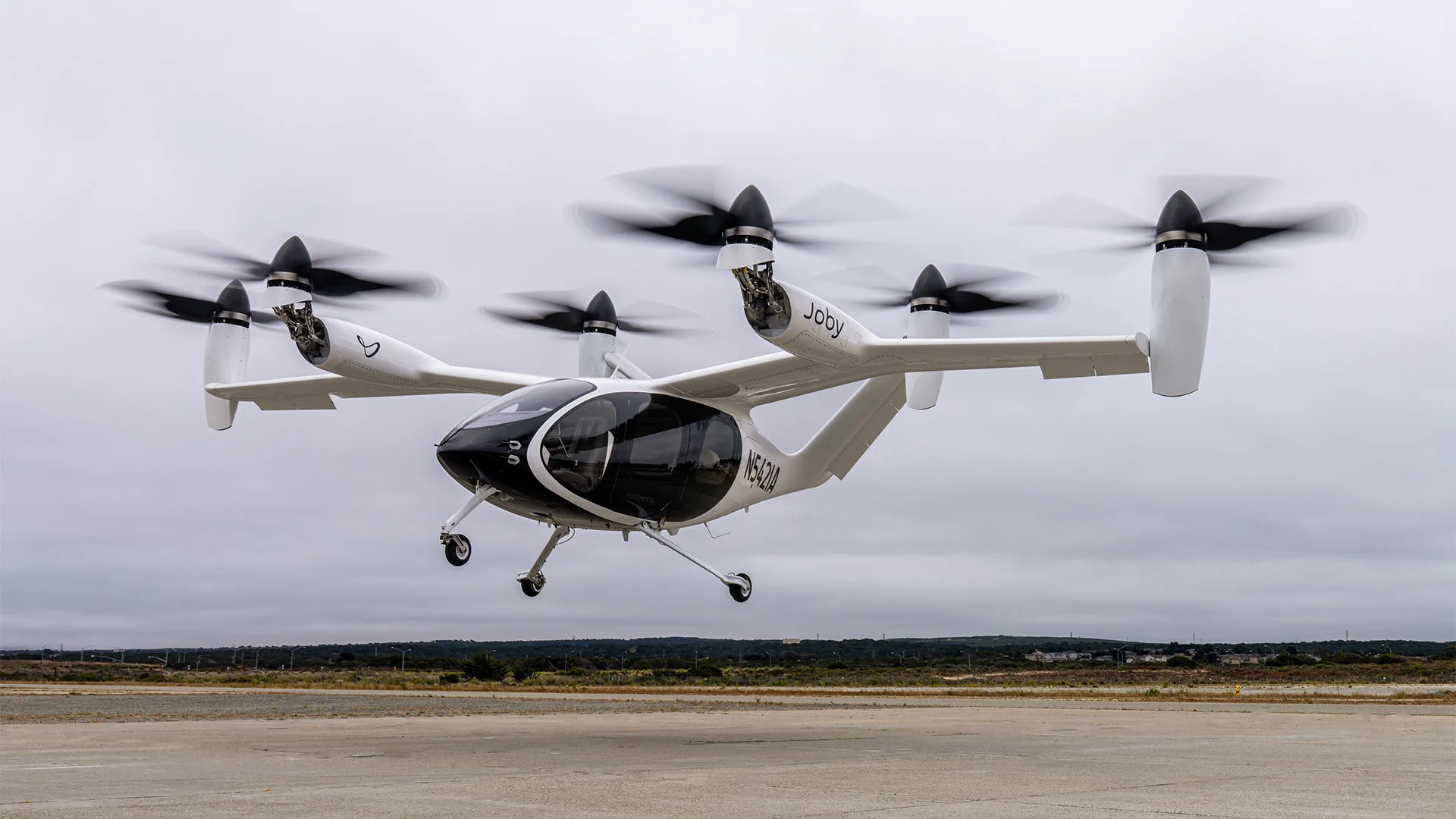 Uber and Joby join forces in the development of electric air taxis
Urban Air Mobility: Center-to-Center with No Fixed Routes
eVTOLs surpass land transportation limitations and strengthen urban resilience.
eVTOL vehicles are designed for shared trips between strategic points in the city, without relying on roads or railway lines. This allows for:
- Direct travel between urban centers
- Increased resilience against road closures or incidents
- Reduction of urban noise and improvement in energy efficiency
Prototypes and User Experience: Passenger-Centered Design
eCRM models developed by Uber and Safran Cabin prioritize comfort and performance.
Uber’s engineering team, led by Mark Moore (former NASA), has developed eCRM prototypes with specifications such as:
- Cruise speed of 240 km/h
- Range of 96 km
- Capacity for one pilot and four passengers
- Cabin designed in collaboration with Safran Cabin, focused on the user experience
Next Generation of Transportation: Quiet, Electric, and App-Accessible
Uber and Joby envision emission-free aircraft integrated into the digital platform.
Following the acquisition of Blade, Joby Aviation anticipates that users will be able to book electric flights directly from the Uber app.
According to JoeBen Bevirt, CEO of Joby, the goal is to offer quiet, emission-free aircraft in the coming years. Meanwhile, Andrew Macdonald, Uber’s Chief Operating Officer, stated that this collaboration represents the next generation of urban transportation.
The project still requires approval from the Federal Aviation Administration (FAA), but promises to transform how people connect within cities.



