



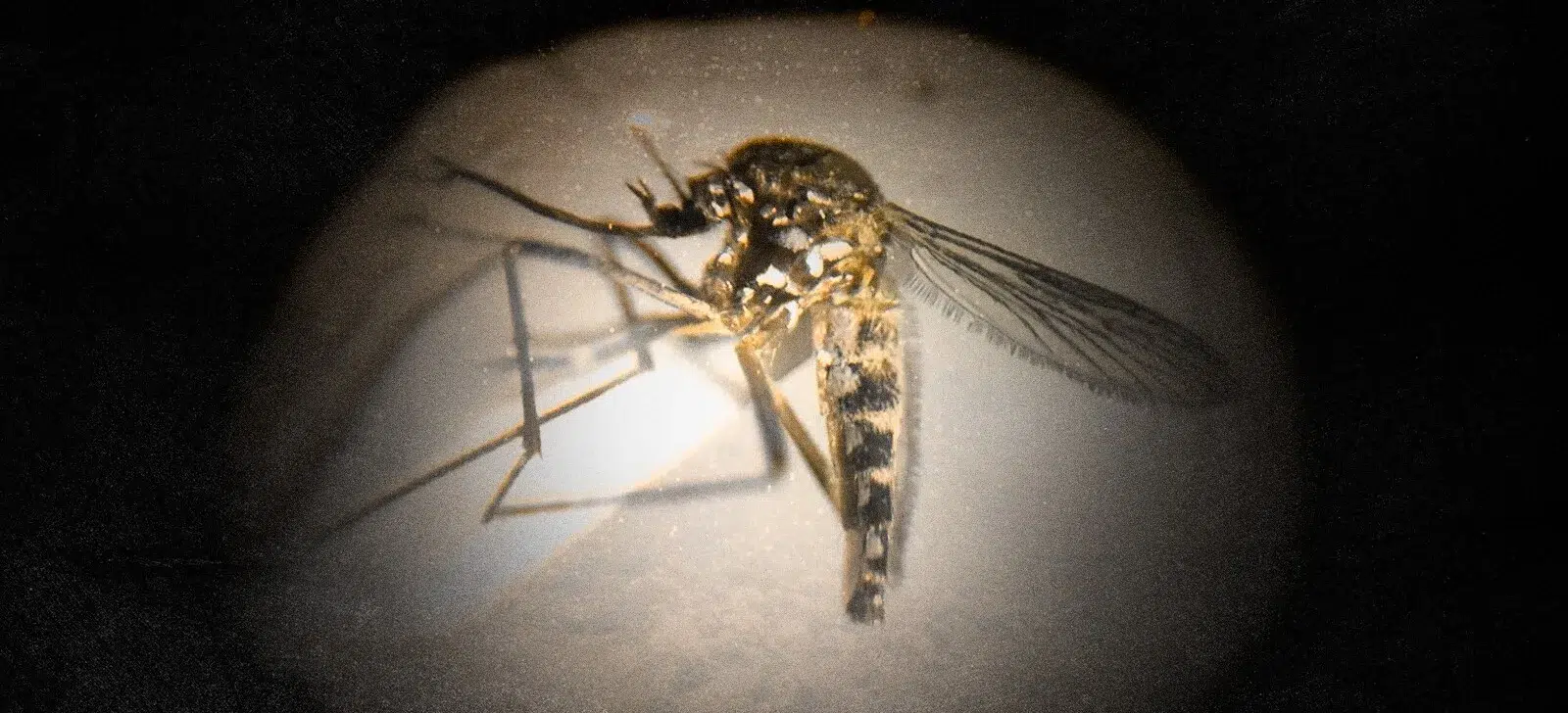
In December 2024, a scientific team captured 191 specimens of Aedes aegypti var. queenslandensis in a fragment of urban forest in Macapá, northern Brazil. This variety, known as the “pale mosquito”, has lighter scales on the abdomen and thorax, which can make visual identification difficult.
“It is not a subspecies or a new vector, but a morphological variation of the same mosquito,” explained José Ferreira Saraiva, a researcher at the Institute of Scientific and Technological Research of Amapá (IEPA).
What does this variation of Aedes aegypti imply?
Greater resilience to heat and less seasonality in the transmission of arboviruses.
Although there is no evidence that this variety has greater transmission capacity or insecticide resistance, its presence in warm and urbanized regions such as Southeast Asia, Australia, and the Mediterranean suggests an adaptation to heat and low humidity.
This could extend the transmission windows of diseases such as dengue, zika, chikungunya, and yellow fever.
“The pale variety may reduce seasonality and increase the persistence of the mosquito in urban areas,” warned Saraiva.
Increase in cases and need for entomological surveillance
Between January and September 2025, Brazil recorded more than 1.6 million probable cases of dengue, with 1,665 confirmed deaths. In Amapá, cases increased from 620 in 2023 to 5,071 in 2024, reinforcing the need to strengthen epidemiological and entomological surveillance.
“It is essential to train teams to recognize the pale phenotype and communicate to the public that the dengue mosquito can also be whitish,” noted Saraiva.
Climate change and mosquito expansion
Simulations project an increase of up to 92% in southeastern Brazil by 2080.
A study published in PLOS Neglected Tropical Diseases combined biological models of the mosquito’s life cycle with climatic and urban projections.
In scenarios of high greenhouse gas emissions, a significant increase in mosquito density is projected in southern and southeastern Brazil.
- Southeast: +92%
- South: +89%
- North: no increase, but due to extreme heat exceeding the mosquito’s tolerance
“Mitigating climate change can reduce the projected increase from 30% to 10%,” explained Katie Heath, a researcher at the Burnet Institute.
Local preparation and global decisions
Climate planning directly influences future public health.
The study serves as a roadmap for local preparation and as a reminder that current climate decisions will determine the impact of mosquito-borne diseases in the coming decades.



