



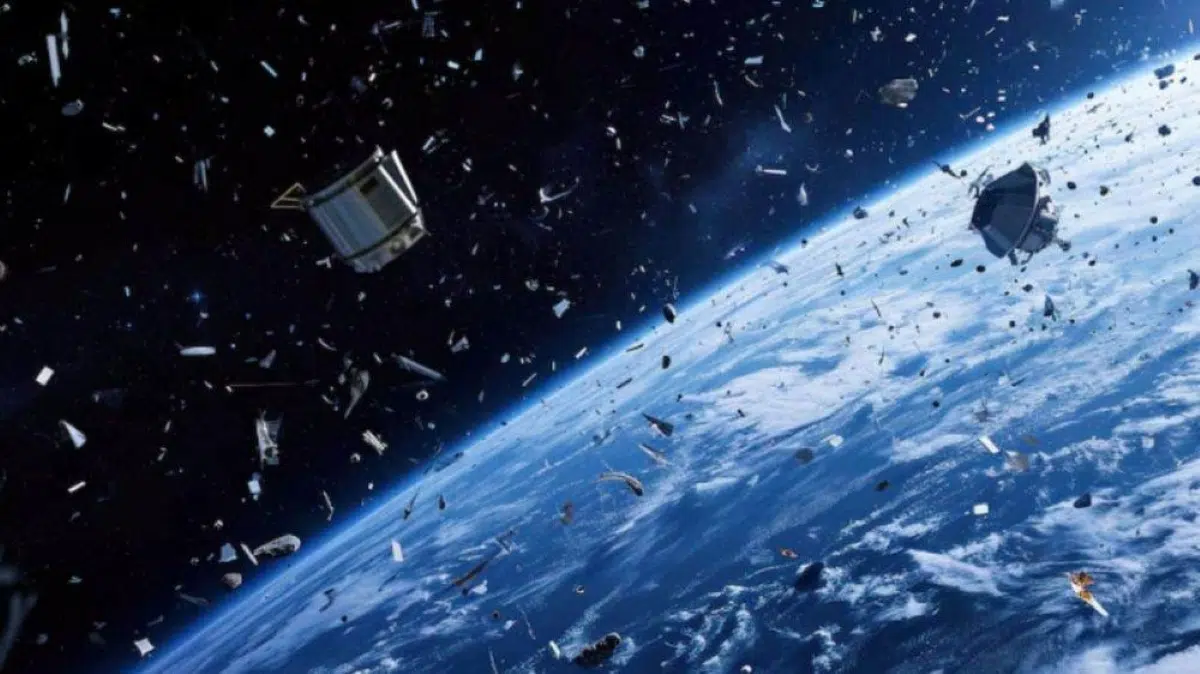
Today, almost 130 million fragments of space debris orbit the Earth: inactive satellites, rocket stages, and collision remnants. This growing field threatens safe access to space.
A new study reveals that the Sun plays a key role: when its activity exceeds a certain threshold, debris loses altitude much faster, accelerating its reentry.
The Scientific Study
The research, published in Frontiers in Astronomy and Space Sciences, was led by Ayisha Ashruf from the Vikram Sarabhai Space Centre (India). The team analyzed the trajectories of 17 objects launched in the 1960s over 36 years, covering three complete solar cycles.
The results show that solar activity heats and expands the thermosphere, increasing atmospheric density. This creates greater resistance on objects in low orbit, which, without engines to correct their trajectory, slow down and fall faster. “For the first time, we discovered that this loss of altitude occurs remarkably faster,” Ashruf noted.
Impact on Active Satellites
The effect not only affects debris: satellites in low orbit also require more corrections during solar maxima. This implies:
- Higher fuel consumption.
- Shorter mission lifespan.
- Adjustments in deorbiting calculations and propellant reserves.
Space Sustainability
With the growth of mega constellations and the increase in launches, understanding this relationship is critical to avoid chain collisions and plan safer missions. Solar activity, which lights up our days, also sweeps the low orbit.
Strategies Against Space Debris
The report highlights that dealing with debris requires a combination of active removal and preventive mitigation:
- Active debris removal (ADR): missions to capture inactive satellites and large remnants.
- Capture technologies: robots with claws, nets, harpoons, or magnetic sails.
- Space bags: giant inflatables to collect multiple fragments.
- Sustainable design: satellites that automatically deorbit or move to graveyard orbits.
- International regulation: strict norms to prevent new debris.
- In-orbit maintenance: refueling to extend satellite lifespan.
Future Projections
It is estimated that by 2029, there will be about 57,000 satellites in orbit, making it urgent to implement these technological solutions. The combination of intense solar activity and a saturated orbital environment turns space debris management into a global challenge for space sustainability.
The study demonstrates that solar activity accelerates the fall of space debris, affecting both inactive fragments and operational satellites. Mission planning must consider this factor to ensure safety and efficiency. Space sustainability depends on integrating science, technology, and international regulation to prevent low orbit from becoming an uncontrollable environment.


