



On a 45-day scientific expedition in the Chukchi Sea, a team from Stanford University managed to document a surprising discovery: the presence of living diatoms inside the Arctic ice, unicellular organisms capable of moving and performing complex functions in temperatures that were previously considered incompatible with active cellular life.
What are diatoms and why are they key?
Microscopic, photosynthetic, and essential for the polar food chain and global climate balance.
Diatoms are unicellular algae that inhabit aquatic environments, and it is estimated that there are between 20,000 and 2 million species. They are responsible for fixing carbon and releasing oxygen through photosynthesis, making them chemical regulators of the atmosphere.
In the Arctic, they also play a vital ecological role by connecting microorganisms with larger organisms, forming part of the base of the polar food chain.
“It’s not just a tiny thing, but an important part of what happens under the ice,” emphasized Manu Prakash, a bioengineering professor at Stanford.
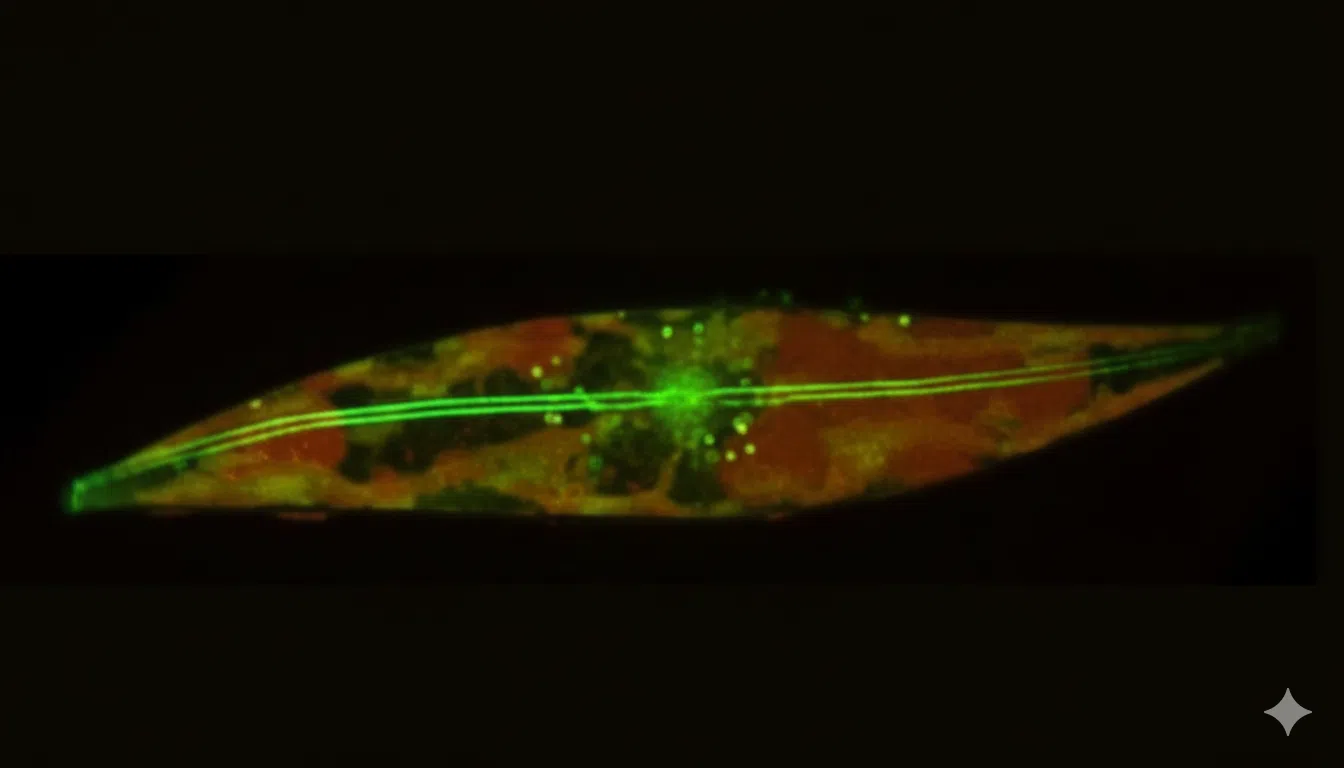
Movement in Arctic ice: an unexpected mechanism
Diatoms slide on icy surfaces thanks to molecular motors and adhesive secretions.
The team observed that these algae use an active sliding mechanism: they secrete mucilage, a sticky substance, and then propel themselves using actin and myosin, proteins that act as internal molecular motors.
This ability is due to a specialized structure called a raphe, which allows them to move on sand grains, marine mud, or even other diatoms.
“It’s like they’re skating on ice,” described the study’s lead author, Qing Zhang.
An ecosystem hidden under polar ice
The discovery forces us to rethink the idea of the poles as biologically inert zones during winter.
Diatoms not only survive but actively modify their environment: they redistribute nutrients, create microhabitats, and alter the biological structure of the ice.
This discovery reveals that polar ice hosts dynamic microscopic communities, even in conditions of extreme cold.
Frontier technology to explore the invisible
Optical and electronic microscopes reveal cellular activity on Petri dishes simulating Arctic environments.
The research was conducted aboard the ship Sikuliaq, operated by the University of Alaska Fairbanks, where ice cores were collected at 12 stations.
The samples were analyzed with microscopes developed by the Prakash Laboratory, which allowed visualizing cellular activity on Petri dishes with layers of frozen freshwater and very cold saltwater.
Implications for science and climate
Diatoms could be biological indicators of climate change and models for biotechnology in extreme environments.
This finding not only expands knowledge about life in extreme conditions but also provides clues on how polar microorganisms could respond to global warming.
Furthermore, it opens up new possibilities for biotechnology, astrobiology, and the study of resilient ecosystems.


