



An international team of paleontologists has identified in the United Kingdom the fossil of a fish with an innovative feeding strategy, never before documented in species from its time.
It is Platysomus parvulus, a fish with ray-finned fins that lived 310 million years ago and developed a lingual bite, a mechanism that allowed it to crush hard prey such as insects and shells.
What is the lingual bite?
An evolutionary tool that replaces or complements the use of jaws.
Unlike most current fish that use their jaws to chew, some groups have evolved a second biting structure: the lingual bite. This system consists of opposing sets of teeth, located in the palate and the gill skeleton, that work together to grab, crush, and process food.
Until now, the oldest example of this adaptation dated back to 150 million years ago, making Platysomus parvulus a unprecedented fossil record.
Digital reconstruction and anatomical findings
High-resolution tomographies reveal complex dental plates and specialized structures.
The fossil was discovered in Carboniferous formations in Staffordshire, England, and shows exceptional three-dimensional preservation. Thanks to computed tomography, researchers were able to:
- Visualize dental plates in the palate and base of the mouth
- Identify sharp electrocytes in a single layer
- Detect a transition stage towards more advanced systems, as observed in the genus Bobasatrania
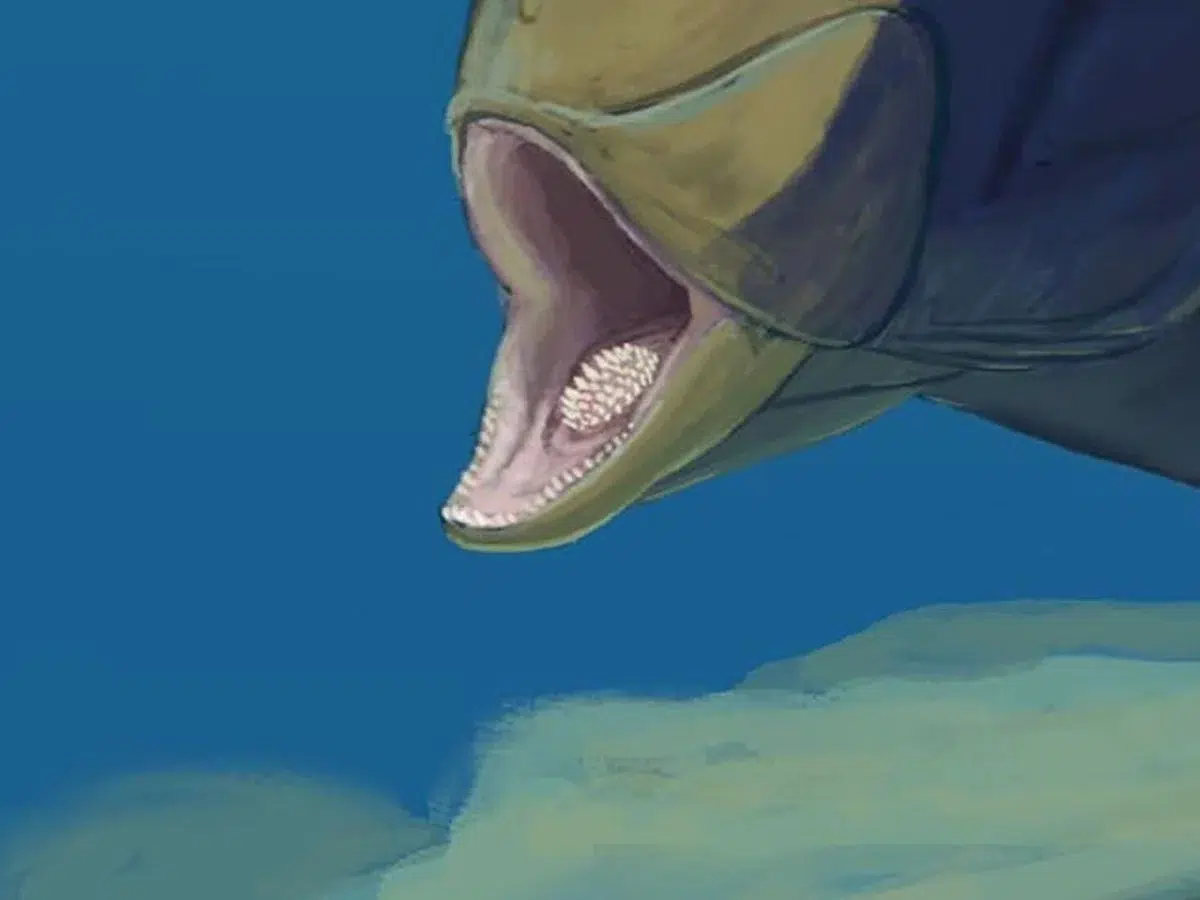 A 310 million-year-old fossil fish with a unique feeding behavior
A missing link in the evolutionary feeding of fish
Co-author Dr. Matthew Kolmann, from the University of Louisville, described Platysomus as an evolutionary intermediary between fish with conventional jaws and those that exclusively rely on their lingual bite to feed.
This innovation allowed fish to expand their diet and adapt to new environments after the mass extinction at the end of the Devonian period.
Post-extinction innovation: the emergence of new strategies
The lingual bite as part of an evolutionary wave after an ecological crisis.
Lead author Prof. Sam Giles, from the University of Birmingham, explained that after the Devonian extinction, fish began to experiment with new body shapes and feeding modes.
The lingual bite evolved several times in different lineages, including modern species like the trout and the pike, demonstrating its adaptive effectiveness.
Ancient ecosystems and modern lineages: an evolutionary connection
Professor Matt Friedman, from the University of Michigan, pointed out that this discovery allows us to reconstruct how Carboniferous ecosystems functioned and how modern fish lineages emerged.
The lingual bite is just one of the many dietary innovations that emerged in that period of rapid evolutionary diversification.
Cover photo: Joschua Knupp


