



An international team of scientists developed a groundbreaking technique to date dinosaur fossils using fossilized eggshells.
This opens new possibilities for understanding the evolution of these extinct species.
The finding, published in Communications Earth & Environment, represents a significant advancement for paleontology.
Until now, many fossil sites lacked precise dating, making it difficult to establish when ancient species lived.
Uranium and lead: the geological clock in the shells
Dr. Ryan Tucker, from the University of Stellenbosch, led the research that employs advanced uranium-lead dating (U-Pb) combined with elemental mapping.
This technique measures traces of these elements in the calcite of the shells.
The isotopes act as a natural clock that allows determining the burial date of the eggs.
Now, scientists can establish geological ages without relying exclusively on minerals like apatite or zircon, often absent at the sites.
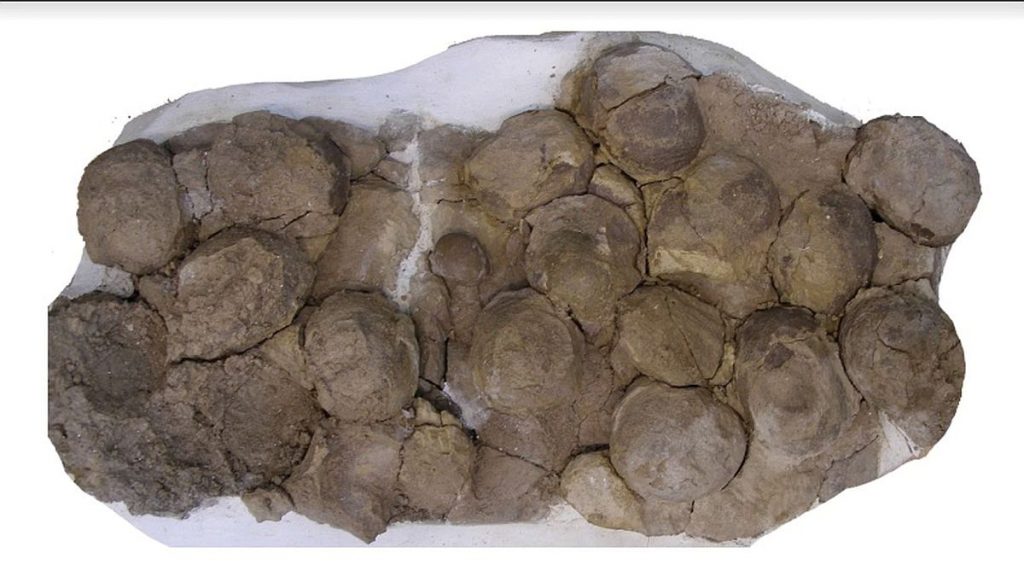
Tests conducted on eggshells from Utah and the Gobi Desert showed results with 5% more precision compared to volcanic ash datings.
Thanks to this, in Mongolia the team also recorded the first direct age of approximately 75 million years for a locality with nests and fossilized eggs.
A versatile tool for science
“The calcite of eggshell is extraordinarily versatile,” stated Dr. Tucker.
“It provides us with a new way to date fossil sites where volcanic layers are missing, a challenge that has limited paleontology for decades,” he added.
The method offers clear advantages for research:
- Allows direct dating of dinosaur fossils without relying on volcanic layers
- Provides 5% precision compared to traditional methods
- Works in sites where other minerals are absent
- Reliably records geological ages through isotopes
Lindsay Zanno, co-author of the study and professor at the North Carolina State University, highlighted the impact of the discovery.
“The direct dating of fossils is the dream of any paleontologist,” she noted.
And she emphasized: “Thanks to this new technique, we can unravel mysteries about the evolution of dinosaurs that were previously insurmountable.”

International scientific collaboration
The research brought together institutions from several countries, including the North Carolina State University, the North Carolina Museum of Natural Sciences, and the Colorado School of Mines.
The Institute of Paleontology of the Mongolian Academy of Sciences and the Federal University of Ouro Preto in Brazil also participated.
The fieldwork in Mongolia was carried out by the Mongolian Alliance for Dinosaur Exploration (MADEx).
The project also received support from the National Geographic Society and the National Science Foundation.
The findings will allow researchers worldwide to apply this dating technique in various paleontological sites.
The dinosaur eggshells prove to be much more than just fossil remains.
They now become a fundamental scientific tool to reconstruct the evolutionary history of species that dominated the Earth millions of years ago.



