



The global dependency on plastic has become a significant environmental issue. Its degradation does not eliminate the material, but rather transforms it into microplastics that end up in seas, rivers, food, and even in the human body. Faced with this situation, science is seeking sustainable alternatives that match its properties without generating toxic waste, such as the use of bacteria.
Although recycling is useful, it has not managed to curb pollution. Regulations to limit its use have increased, but the presence of microplastics and dangerous chemicals such as phthalates and bisphenol A remains alarming. Therefore, the challenge is to find a material that is strong, durable, safe, and scalable.
A group of researchers from Rice and Houston universities focused their work on bacterial cellulose, a substance naturally produced by some bacteria. Although it was already known, its large-scale use was limited due to the disorganization of its fibers, which affected its performance and resistance.
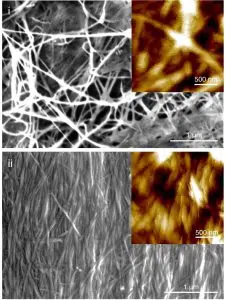
The innovation lies in the production process. Scientists developed a “rotational bioreactor” that spins the bacteria in a liquid, forcing the fibers to align in a specific direction. This structural order significantly improves mechanical properties, similar to what happens with materials like steel or carbon fiber.
A strong, versatile, and biodegradable material
The resulting new bioplastic is biodegradable, resistant, and flexible. It has a tensile strength of up to 436 MPa, comparable to glass or aluminum, but with transparency and lightness. In addition, its structure allows additives that can customize its properties for different uses.
By incorporating boron nitride nanosheets, the strength increases to 553 MPa, and the heat dissipation capacity triples. This opens the door to applications in packaging, technical textiles, flexible displays, sensors, or lightweight construction components.
Although still in the experimental phase, the potential of this material to replace traditional plastics is remarkable. Its scalable production and reduced environmental impact make it a viable option for multiple industries.

Other ways to replace plastic
The fight against plastic pollution is not limited to this bioplastic. Materials such as PLA (polylactic acid) derived from corn, algae-based bioplastics, and edible packaging made from starch or proteins are gaining ground. All aim to minimize waste and reduce reliance on fossil fuels.
Recycled glass is another effective alternative for packaging and bottles, as it can be reused endlessly without losing quality. Similarly, metals like aluminum, almost 100% recyclable, allow for replacing packaging and plastic parts in various products.
There is also a growing trend towards designing reusable products and promoting container return systems. This change in habits, together with technological innovation, is key to reducing the environmental footprint and moving towards a circular economy.


