



While Europe reaches a 15% market share of 100% electric vehicles (BEVs) in its total sales, Argentina barely reaches 0.14%, equivalent to 1 BEV for every 700 new vehicles. This was revealed by a technical report by Engineer Alejandro Sureda, a professor at the Faculty of Engineering of the Austral University, which analyzes the current state of electric mobility in Argentina compared to international standards.
Four key dimensions to understand the Argentine delay
The study applies a comparative methodology used by European organizations and global manufacturers, grouping the indicators into four strategic areas:
- Market adoption
- Regulatory environment
- Charging infrastructure
- Industrial development
Stagnant market: hybrids dominate, pure electric vehicles don’t take off
During 2024, only 567 100% electric vehicles were commercialized throughout the country.
In contrast, Norway already has a fleet where almost 40% are pure electric vehicles, highlighting the technological and adoption gap.
 Differences in electric mobility between Europe and Argentina
Dispersed incentives and lack of clear regulatory horizon
Unlike the European Union, which will ban the sale of combustion vehicles by 2035, Argentina has not enacted a Sustainable Mobility Law.
There are isolated tax benefits, such as patent exemptions in CABA, but there is no comprehensive federal framework that articulates incentives, goals, and regulations.
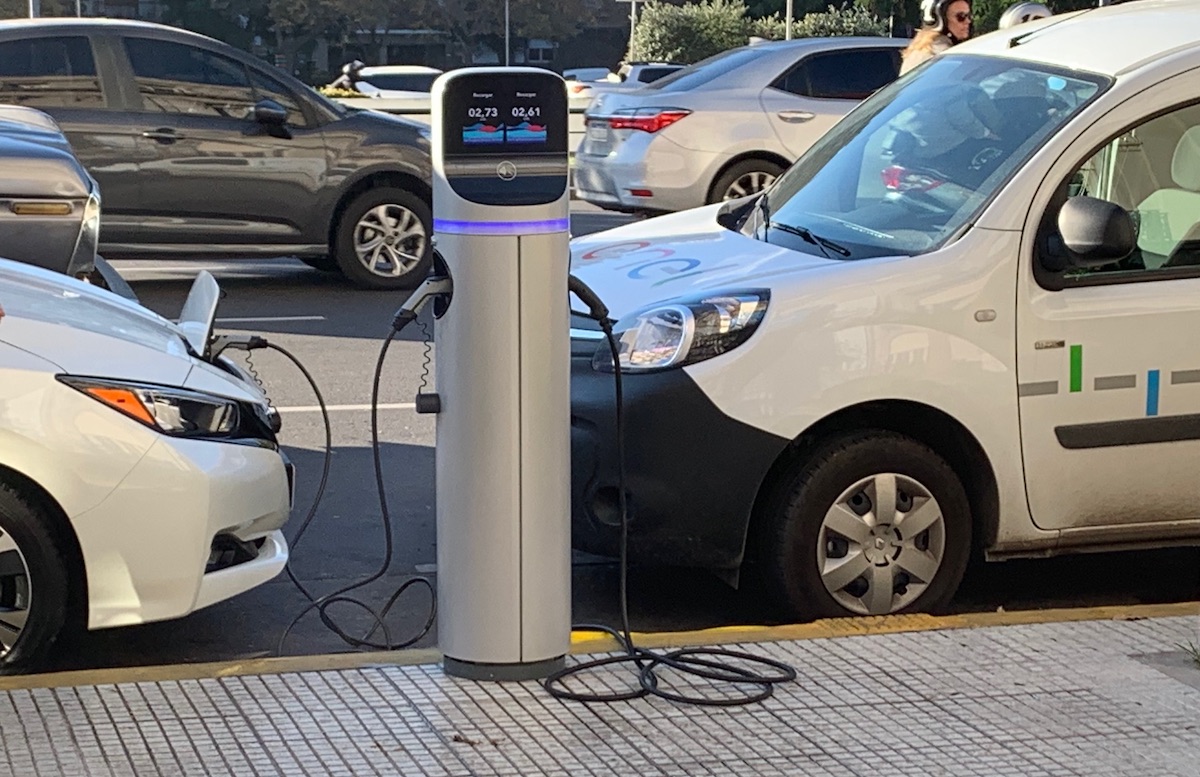
Charging infrastructure: scarce, slow, and inefficient
The charger density per capita is 80 times lower than in Europe, and most are slow (22 kW AC), which limits long-distance travel and affects the user experience.
The lack of modern infrastructure is one of the main obstacles to the expansion of the electric market.
National industry: nascent advances without industrial scale
Companies like Volt Motors, Coradir, and Sero Electric are developing electric urban vehicles, but without industrial scale. Toyota is considering manufacturing the electric Hilux in Zárate, although the decision depends on clear and stable regulatory signals.
In 2024, the first lithium cell plant in La Plata was inaugurated, an important step but insufficient without a national electrification strategy.
2025: a pivotal year for electric mobility in Argentina
“2025 could be a turning point: if incentives, infrastructure, and production align, electric mobility can take off. If not, it will be another decade of missed opportunities,” warns Sureda.
The report concludes that Argentinian lithium and renewable energies are not enough without a clear public policy, a robust infrastructure, and a competitive national industry.



