



Producers from the Quebrada and Puna are moving towards cleaner agricultural practices through the use of biofertilizers. Researchers from the Ipaf NOA are driving this transformation by supporting communities with training, field trials, and application protocols.
The initiative aims to reduce dependence on chemical inputs and strengthen soils degraded by decades of conventional management. The central focus is bokashi, a fermented biofertilizer that utilizes local waste and beneficial microorganisms.
The goal is to generate more resilient agricultural systems, improve yields, and recover ancestral techniques that have always prioritized harmony with the environment.
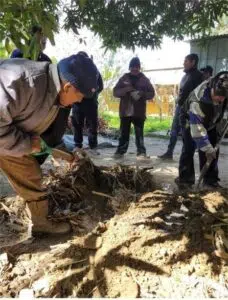
Recovering knowledge and building sustainable knowledge
The scientific work recognizes the value of the knowledge transmitted by producers, who have been making biopreparations for generations. The research does not start from scratch: it builds on traditional practices and adds technical evidence to perfect them.
Inta combines formal experiments with direct observation on family farms, allowing for the evaluation of doses, yield, and effects on local crops. This participatory approach facilitates the real adoption of biofertilizers.
The protocols created aim to standardize processes that have historically been done in an artisanal manner, without losing their community essence or their connection to natural cycles.
Bokashi: a fast, adaptable, and accessible biofertilizer
Bokashi differs from traditional compost due to its accelerated process: it is ready to use in just two weeks. Its production is adjusted to the materials available in each region, from remnants of Andean crops to by-products of the Yungas.
In addition to providing nutrients, it incorporates microorganisms that regenerate the soil and improve its structure. In areas with less than 1% organic matter, its use makes a key difference in sustaining productivity.
Although the dose per plant is small, its impact at the hectare level is notable, especially in crops that require high potassium inputs or improvements in the final product quality.
Challenges to changing entrenched models
The transition to bio-inputs faces the pressure of conventional models based on synthetic chemical inputs. Many producers are still constrained by intermediaries and market timings that make change difficult.
Despite this, trials show clear improvements in crops like garlic and potatoes, with increases in size, weight, and quality. Seeing the results in the field motivates more producers to try the system on small surfaces.
The challenge lies in breaking the idea that only market technology guarantees productivity. Local evidence shows that biofertilizers can be profitable and sustainable.

Uses, applications, and benefits of biofertilizers
Biofertilizers are used to improve impoverished soils, increase the availability of nutrients, and strengthen the soil microbiota. Their application can be periodic and adapted to each crop, promoting more balanced growth.
They serve to stimulate roots, improve water retention, and increase the soil’s capacity to recover after intensive cycles. They also reduce the use of chemical products that degrade biodiversity.
Among their benefits are low cost, ease of local production, and their contribution to more resilient agricultural systems in the face of climate change and water variability.
A key tool for the agriculture of the future
The advancement of bokashi and other biopreparations shows a possible path for vulnerable regions where fertility quickly decreases. Regenerative practices allow for sustaining production without compromising ecosystems.
The integration of local knowledge and scientific evidence strengthens the productive fabric and safeguards the agricultural culture of the region. This strategy promotes fairer agriculture, autonomous and respectful of the environment.
In a global context of degraded soils, biofertilizers emerge as an accessible and high-impact solution for food security and the health of the planet.



