



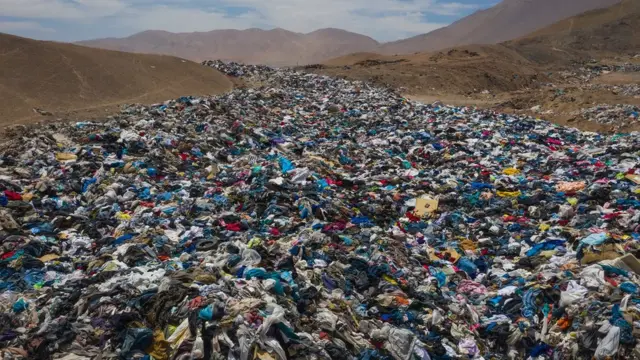
Chile, known for the striking images of the Atacama Desert covered with mountains of clothing, once again made international headlines due to the amount of textile waste. This time, for a hopeful reason: it achieved the Guinness World Record for the largest clothing swap in the world.
More than 2,300 garments in good condition were exchanged over eight hours at the La Moneda Cultural Center in Santiago. The event, in addition to celebrating reuse, aimed to highlight the severe environmental crisis caused by textile overproduction and promote a shift towards more sustainable consumption models.
Every year, thousands of tons of clothing are discarded after few uses, many ending up in open-air landfills like Atacama. This swap marked a symbolic step towards a circular economy, promoting the idea of giving new life to garments and reducing dependence on so-called fast fashion.
In Chile, the average textile consumption reaches 32 kilos per person per year, generating more than 572,000 tons of waste, according to the Ministry of Environment. In this scenario, circular fashion emerges as a concrete alternative to reduce the pressure on the planet.
The silent pollution of the textile industry
The textile industry has become one of the most polluting in the world. The United Nations warns that it is responsible for 20% of global wastewater and 10% of greenhouse gas emissions. From production to disposal, every stage of the clothing cycle leaves a deep environmental footprint.
The process begins with the cultivation of raw materials, especially cotton, which requires enormous volumes of water and pesticides. Added to this are the chemical dyes used in manufacturing, which pollute rivers and soils, affecting communities near industrial hubs in Asia, Africa, and Latin America.
Mass consumption exacerbates the problem. Every year more than 100 billion garments are produced, many of which are worn only a few times. Fast fashion drives a production chain that prioritizes speed and low cost over environmental and social impact.
As synthetic fibers —such as polyester— gain ground, another challenge grows: microplastics. These tiny particles are released with each wash and end up in the oceans, affecting marine life and entering the human food chain.
Reducing the impact of this industry requires rethinking the entire production model. Betting on recycled materials, extending the lifespan of garments, and promoting responsible consumption are essential steps to curb a crisis that is already global.

From the desert to change: a new possible path
The Atacama Desert has become a symbol of global textile excess. There, nearly 60,000 tons of clothing —much of it from Europe and North America— remain piled up in the open air, generating visual, chemical, and atmospheric pollution.
In 2021, more than 46,000 tons of used clothing entered Chile. Some are resold or reused, but others end up in illegal dumps, where synthetic fabrics release toxic gases when burned or slowly degrade under the sun.
The Chilean government took an important step by including textiles in the Extended Producer Responsibility Law (REP), requiring companies to take responsibility for the entire lifecycle of their products. However, environmental organizations insist that effective enforcement of this law is urgent to prevent the Atacama disaster from continuing to grow.
Change in the textile industry is possible
The recent Guinness record demonstrates that change is possible when society gets involved. Transforming the habit of overbuying into the practice of swapping or reusing is more than a trend: it is an ecological necessity.
Chile, once known for its “clothing cemetery,” now seeks recognition for its commitment to a conscious consumption model. In this transition, the desert could cease to be a symbol of waste and become an example of environmental transformation.



