



In a scenario marked by the housing deficit and waste accumulation, an alternative emerges that combines technology and sustainability. It is the construction of houses with recycled plastic.
This system allows houses to be built in just five days, representing a significant change compared to traditional methods. Moreover, it addresses two global issues: housing and pollution.
Consequently, different countries, including Argentina, are beginning to adopt this solution. Thus, the circular economy positions itself as a key axis in the construction of the future.
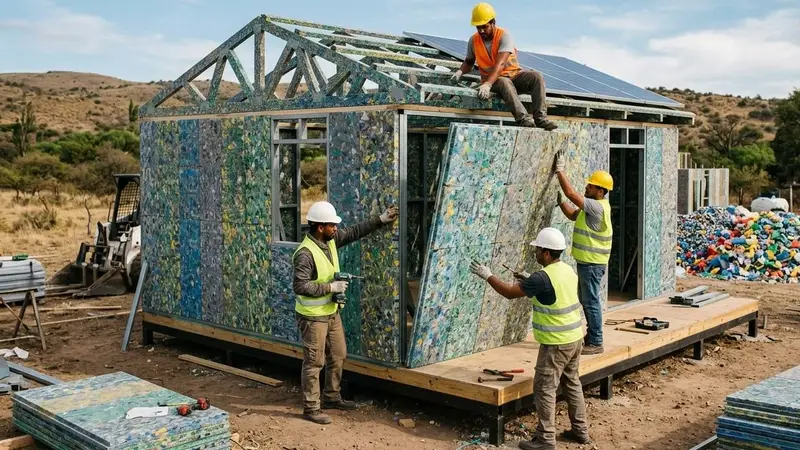
How the plastic brick system works
The core of this technology lies in the so-called plastic bricks. These blocks are made from recycled urban and industrial waste.
Then, through an extrusion process, the material is melted and molded into modular pieces. These are assembled together in a manner similar to a locking system.
Moreover, they do not require large amounts of cement. Therefore, the use of traditional resources is reduced, and the construction process is accelerated.
A 40-square-meter house, with two bedrooms, bathroom, kitchen, and living room, can be completed in a few days. These structures even allow for expansions of up to two floors.
Impact in Argentina and the growth of recycling
In Argentina, the development of recycled materials shows a sustained growth. During 2023, plastic recycling reached approximately 294,000 tons.
Likewise, this activity has multiplied over the last two decades. This reflects a progressive change towards more sustainable practices.
Additionally, the recycling chain generates more than 50,000 jobs. In parallel, it has prevented the emission of 482,000 tons of carbon dioxide in one year.
However, the country faces a significant housing deficit. Therefore, these solutions emerge as a viable and accessible response.

The benefits of building with recycled plastic
The use of recycled plastic in housing offers multiple environmental advantages. Firstly, it reduces the amount of waste ending up in landfills or ecosystems.
Furthermore, it decreases the need for traditional materials like cement. This implies a lower carbon footprint in the construction process.
On the other hand, the houses offer good thermal and acoustic insulation. Consequently, they improve energy efficiency and reduce resource consumption.
Additionally, their low cost, around 6,800 dollars for a basic unit, facilitates access to housing. This is crucial in contexts of emergency or vulnerability.
An expanding alternative towards a more sustainable model
Although it does not yet completely replace conventional construction, this technology is gaining ground. Its application is especially useful in social projects and emergency situations.
Moreover, there are pilot experiences in Argentina that aim to adapt the system locally. This allows for evaluating its viability in different contexts.
Ultimately, transforming waste into housing represents a paradigm shift. In this way, innovation not only solves housing needs but also contributes to environmental care.


