



The local government aims to strengthen policies that promote the inclusion of urban recyclers in Tucumán and circular economy.
The Municipality of San Miguel de Tucumán, led by Mayor Rossana Chahla, joined a select network of global cities to address these issues.
Thus, the provincial capital becomes one of the three Argentine cities and eight in Latin America chosen to participate in the Bloomberg Cities Idea Exchange program. This program focuses on integrating informal waste workers, known as urban recyclers.
A commitment to circular economy and labor inclusion
During the first virtual session, Mayor Chahla and her team discussed with experts from 17 cities around the world.
The main objective is to strengthen policies that promote inclusion and recognition of these workers, essential for contributing to the care of the planet and sustainable development.
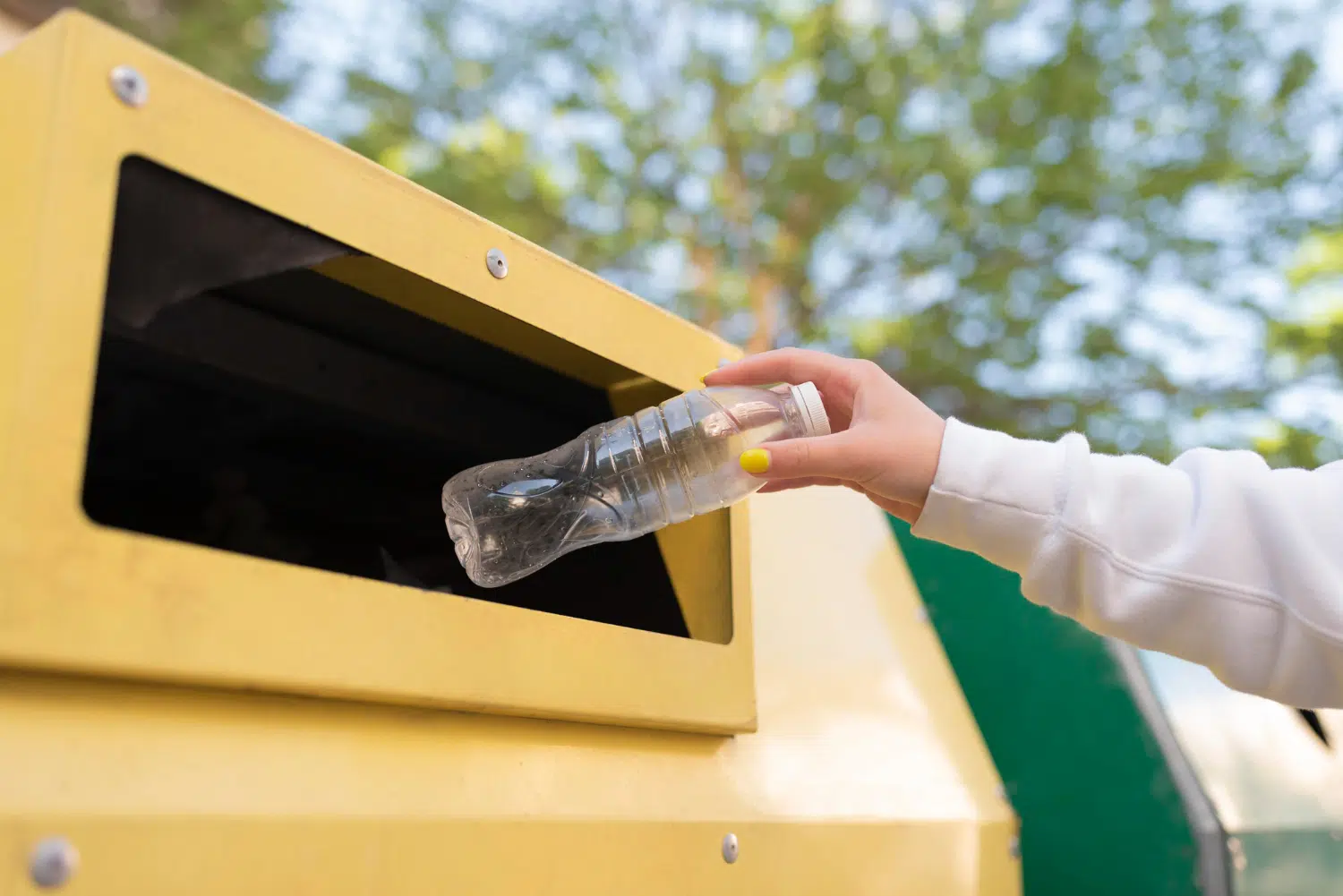 The program aims at circular economy and labor inclusion. (Photo: Freepik).
Mayor Chahla emphasized the importance of this program for “learning and generating strategies that allow us to support, include, and value those who perform this task.”
The commitment is essentially to strengthen the role of urban recyclers in the circular economy. It is a productive model that seeks to reuse resources and reduce environmental impact.
The Environment Secretary, Julieta Migliavacca, explained that participation in this initiative arises from an application to a call from Bloomberg Philanthropies and C40. A global coalition of mayors committed to the fight against climate change.
Transforming the reality of recyclers
Migliavacca pointed out that the project is an opportunity to transform the reality of thousands of workers in Tucumán who operate in the informal sector. This leads them to constantly expose their health and integrity.
“This new project will allow us to train, access tools, and potentially obtain financing to dignify the work,” she stated.
“Many walk hundreds of blocks per day, facing cold, heat, often accompanied by their children or pets because they have nowhere to leave them,” she added.
 The global network Tucumán joins. (Photo: municipality).
During the first working session, they discussed the goals that each city aims to achieve by 2026 and analyzed successful models implemented in other countries.
The ultimate goal is to support the workers, who are the backbone of many families and a fundamental part of material recovery.
Recycling and partnership in Santa Fe
In view of similar objectives, but on a local level, several companies and organizations in the city of Santa Fe joined forces to address a key logistical challenge: the transport of recyclable materials.
The initiative, led by CCU and in collaboration with the Municipality of Santa Fe, McDonald’s, Torre Puerto, and La Segunda Seguros, aims to improve the efficiency of the Dignidad y Vida Sana cooperative.
The city of Santa Fe generates more than 9000 tons of waste daily, most of which are recyclable.
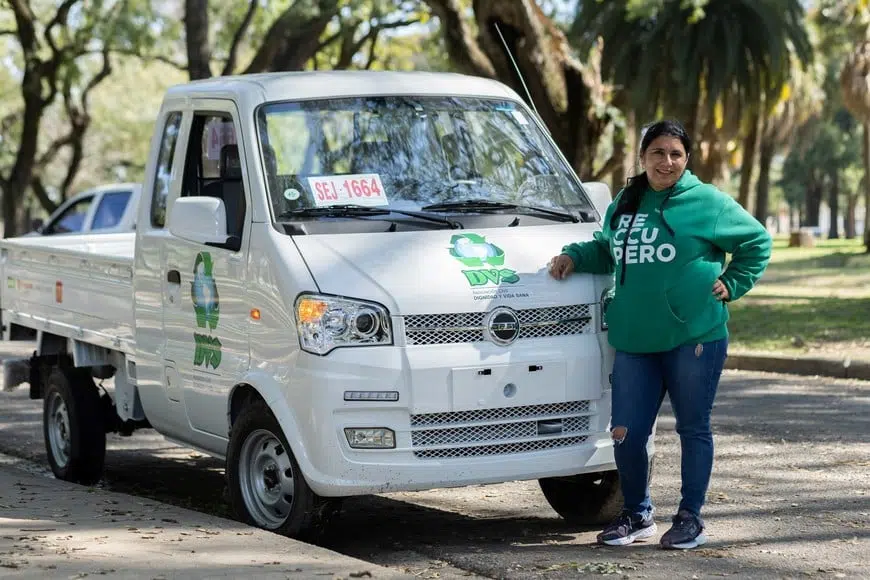 The vehicle delivered to recyclers. (Photo: Government of Santa Fe).
In this process, urban recycling cooperatives play a fundamental role but often face obstacles such as high costs and the lack of suitable vehicles to collect and transport materials.


