



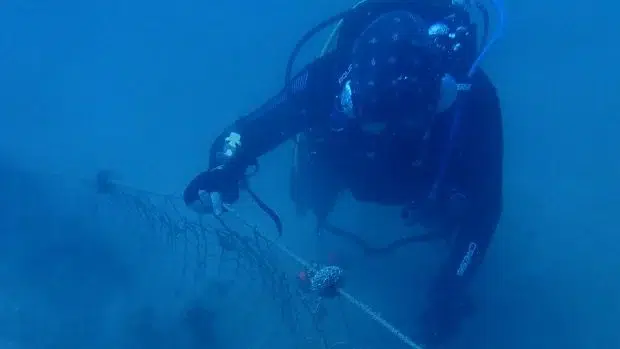
A gigantic ghost net over 400 meters long, along with remnants of ropes, wheels, and fishing gear, was removed from the seabed of the Peñón de Ifach, Spain, thanks to the Misión Calpe, an unprecedented ecological operation led by the environmental company Gravity Wave.
During three days of underwater work, specialized divers and technical teams managed to recover the waste accumulated over decades in the area known as Brut de Ifach, a natural enclave where marine fauna coexisted among invisible traps.
The intervention, carried out between September 16 and 18, marked a turning point in the marine conservation of the Alicante coast, by combining private, scientific, and environmental efforts in a coordinated high-complexity action.
Thanks to the precision of the operation, it was possible not only to remove the waste without damaging the meadow of Posidonia oceanica but also to free animals that were trapped in the net.
Invisible threat: ghost nets and ecological damage
The so-called ghost nets are one of the most destructive and persistent wastes in the Mediterranean. Formed by abandoned fishing remnants, they can take up to 1,000 years to degrade. During that time, they continue to trap fish, turtles, dolphins, and other species, causing a slow and invisible death under the sea.
Moreover, their weight and structure destroy essential habitats like the meadows of Posidonia oceanica, which act as the lungs of the Mediterranean by producing oxygen, storing carbon, and serving as a refuge for hundreds of species. Their deterioration not only threatens biodiversity but also the ecological stability of the coastline.
According to the IUCN, more than 40% of the plastic waste in the Mediterranean Sea comes from abandoned nets and fishing gear. Each year, about 229,000 tons of new plastic are added, making this basin one of the most polluted on the planet.
The net removed in Calpe symbolizes just a fraction of a global problem: tons of synthetic material remain trapped in the seabeds, releasing microplastics and altering the natural cycles of ecosystems.
A precision and science operation
The operation followed three carefully planned phases. First, the work area was buoyed to avoid impacts on the underwater vegetation. Then, divers and crane ships coordinated the meticulous extraction of the net, preventing its movement from damaging the surrounding ecosystem.
Finally, the remnants were transported to the port of Calpe, where Reciclamás took care of their classification and sustainable management. Each fragment was analyzed to measure its composition and determine its possible reuse within a circular economy model.
The team had the scientific collaboration of IMEDMAR-UCV, which documented the interaction between the waste and marine communities. This monitoring will allow the evaluation of the ecosystem’s regeneration in the coming months.
Consequences for the seabed
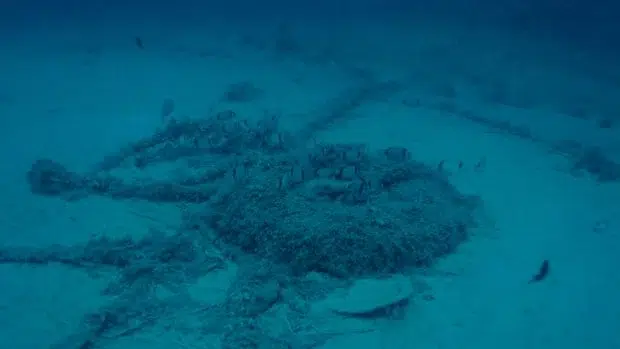
The prolonged presence of a ghost net severely alters the ecosystem’s balance. Its tangled structure creates dead zones where life cannot develop, covers corals and rocks that serve as anchors for organisms, and in its degradation, releases toxic microplastics that enter the food chain.
Moreover, the constant friction of the nets on the seabed stirs up sediments, clouds the water, and hinders the photosynthesis of Posidonia, a key species in CO₂ capture and protection against coastal erosion.
Scientists warn that the accumulation of these wastes is reducing the Mediterranean’s capacity to self-regulate in the face of climate change. Their removal, therefore, not only saves trapped species but also contributes to the ecological resilience of the sea.
Towards a regenerated Mediterranean
Misión Calpe is just the first step of a long-term regeneration plan driven by Gravity Wave, which seeks to restore the seabed to the state it presented half a century ago. The next phases of the project will include new dives to remove more waste and promote the natural recovery of underwater meadows.
The company, which has already removed more than 1.2 million kilos of marine waste, works with over 7,000 fishermen and 250 brands committed to ocean cleaning. Their goal is to demonstrate that cooperation between sectors can reverse decades of environmental damage.
The operation in Calpe not only freed the sea from a silent trap but also ignited a beacon of hope: with science, collaboration, and will, it is possible to bring life back to the Mediterranean.



