



In March, one of the two annual orca watching seasons begins in Chubut. Therefore, the provincial government is advancing with works at the Punta Norte Operational Station, within the Protected Natural Area of Península Valdés.
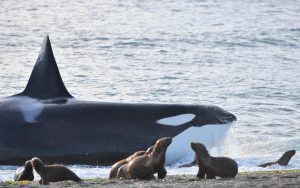
The works aim to optimize the visitor experience in one of the most emblematic settings of Patagonian nature tourism. There, orcas display their impressive hunting technique known as intentional stranding.
The tasks include reconditioning trails and viewpoints, replacing wood on walkways, and general structural improvements. Additionally, painting and maintenance work is being done to enhance safety and ensure orderly circulation.

Infrastructure and organization for responsible tourism
The interventions are carried out by park rangers and protected area staff. Consequently, the main goal is to facilitate movement without altering the coastal environment or the dynamics of the marine fauna.
Furthermore, there are plans to expand the parking area at Punta Norte and organize separate areas for private vehicles and tourist agency units. This way, the aim is to reduce the impact during peak visitor times.
During days when orcas are present, the influx increases significantly. In addition to tourists, photographers, documentarians, and scientists from around the world arrive to conduct extensive vigils to document the phenomenon.
The orca season in Chubut
Orcas arrive at the Chubut coast in two defined periods each year. The first extends between March and May, while the second occurs between October and November.
During these months, the coastline becomes the stage for one of the most unique behaviors in wildlife. During high tide, the specimens propel themselves onto the beach to capture sea lion or elephant seal pups.
After the maneuver, they return to the open sea. This behavior was first documented in 1974 and is considered unique on a global scale, both for its precision and complexity.
Additionally, the technique is passed down from generation to generation within family groups led by females. Thus, the juveniles learn over years before executing the stranding themselves, which reinforces its biological and cultural value.
Mel and the living memory of the Patagonian sea
Every March 16, Chubut commemorates the Provincial Orca Day. The date recalls the last sighting of Mel, an emblematic male first observed performing intentional stranding in 1975.
In 1976, Mel was injured in front of a sea lion colony and his dorsal fin became visibly bent. However, he continued hunting for years and became a symbol of resilience and conservation.
His last record occurred on March 16, 2011, at Punta Norte. Since then, that date marks the official launch of the watching season in Península Valdés, consolidating a tourism model that seeks to balance contemplation, environmental education, and marine ecosystem protection.



