



In the Tambopata National Reserve, in the department of Madre de Dios, artificial intelligence has become a key tool for estimating the density of jaguars.
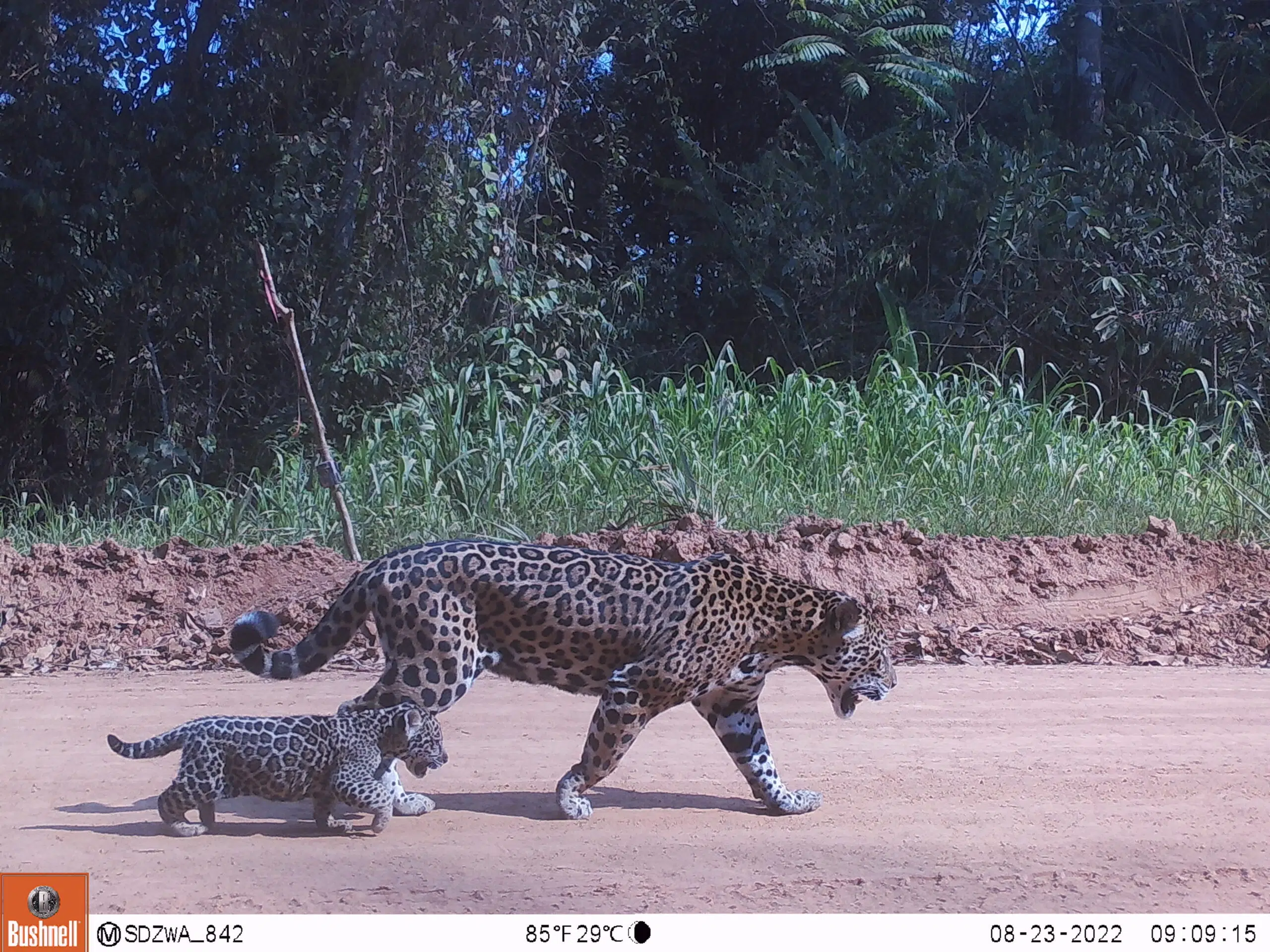
Two specialized software programs allow for the analysis of thousands of images captured by camera traps, distinguishing this species from other animals and identifying each individual. What used to take months of manual work can now be resolved in a few days.
Since 2021, Sernanp has been implementing the Jaguar Program, in coordination with the AIDER Association and SDZWA–Peru, which processes the photographs with the help of AI.
How monitoring works
The camera traps are installed in pairs, facing each other, on trails or paths where wildlife transit is presumed. Every time an animal passes by, the infrared sensors are activated, and records are generated from different angles.
The processing is done with two programs:
- Animl (Animal Machine Learning): distinguishes species with great precision, even among very similar animals like the ocelot and the margay.
- Matchy Patchy: specifically discriminates jaguars, identifying how many individuals appear in the images and differentiating them one by one.
Results obtained
- First evaluation (2021-2022): 101 cameras in 830 km² recorded 15 jaguars, with an estimated density of 1.54 per 100 km². Additionally, 48 mammal species and five bird species were detected.
- Second evaluation (2024): 90 cameras in the same area recorded 20 jaguars, with a density of 1.16 per 100 km².
Furthermore, species such as the red deer, the Amazonian tapir, and the agouti were identified, reinforcing the importance of the jaguar as a “umbrella species”: by protecting it, the habitat of numerous associated species is also conserved.
Current threats
Between 2025 and 2026, illegal mining deforested about 500 hectares in areas near the Malinowski River, the reserve’s boundary. This activity, along with retaliatory hunting and the illegal trafficking of skins and fangs, poses a critical risk to the species.
The IUCN classifies the jaguar as “Near Threatened,” with a population reduction of 20-25% in the last two decades. The Peruvian government’s National Jaguar Conservation Plan 2022-2031 places it in the same category, warning that it could become vulnerable if protection measures are not intensified.
Conservation strategies
The Jaguar Program aims to generate applied scientific knowledge and promote pilot projects together with local communities to reduce negative interactions. Among its objectives:
- Prevent retaliatory hunting.
- Promote responsible ecotourism, which can generate income without compromising the species’ survival.
- Encourage community participation in conservation.
Researchers like Zamalloa and Aviana have recorded sightings and roars of jaguars near the Malinowski River, especially in May and June, the mating season. These testimonies reinforce the potential of ecotourism as a tool for coexistence between humans and wildlife.
The application of artificial intelligence in Tambopata marks a milestone in jaguar conservation. By accelerating data analysis and improving the accuracy of records, the response capacity to threats such as deforestation and illegal hunting is strengthened.
The Peruvian experience demonstrates that technology, combined with community and scientific commitment, can be a decisive driver in ensuring the survival of one of Latin America’s most emblematic species.


