



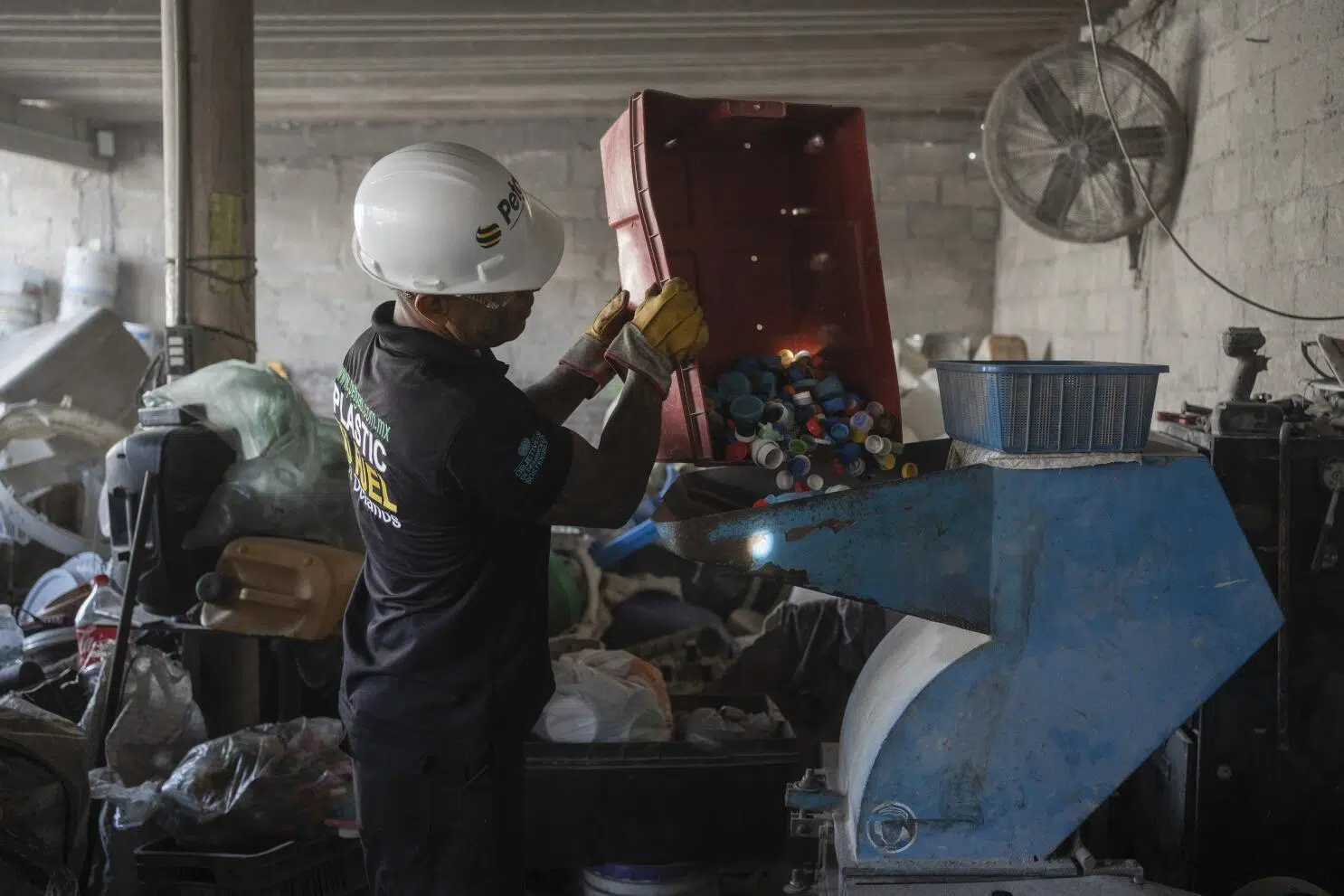
The Mexican startup Petgas has developed a technology that transforms hard-to-recycle plastics into gasoline, diesel, and kerosene through a process of pyrolysis. This thermochemical technique heats waste without oxygen, breaking down hydrocarbon chains into smaller molecules that then become fuels.
At its pilot plant in Boca del Río, Veracruz, Petgas processes about 1.5 tons of plastic per week, generating around 1,350 liters of fuel. For now, the production is donated to local firefighters and food delivery services, while the company seeks to scale the model for greater impact.
Global Context of Plastic Pollution
Global plastic production exceeds 400 million tons annually and could increase by 70% by 2040, according to the United Nations. Every day, the equivalent of 2,000 garbage trucks full of plastic ends up in oceans, rivers, and lakes.
In December 2025, negotiations for a binding international treaty on plastic pollution failed, reinforcing the urgency for technological and policy solutions.
Environmentalists’ Criticisms
Although pyrolysis reduces visible waste in landfills and beaches, environmental organizations question whether it can be considered real recycling:
- The plastic does not become plastic again, but fuel.
- When burned, carbon is released into the atmosphere, contributing to climate change.
- It is considered more of a delay in emissions release than a definitive solution.
Biologist Alexa Mendoza, a specialist in marine pollution, described the initiative as a “first step,” but warned that it should not be seen as a complete solution, but as a “temporary stopgap” for a global problem.
Business Vision and Social Campaigns
Petgas CEO, Carlos Parraguirre Díaz, argues that the project is part of a circular economy, where plastic ceases to be waste and becomes an energy resource.
The company organizes collection campaigns on beaches and encourages the population to bring plastic waste to collection points. Additionally, it receives clean and shredded material from recycling plants, which facilitates the pyrolysis process.
Sustainability Debate
Petgas’s proposal reflects the tension between technological innovation and environmental sustainability:
- Advantages: reduces hard-to-recycle plastics, prevents accumulation in landfills and seas, and generates useful energy.
- Limitations: does not reincorporate the material into the production cycle, maintains dependence on fossil fuels, and generates carbon emissions.
The challenge will be to integrate this technology into a broader framework of solutions that include production reduction, true recycling, and transition to sustainable materials.
Petgas paves an innovative path in plastic waste management, but it also raises questions about its long-term environmental impact.
The key will be to combine this type of initiative with global reduction and recycling policies, so that plastic ceases to be a problem and becomes a resource within a truly circular economy.


