



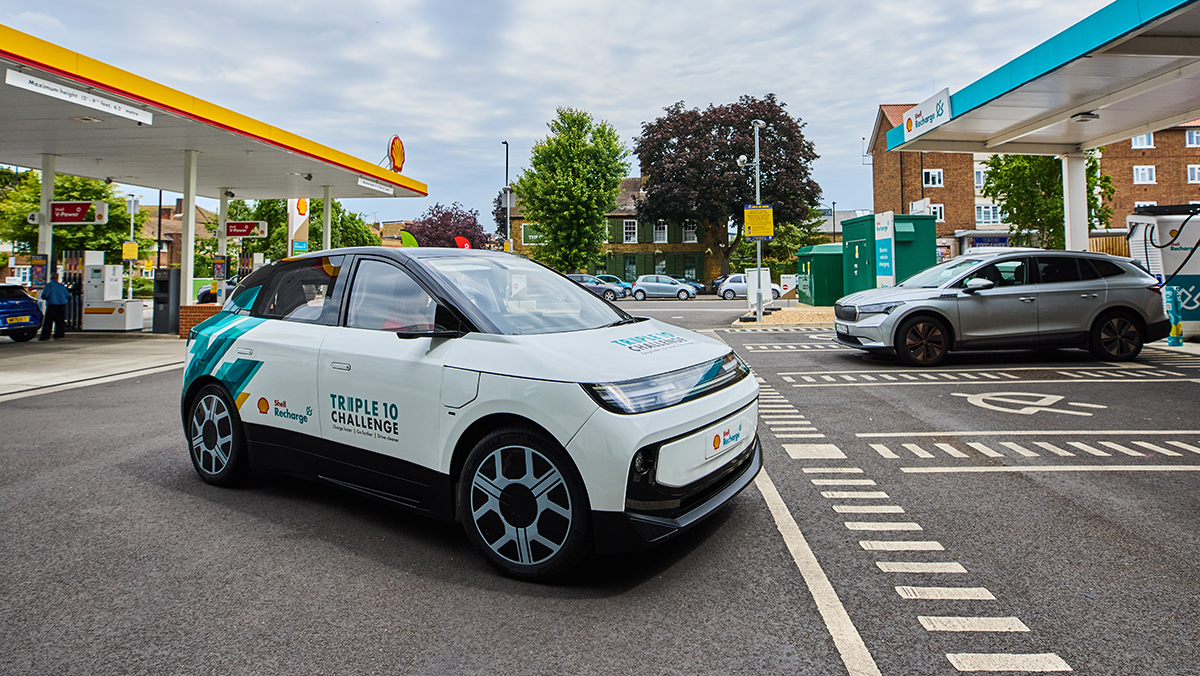
The oil company Shell surprised the automotive sector with the launch of the Triple 10 Challenge Concept Car, an electric prototype that aims to redefine the way these types of cars are designed.
Instead of betting on increasingly larger and more expensive batteries, the proposal focuses on maximizing energy efficiency, reducing weight, and optimizing thermal management.
The three goals of the Triple 10
The project’s name refers to three specific goals:
- Ultra-fast charging: going from 10% to 80% in less than 10 minutes.
- Efficient consumption: achieving 10 km per kWh, far surpassing most current models.
- Reduced carbon footprint: limiting lifecycle emissions to about 10 tons of CO₂ equivalent, including manufacturing and use with renewable energies.
Innovation in thermal management
The most revolutionary aspect of the prototype is its cooling system:
- Instead of glycol water circuits, it uses a dielectric fluid developed by Shell that allows for directly immersing the battery cells.
- This liquid absorbs heat without conducting electricity, maintaining uniform temperatures even during ultra-fast charges.
- The reduction of hot spots decreases thermal stress, improves durability, and increases efficiency.
- Additionally, the vehicle uses a single cooling circuit for the entire propulsion system, reducing weight and simplifying manufacturing.
Key highlights
- The prototype manages to charge from 10% to 80% in 9 minutes and 54 seconds with a 175 kW charger.
- It achieves 24 km of range per minute connected, almost double what many current models offer with the same power.
- This means it does not require more powerful charging stations or large additional investments in infrastructure.
Environmental and manufacturing impact
The project’s sustainability begins at the factory:
- By reducing the battery size, fewer critical raw materials such as lithium, nickel, graphite, copper, and aluminum are used.
- The energy needed in the production process is decreased.
- Shell estimates that the concept could reduce lifecycle emissions by up to 50% compared to current electric vehicles in Europe.
Industry trends
The Triple 10 Challenge is part of a growing trend:
- Smaller and more efficient batteries instead of giant accumulators.
- Electrical architectures of 800 volts and advanced cooling systems.
- New materials capable of withstanding more intense loads.
Shell’s proposal demonstrates that innovation does not solely depend on increasing battery capacity, but on better using existing technology.
The Triple 10 Challenge Concept Car opens the door to a new generation of more efficient, affordable, and sustainable electric vehicles.
If these solutions reach commercial models, they could accelerate the transition towards low-emission mobility, reducing the demand for mineral resources and bringing recharge times closer to those of conventional refueling.


