



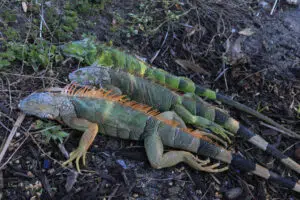
In the south of Florida, a region accustomed to warm weather, the low temperatures created an unexpected scene. Neighbors began to observe iguanas falling from trees, immobilized by the cold.
This episode occurs in the context of a polar wave affecting much of the United States. However, in tropical regions like Florida, the ecological impact is more evident.
Thus, the local fauna faces conditions for which it is not adapted, raising concern among residents and environmental authorities.
The reaction of the community and the authorities
Over the weekend, the falling of iguanas became frequent in residential neighborhoods and parks. Faced with uncertainty, neighbors sought guidance on how to act.
In response, the Florida Fish and Wildlife Conservation Commission set up temporary collection centers distributed throughout the state. There, the animals are subjected to specific protocols.
According to reports, some iguanas are humanely euthanized, while others are transferred to license holders for relocation out of state.

A broader environmental impact
This type of event is not limited to one species. The extreme temperatures disrupt the balance of ecosystems where cold is not usual.
Moreover, the massive fall of reptiles exposes how abrupt climate changes can cause mortality or stress in urban and wildlife.
In this sense, the phenomenon reopens the debate on the adaptation of species and environmental management in the face of increasingly frequent climatic events.
How does the cold affect iguanas?
Iguanas are cold-blooded reptiles, so they depend on ambient heat to regulate their body temperature. When the thermometer drops below 10 degrees, their metabolism slows down.
As a result, the muscles stop responding and the animals become paralyzed. In many cases, this occurs while they are resting in trees, from which they fall upon losing bodily control.
However, this state does not always imply death. If temperatures rise gradually, many iguanas can regain mobility and continue with their life cycle.
Recommendations to avoid unnecessary harm
In these episodes, authorities recommend not handling iguanas directly. Although they may appear dead, some are only temporarily immobile.
Additionally, it is suggested to allow the natural process to take its course, avoiding intervention unless there is a risk to people or pets.
In this way, the aim is to reduce human impact on a phenomenon that primarily responds to climatic factors.
A changing climate and its consequences
The south of Florida does not usually face extreme temperatures. However, these events show how the climate is becoming more variable.
The presence of frozen iguanas is a visible symptom of that instability. It also reflects the vulnerability of tropical species to abrupt changes.
Thus, the episode leaves an ecological warning: even warm regions can be affected by extremes that test the coexistence between climate, fauna, and city.



