



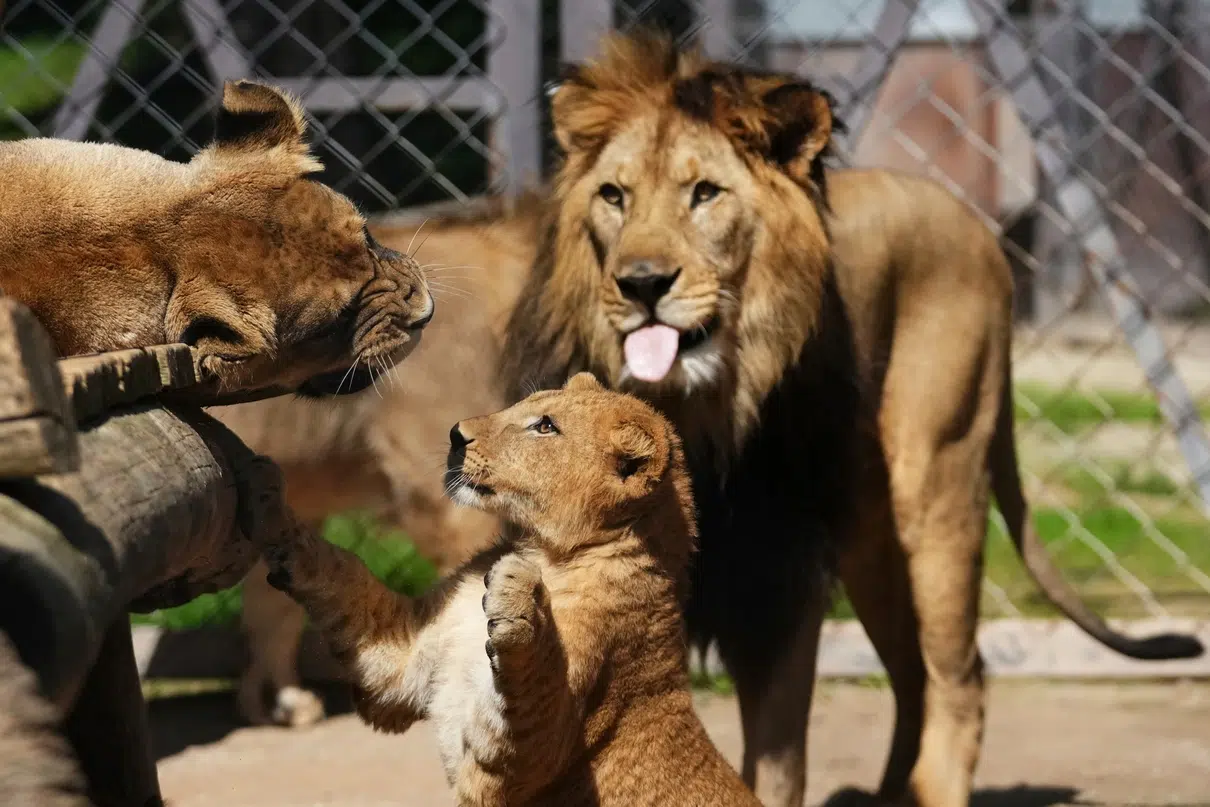
The recent birth of **four Barbary lion cubs** at **Dvůr Králové Safari Park** in the Czech Republic marks a milestone in the fight to preserve a subspecies that **vanished from the wild over 80 years ago**.
Offspring of **Khalila and Bart**, these specimens represent a new hope for **African biodiversity** and for international programs of [breeding and reintroduction](https://noticiasambientales.com/animales/rehabilitaron-y-liberaron-a-cuatro-monos-caraya-en-corrientes-como-sera-la-reintroduccion-a-su-habitat-natural/).
Healthy development and international technical support
During their first weeks, the lions have shown **active and healthy growth**, thanks to the expert care of the Czech park, renowned for its track record in [African wildlife management](https://noticiasambientales.com/turismo/el-archipielago-de-bijagos-la-joya-natural-africana-que-fue-declarada-patrimonio-de-la-humanidad-de-la-unesco/).
This achievement reflects the progress of **cooperation between zoos, geneticists, and conservationists** from different continents.
Soon, the cubs will be transferred to other enclosures as part of an **international genetic exchange program**, which aims to **strengthen the diversity** of the captive population. One of the confirmed destinations is the **Beersheba Zoo** in Israel, where they will be integrated into new social dynamics under permanent technical supervision.
Less than 200 individuals in captivity: every birth counts
Currently, **less than 200 Barbary lions survive in captivity** in zoos and breeding centers in Europe, Africa, and the Middle East. The management of these animals requires:
– Genetic monitoring to prevent inbreeding
– Specialized logistics for international transfers
– Coordination between multidisciplinary teams and local authorities
Each birth and each transfer are strategic moments to **guarantee population health** and **prepare the way for a possible reintroduction**.
The Atlas lion: the story of a man-made extinction
Originally from the **Atlas Mountains and North Africa**, the **Barbary lion** fell victim to centuries of **excessive hunting**, **capture for shows**, and **destruction of its natural habitat**. The last wild record dates back to **1925**, and the last known specimen was shot in **1942**.
Since then, the only hope of survival has been in the hands of **zoos and scientists**, working on **breeding under strict supervision** and the design of **long-term conservation strategies**.
Reintroduction in Morocco: an ecological and social challenge
This year, a **specialized conference in Morocco** will address the necessary conditions for **reintroducing the Barbary lion** into its natural environment. The debate will include:
– Availability of prey and ecological restoration
– Safety of individuals and permanent monitoring
– Active participation of local communities
– Phases of adaptation in semi-natural environments
International experience indicates that **reintroduction must be gradual**, with an emphasis on **community education** and **constant technical monitoring**.
Zoos as allies of modern conservation
The case of Dvůr Králové Safari Park reflects how zoos have **transformed their role**: they are no longer just exhibition spaces but **key platforms for applied science**, **environmental education**, and **active protection of endangered species**.
“Our goal is to return the Barbary lion to nature, so it can regain its ecological and symbolic role,” says **Jaroslav Hyjánek**, deputy director of the park.
A symbol of resistance and international cooperation
This birth validates years of **collaborative work between institutions, scientists, and governments**, and demonstrates that **ex situ conservation**, when well planned, can **pave the way for ecological restoration**.
The **Barbary lions** are now a **symbol of hope**, and their story reminds us that, although human actions can lead to extinction, they can also **reverse the damage** and **rebuild the bond between species and their habitats**.



