



A team of scientists from the Galapagos National Park and the organization Galapagos Conservancy confirmed a historic discovery. For the first time, they identified pink iguana offspring (Conolophus marthae) in their natural habitat, on the slopes of the Wolf volcano, on Isabela Island.
This discovery represents a crucial advance in the conservation of this endemic species critically endangered.
The pink iguana was first discovered in 2009 and has since been the subject of intense study due to its rarity. It only inhabits a small high mountain area in Galapagos and its estimated population does not exceed 300 adult individuals.
A discovery that renews hope for the pink iguana
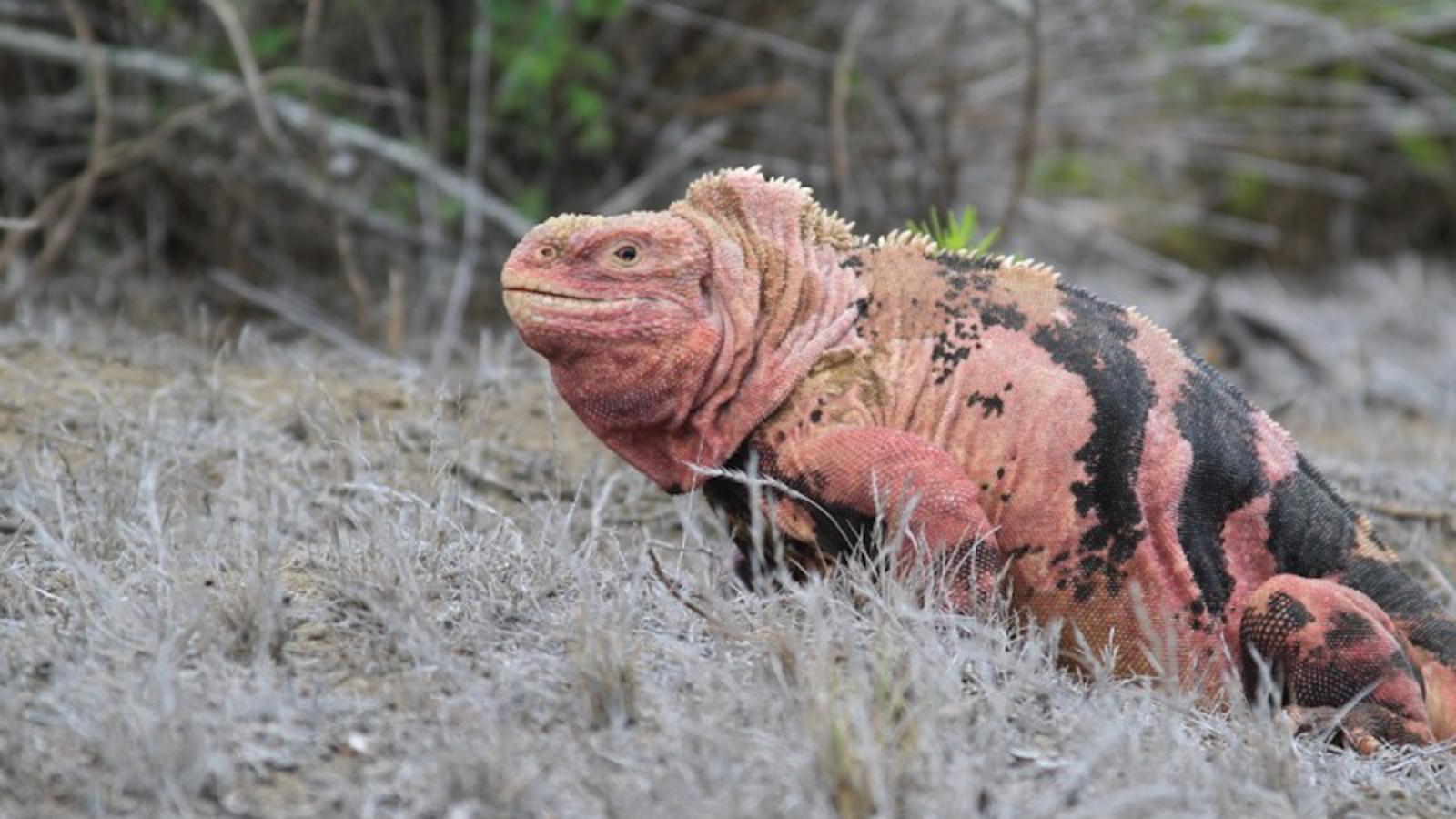 What the pink iguana from Galapagos looks like.
The finding of young individuals is a positive sign: it confirms that the species still reproduces naturally, which could allow for the design of more effective strategies for its recovery.
Until now, no offspring or juveniles had ever been documented in the wild, which generated uncertainty about its reproductive cycle.
During the recent expedition, researchers recorded about twenty offspring and subadults, indicating that there are suitable conditions for reproduction.
However, they also warn that the habitat faces threats such as the presence of invasive species (rats and feral cats) and the effects of climate change.
Technology and conservation at high altitudes
To achieve this milestone, the scientific team used camera traps, drones, and GPS tracking, essential tools in a difficult-to-access terrain like the Wolf volcano, which surpasses 1700 meters in altitude.
The combination of technology and fieldwork allowed for the location of nesting areas and the recording of little-known behaviors of this species.
The next step will be to implement specific protection measures, such as controlling invasive species and possibly creating a captive breeding program.
The pink iguana: an icon of Galapagos’ unique biodiversity
The Galapagos pink iguana is one of the most emblematic species of the islands due to its particular coloration and limited geographical distribution. It was recognized as a distinct species only in 2019, after genetic studies differentiated it from other land iguanas.
 The pink iguana, in danger of extinction.
Its situation is so delicate that the International Union for Conservation of Nature (IUCN) included it in its list of species critically endangered, which has driven international research and protection actions.
A call to strengthen conservation efforts
The discovery of these offspring demonstrates that the species still has recovery possibilities, but the window of action is limited.
The Galapagos Conservancy Foundation and the Galapagos National Park Directorate made a call to strengthen funding and coordinated actions to preserve this unique biological treasure in the world.
“This finding marks a turning point for the conservation of the pink iguana. We know that nature can recover if given the opportunity,” stated the organization.



