



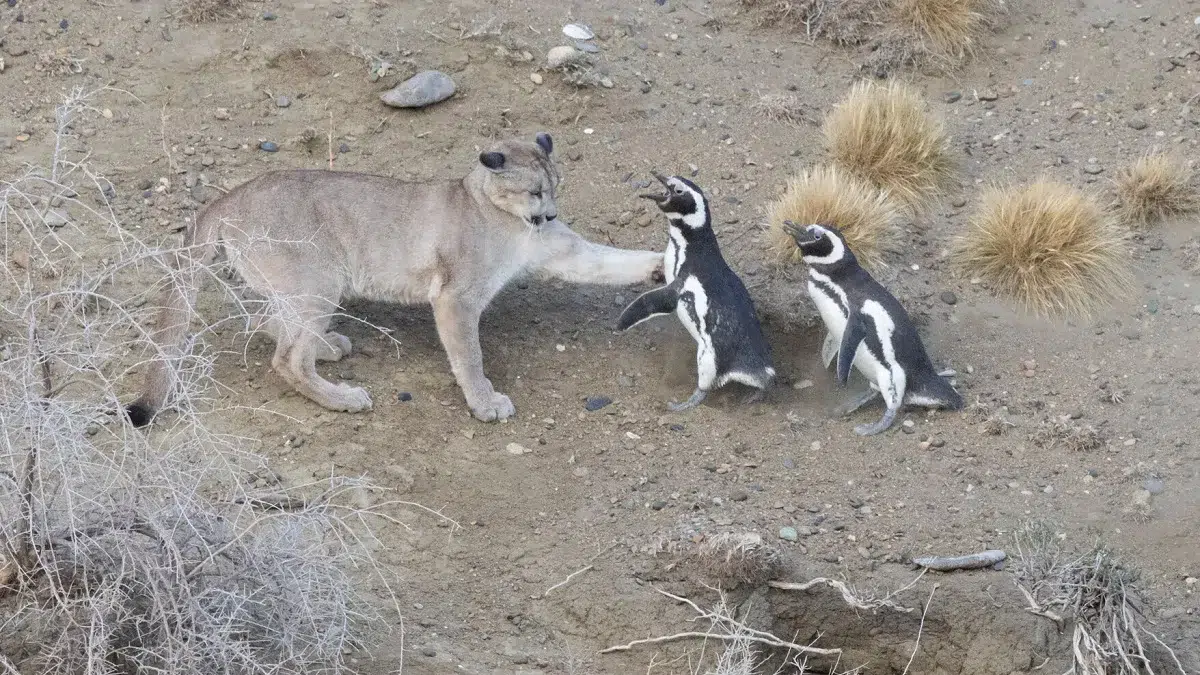
The Monte León National Park, on the Atlantic coast of Santa Cruz, is undergoing an unexpected transformation: pumas have incorporated Magellanic penguins into their diet, a phenomenon never before recorded in the region.
The research, published in the journal Proceedings of the Royal Society, documents a novel adaptation in the predator-prey relationship, driven by the history of human intervention during the 20th century and recent environmental restoration efforts.
How this interaction originated
According to Emiliano Donadio, scientific director of Rewilding Argentina and co-author of the study, more than a new strategy by the pumas, it is an unexpected interaction.
For decades, the persecution of pumas and other predators like foxes freed the Patagonian coasts from predatory pressure, allowing penguins, which usually nested on islands, to colonize the continental coasts and form large colonies. With the creation of the park in 2004 and the reduction of persecution, pumas found a new food source: the thousands of penguins nesting in Monte León.
A natural laboratory of ecological dynamics
The protected area currently hosts about 40,000 breeding pairs of Magellanic penguins and serves as a unique space to observe unprecedented interactions.
Between 2019 and 2023, the scientific team used GPS collars on 14 pumas and camera traps, recording that the felines concentrate their activity near the colony during the breeding season, which occupies more than half of the year.
Ecologist Mitchell Serota, from the University of California-Berkeley, the main author of the work, emphasized that “wildlife is recolonizing ecosystems that have changed radically since these species disappeared.”
Impact on pumas and the penguin colony
What is novel, according to Donadio, is that the interaction has more significant effects on pumas than on penguins. The felines that consume penguins interact more with each other, have smaller territories, and move less, as they do not need to travel long distances to find prey.
The density of pumas reached unprecedented figures: 13.2 to 13.3 individuals per 100 km², more than double that in other regions of South America and 2.3 times higher than the maximum recorded in the Bolivian Chaco.
As for the penguins, censuses show that between 2004 and 2017 the colony remained stable and even increased slightly, indicating that they can withstand current levels of predation.
Consequences on other species
The presence of penguins also modifies the predatory pressure on other species. Between September and March, when the penguins are in the colony, pumas decrease the hunting of guanacos, increasing the survival probability of their offspring. When the penguins migrate, pumas return to preying on guanacos, although monitoring shows that the population remains stable.
Restoration and connection between land and sea
The ecological context has allowed for the recovery of complete populations of native fauna. Donadio highlighted that the park has an abundant prey base capable of sustaining a healthy puma population, demonstrating the success of the restoration.
Additionally, the remains of penguins hunted on land decompose and fertilize the soil, connecting marine and terrestrial ecosystems. “The pumas that hunt penguins connect land and sea, showing us the incredible and unimagined ways nature works when we manage to restore it,” Donadio noted.
The case of Monte León reveals how environmental restoration can generate unprecedented ecological interactions, transforming the dynamics of predators and prey. The research, conducted by Fundación Rewilding Argentina, Monte León National Park, and the University of California-Berkeley with funding from National Geographic, shows that nature, when recovered, can surprise with new forms of balance.
Cover photo: Courtesy / The New York Times



