



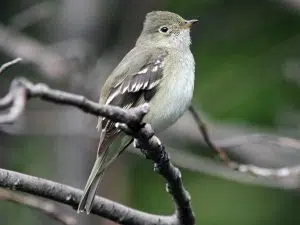
Each year, millions of birds cross entire continents in search of food, shelter, and suitable conditions for reproduction. In the framework of the World Migratory Bird Day, a study conducted between Argentina and the United States provided detailed insights into the extraordinary journey of the whistling flycatcher, a small Patagonian bird capable of flying thousands of kilometers.
The study recorded for the first time how this species migrates between the forests of Argentine and Chilean Patagonia and various regions of Brazil. The data revealed nocturnal flights of up to eight continuous hours and, in an extreme case, almost 29 hours straight without touching land.
The research was developed by specialists from the Esquel Mountain and Patagonian Steppe Research Center, part of the Conicet and the National University of Patagonia San Juan Bosco, together with scientists from Indiana University in the United States.
An aerial journey of over 6,000 kilometers
The whistling flycatcher undertakes one of the longest migratory journeys among small birds in South America. During the austral winter, it leaves Patagonia and moves north to Brazil, where it finds better food and climate conditions.
Then, between September and November, it returns south to reproduce in the Patagonian forests. There, it feeds its chicks mainly with calafate berries and insects found in the region.
To study its movements, researchers placed small devices called BitTags on specimens captured in Chubut. The sensors recorded physical activity and temperature every five minutes, allowing the reconstruction of the bird’s behavior throughout the migration.
The results showed that the flycatcher flies mainly at night. Additionally, it alternates intense flight days with rest periods that can extend between four and five days before continuing the journey.
A key species for South American ecosystems
The whistling flycatcher, whose scientific name is Elaenia chilensis, weighs less than 20 grams and fits in the palm of a hand. Despite its small size, it plays an important role in the ecosystems where it lives.
By feeding on fruits and insects, it contributes to both the natural control of arthropods and the dispersal of seeds in forests and wild areas. This promotes plant regeneration and the maintenance of biodiversity in different regions of South America.
Moreover, its migration connects very different ecosystems, from the Patagonian forests to Brazilian savannas and jungles. This ability makes migratory birds fundamental environmental indicators for measuring the health of natural habitats.
On the other hand, scientists consider that understanding these movements is crucial in the face of the advance of climate change and the loss of natural environments that affect the traditional migratory routes.

Technology and conservation to understand migrations
The study confirmed that new technologies like accelerometers can revolutionize the tracking of small birds in South America. Until now, there were few detailed data on migrations within the continent.
One of the most striking findings was the case of a specimen that remained in continuous flight for 28.9 hours. The temperature records indicated that the bird reached great heights while crossing different territories without stopping.
Furthermore, researchers believe that the flycatcher might prioritize energy conservation over travel speed, a strategy different from that observed in many migratory species of the northern hemisphere.
Thus, this small Patagonian bird not only showcases the enormous resilience of migratory birds but also the urgent need to protect the ecosystems that make possible one of the most astonishing natural phenomena on the planet.



