



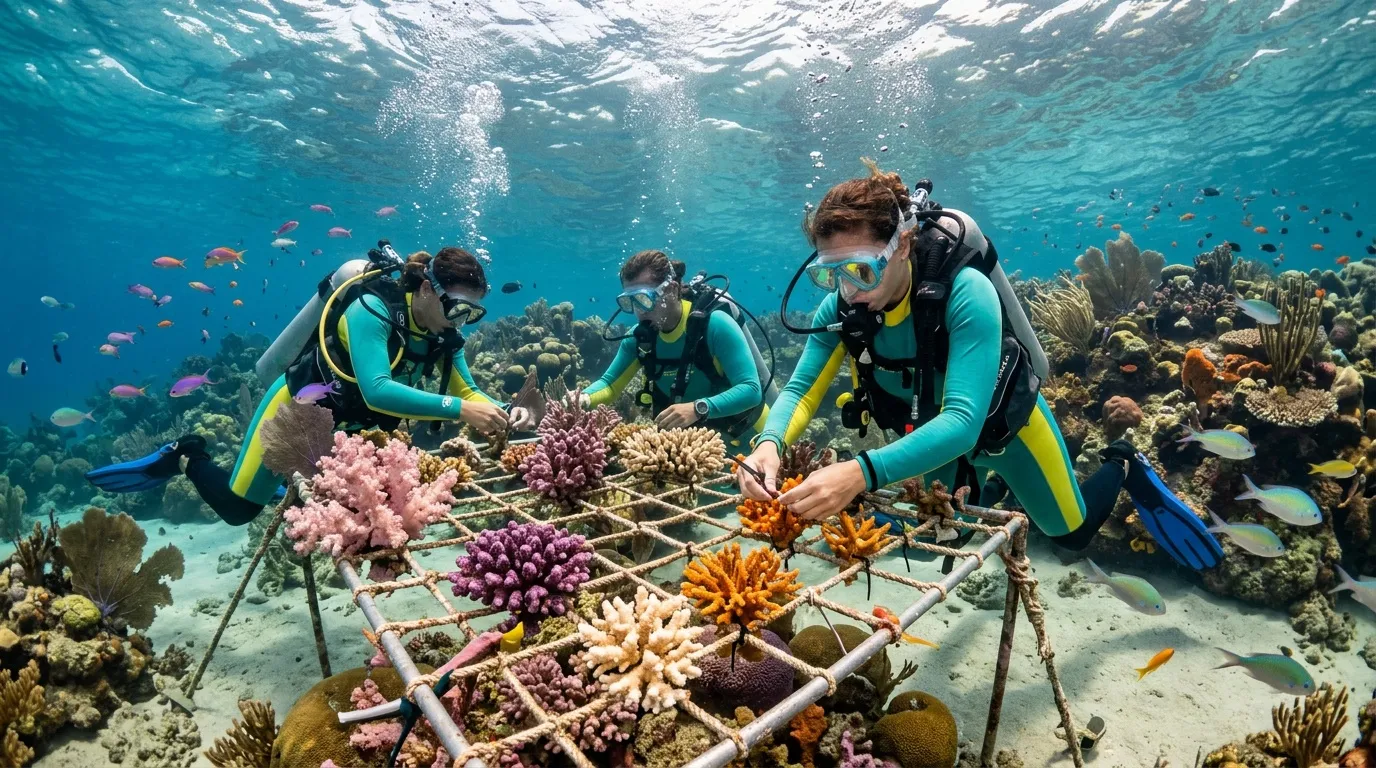
In Santa Marta, Colombia, former fishermen like Yerson Granados and Kevin Monsalvo have left behind destructive practices such as the use of dynamite, nets, and anchors to become guardians of the sea. Today, clad in diving suits, they attach coral fragments to structures that mimic reefs and submerge them with the hope of achieving coral restoration in the Caribbean.
In a conversation with the AFP agency, Granados recalls that before “we used to damage them, they looked like stones,” but now he understands that corals are “homes for fish” and essential for marine life.
Fundación CIM Caribe and community work
The Fundación CIM Caribe leads this project, which has already planted 1.5 hectares of 20 coral species thanks to the work of former fishermen turned environmental defenders. The fragments first grow in controlled nurseries and are then transplanted to underwater gardens about 10 meters deep.
The goal is to restore 36 hectares of coral reefs by 2030, in a country where rising sea temperatures threaten the survival of these ecosystems.
An ecosystem at risk
The International Union for Conservation of Nature (IUCN) warned in 2024 that 44% of the world’s coral species are at risk of extinction, mainly due to climate change. Bleaching and ocean acidification are phenomena that weaken reefs and endanger marine biodiversity.
Importance of coral restoration
- Coastal protection: reefs act as natural barriers against hurricanes and storm surges.
- Biodiversity: they host thousands of marine species and sustain ocean health.
- Artisanal fishing: restored corals serve as nurseries for fish, ensuring food security.
- Sustainable tourism: they generate new economic alternatives for coastal communities.
- Climate action: transplanting resistant species strengthens ecosystem resilience.
- Local empowerment: fishermen become active restorers and guardians of the sea.
One million corals for Colombia
The initiative “One Million Corals for Colombia” surpassed its original goal, achieving the planting of 1,052,340 fragments and the restoration of 204 hectares in the Colombian Caribbean.
Key project details
- Scope: intervention in 12 areas, including the Archipelago of San Andrés, Providencia, and Santa Catalina (Seaflower Reserve), the Tayrona National Natural Park, and the Corales del Rosario and San Bernardo National Natural Park.
- Community impact: transforms the local economy by training fishermen to protect and restore reefs.
- Technique: floating underwater nurseries to cultivate fragments before transplanting them.
- Importance: positions Colombia as an international reference in marine conservation.
Coral restoration in Colombia is more than an environmental project: it is a social and economic transformation that turns fishermen into underwater gardeners and strengthens the resilience of ecosystems against climate change. With initiatives like “One Million Corals for Colombia,” the country establishes itself as a leader in active marine conservation.



