



During 2025, the United States went through an almost continuous succession of severe weather events. As a result, 23 disasters with losses exceeding one billion dollars were recorded, as the country experienced a high-impact environmental and economic episode every ten days.
In addition to material damages, the human toll was significant. In total, 276 people lost their lives in different parts of the territory. Thus, the climate crisis once again showed its social and environmental dimension.
Although no hurricanes made direct landfall, the year was exceptionally costly. Fires, storms, and floods took that place. Therefore, the absence of cyclones did not imply real relief.
Fires, storms, and droughts: a recurring pattern
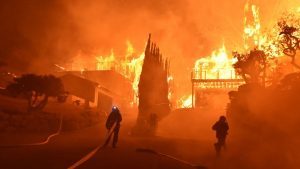
The year began with historic wildfires in the Los Angeles area. These outbreaks spread over weeks, favored by dryness and extreme heat. As a consequence, key urban and peri-urban ecosystems were degraded.
Then, a chain of severe storms swept through the central and eastern parts of the country. Tornadoes, hail, and extreme winds caused repeated damage. Thus, many regions failed to recover before the next event.
Meanwhile, the west suffered from persistent droughts and prolonged heat waves. These conditions affected soils, watercourses, and biodiversity. Thus, environmental stress accumulated throughout the year.
Climate change as an amplifying factor
The frequency of these disasters is not an isolated phenomenon. In recent decades, extreme events have become more intense and frequent. Therefore, global warming appears as a factor that amplifies the impacts.
A warmer atmosphere retains more moisture and energy. When that energy is released, storms become more violent. Thus, concentrated rains and sudden floods become more likely.
Moreover, the increase in temperatures favors fires that are more difficult to control. Ecosystems lose resilience in the face of these changes. Consequently, each event leaves a deeper environmental footprint.
Meteorological phenomena that marked the United States in 2025
Wildfires were the most costly phenomenon. In California alone, they accounted for more than half of the economic losses. Additionally, they released large volumes of pollutants and carbon dioxide.
Severe storms dominated much of the climate calendar. Extreme hailstorms and tornadoes affected extensive agricultural and urban areas. Therefore, the damages extended to both the environment and production.
Sudden floods were also recorded in densely populated areas. These carried sediments, pollutants, and debris into rivers and aquifers. Thus, the impact extended beyond the immediate event.

Invisible costs and ecosystems in slow recovery
Beyond economic figures, there are damages that are difficult to measure. Air pollution from smoke affected the health of millions of people. At the same time, food chains and natural habitats were altered.
Fires and floods caused soil erosion. This reduced the capacity of ecosystems to regenerate. Therefore, environmental recovery could take decades.
Moreover, accelerated reconstruction often increases resource consumption. Without sustainable criteria, this process deepens the ecological footprint. Thus, it reinforces a cycle of degradation that is difficult to reverse.
Data, prevention, and environmental planning
The repetition of disasters highlights the need for anticipation. Having public and updated data is key to reducing risks. In this way, information becomes a strategic environmental tool.
Planning the territory with a climate focus is increasingly urgent. Avoiding expansion in high-risk areas can reduce future damages. Likewise, protecting natural ecosystems helps cushion impacts.
In short, 2025 left a clear signal. Climate disasters are no longer exceptional but recurrent. Therefore, the environmental response must be structural and sustained over time.


