



For the first time in the United States, a heavy-duty electric truck received power while driving on the highway, at real speed and without stopping. The milestone demonstrates that a road capable of recharging electric trucks in motion is no longer a futuristic concept but has become a viable technology, with technical foundation and economic potential.
The experimental section in Indiana
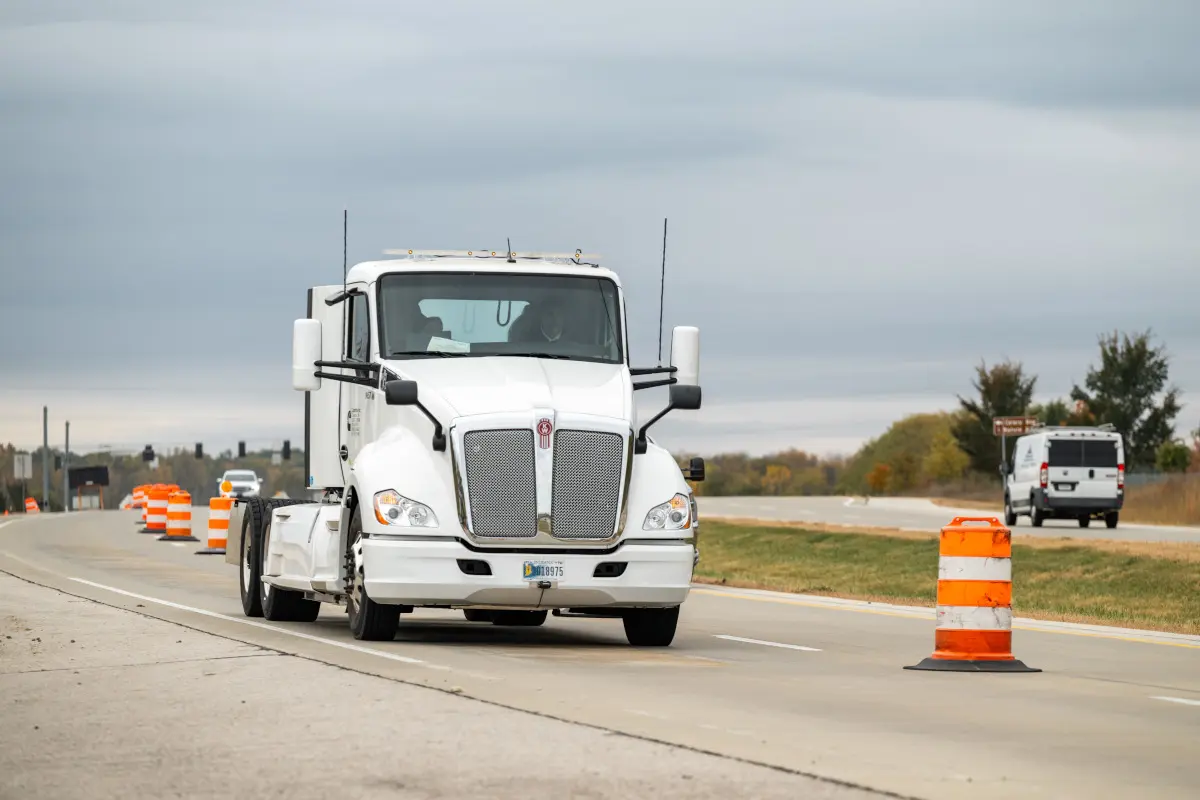
The test section, 400 meters long, was installed on U.S. 52/231 in West Lafayette (Indiana). The project was designed by engineering teams from Purdue University along with the Indiana Department of Transportation (INDOT), in collaboration with companies such as Cummins, AECOM, and White Construction.
The test was conducted in the fall with a modified Class 8 truck, equipped with a receiver coil under the chassis.
“The technology not only works but can be scaled for real-world environments and vehicles of all sizes,” explained Nadia Gkritza, a professor at Purdue.
Dynamic wireless energy transfer
The system is based on dynamic wireless energy transfer, an evolution of induction chargers already used in mobile phones, but taken to much higher power levels.
- The pavement hides large emitter coils that generate magnetic fields capable of transferring up to 190 kW to a truck traveling at 105 km/h.
- To understand the scale: that power could supply 100 homes simultaneously.
The integration of the coils within the concrete, the predominant material in heavy traffic highways, ensures resistance to extreme loads and thermal cycles, also reducing maintenance costs compared to more complex alternatives.
Impact on freight transport
Trucks are the backbone of freight transport in the United States, but their electrification faces challenges: huge, heavy, and expensive batteries, prolonged recharge times, and reduced useful load capacity.
Highway wireless charging changes the approach:
- Less dependence on giant batteries, reducing costs.
- Greater load capacity by freeing up space and weight.
- Fewer stops, improving logistics and reducing times.
Moreover, a system designed for a 40-ton truck can also power cars, vans, or buses without significant modifications.
Chain benefits
The Purdue team insists that if the road provides energy, vehicles can carry smaller, cheaper, and lighter batteries, with chain effects:
- Lower purchase cost.
- Less use of critical materials like lithium, nickel, and cobalt.
- Distributed and constant charging, without demand peaks on the grid.
- Massive reduction of megacharger infrastructure.
“The road becomes the charger. Just like a mobile phone on a wireless base, but on a highway scale,” summarized John Haddock, a professor of civil engineering.
Standards and interoperability
The project is integrated into ASPIRE, a research center funded by the National Science Foundation, which brings together more than 400 members from universities, industry, NGOs, and public agencies.
The goal is to avoid fragmentation and promote an interoperable model:
- Any compatible vehicle should be able to use any electrified road.
- Operators need technical and financial security before investing.
- The industry requires stability to manufacture adapted vehicles.
Global implications
States like Utah, Colorado, Michigan, and Florida are already studying similar scenarios. In Europe, countries like Germany, Sweden, and Italy are advancing their own tests, while Israel and South Korea are developing their models.
The Indiana test will be key to defining dynamic charging protocols and standards, fundamental for mass adoption.
The experimental highway in Indiana opens very realistic doors:
- Electric corridors for freight between ports and logistics centers.
- Reduction of peak energy consumption.
- Accelerated electrification of heavy transport.
- More efficient use of public space.
A small step in meters, but a big one in vision: transforming the road into an active part of the energy transition.



