



A team from Rice University is developing a device that allows blind dogs to move with greater autonomy and safety.
Technology has transformed the lives of people with visual impairments through braille displays, smart canes, and artificial intelligence applications. However, blind dogs still face significant limitations in their daily mobility.
Traditional solutions—such as “halo” frames or Elizabethan collars—are often uncomfortable, restrictive, and not very functional, making socialization and play difficult.
Kunde: the dog that inspired an innovation
After losing his sight due to advanced glaucoma, Kunde, a dog from Houston, became the real client of a team of engineering students from Rice University.
His owners, Grant Belton and AJ Price, sought alternatives that would allow their pet to adapt without stress or constant collisions. This led to the project led by Adam Vuong, Cristiana De Sousa, Issy Tsai, and Santiago Brent.
“We wanted to give Kunde independence to move without relying on collision as a tactile signal,” explained Vuong.
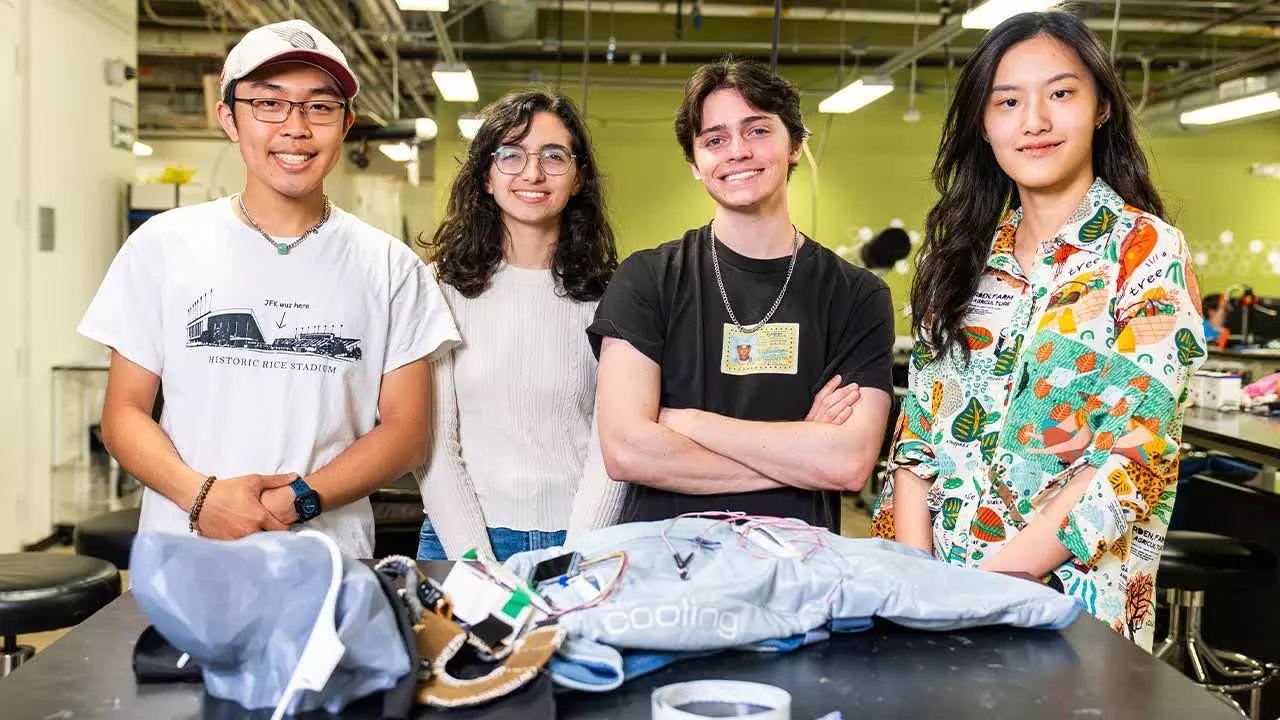 A group of students and an innovation to help blind dogs
Haptic technology and stereoscopic vision
The device consists of a lightweight vest equipped with resonant linear actuator motors, similar to those used in smartphones. These motors vibrate in different areas of the vest according to the proximity and location of obstacles, allowing the dog to adjust its trajectory in real-time.
A stereoscopic camera mounted near the head captures depth information, processed by a printed circuit board (PCB) and a specialized computer module. The system offers a range of up to 8 meters and a battery life of two hours, enough for walks or daily activities.
User-centered design… for dogs
Unlike other devices that limit play or interaction, the vest was designed to not restrict movement, respecting the dog’s natural behavior.
The team prioritized lightness, adaptability, and intuitive response, with the goal of reducing collisions and improving the quality of life for pets with visual impairments.
Education, empathy, and purpose-driven design
The project demonstrates how real challenges can drive meaningful solutions.
Although the vest is still in the testing phase, the initial results are promising.
For the students, the process was more than an academic exercise: it was a transformative experience that allowed them to apply their knowledge in an emotionally significant and technically challenging context.
“It is motivating to see how design can make a direct difference in someone’s life… or even a dog’s life,” celebrated Bisesti, the project mentor.



