



The water hyacinth (Eichhornia crassipes), native to the Amazon basin, reproduces rapidly, forming dense layers over the water. Its proliferation affects navigation, reduces biodiversity, and obstructs the entry of water into irrigation systems, domestic consumption, and hydroelectric plants.
In the Argentine NEA, the solutions available so far have been insufficient: backhoes from the shore or artisanal boats that disperse fragments of the plant, creating more problems than solutions.
The innovation of three students
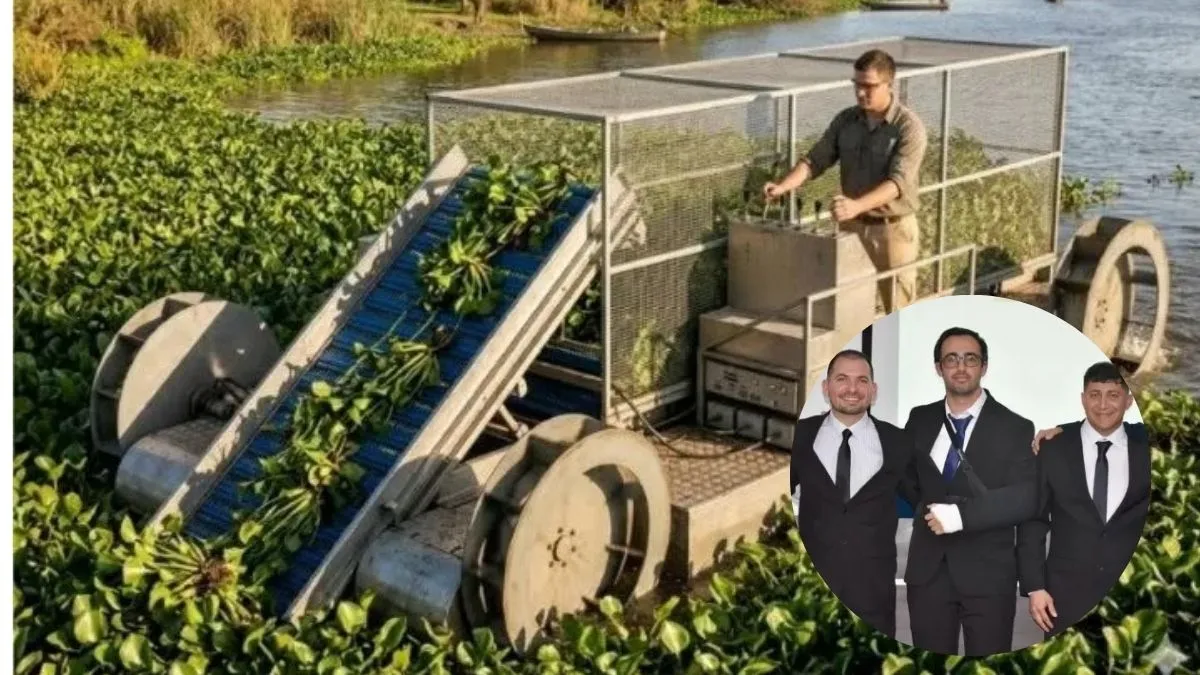
In this scenario, three Electromechanical Engineering students from the National University of the Northeast (UNNE) —Matías Agoltti, Arturo Costilla, and Yohans Tolke— presented a “Water Hyacinth Harvester Machine. Optimized Design and Development for the NEA Region” as their Final Graduation Project.
- The equipment continuously extracts the vegetation.
- It prevents the dispersal of fragments that later regrow.
- It does not damage the margins of water bodies.
The project was directed by engineers José Leandro Basterra, Germán Edgardo Camprubí, and Marcelo Fabián Larrea, faculty members of the Faculty of Engineering.
Operation of the equipment
The machine is mounted on two floats that provide stability and supports a structure with all the working components. The process is developed in three steps:
- A belt with blades cuts the vegetation and lifts it inward.
- The material accumulates in a compartment.
- A second belt unloads the collected material out of the water.
The hydraulic pressure system regulates the speed and power at each stage, ensuring precision and safety.
Advantages over existing alternatives
The authors identified three key aspects:
- Size and maneuverability: it can enter lagoons where imported machines do not operate and complies with road transport dimensions.
- Working method: it extracts the vegetation definitively, preventing regrowth.
- Affordable cost: it simplifies mechanical construction without losing operational capacity, achieving results equivalent to state-of-the-art equipment.
Economic impact
The project includes a detailed financial analysis:
- Initial investment: 31,053 dollars.
- Financing: five-year loan with annual installments of 10,383 dollars.
- Projected net annual profit: 26,666 dollars.
- Accumulated profit in five years: more than 133,000 dollars.
- Net present value: 33,894 dollars (positive, indicating value generation).
- Internal rate of return: 82%, much higher than the 30% reference.
Regional relevance
The design responds to the local needs of the NEA, where municipalities cannot access imported equipment due to its cost and size. Additionally, the components are accessible in the national market, maintenance does not require high specialization, and downtime is low.
The water hyacinth harvester machine designed by Agoltti, Costilla, and Tolke represents an innovative and viable solution to tackle a pest that affects both the environment and production in the NEA.
The project demonstrates how applied engineering can offer concrete responses to regional problems, combining technical efficiency, environmental sustainability, and economic profitability.



