



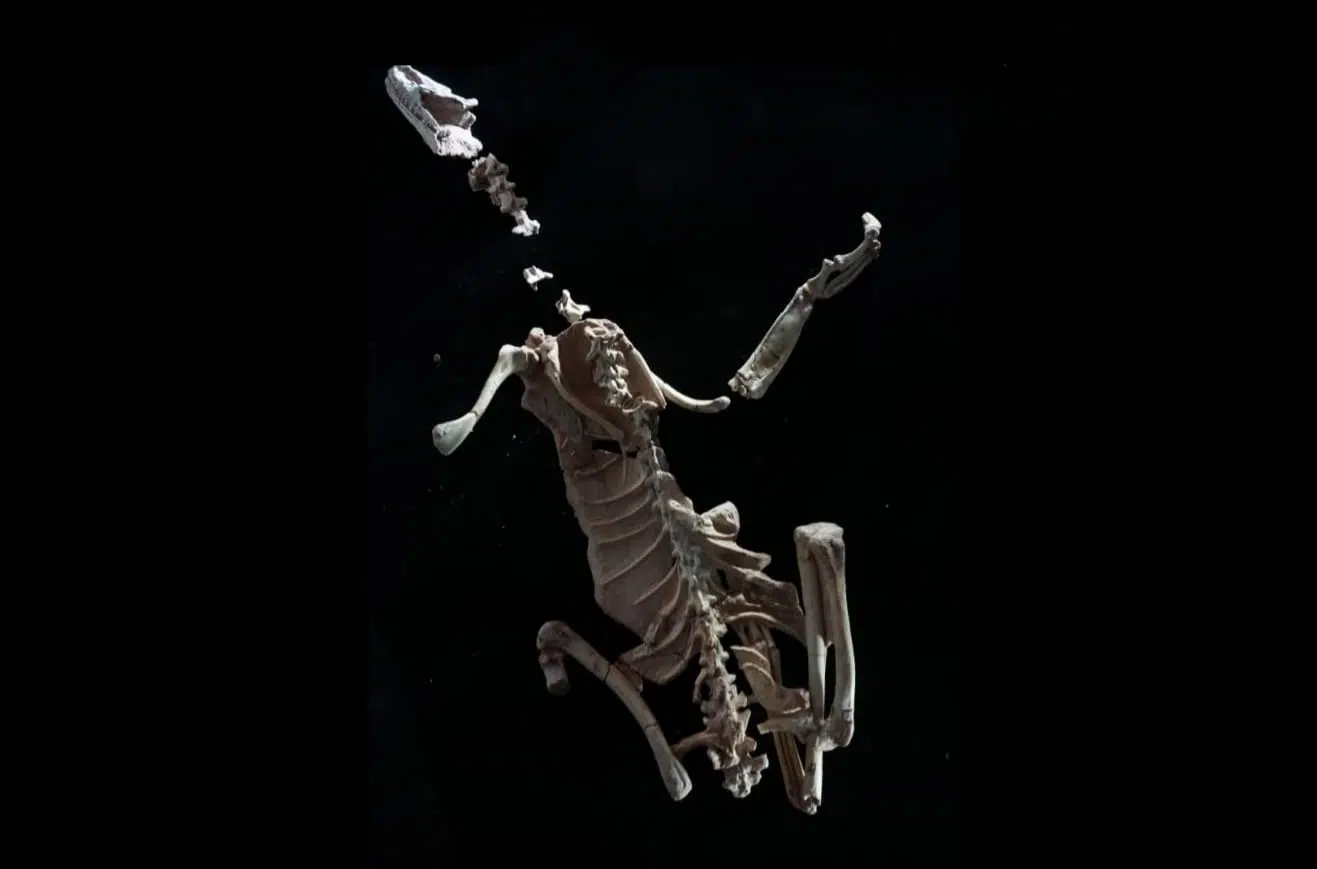
A team of paleontologists from CONICET along with colleagues from the United States discovered an exceptionally well-preserved fossil of a tiny carnivorous dinosaur from the Late Cretaceous in northern Río Negro, Argentine Patagonia. The specimen belongs to the species Alnashetri cerropoliciensis, and its study was published in the prestigious journal Nature.
This fossil, the most complete alvarezsaurid found in South America, allows us to rewrite the evolutionary history of this enigmatic group of small dinosaurs.
The alvarezsaurids: a peculiar lineage
The alvarezsaurids emerged about 150 million years ago and are characterized by:
- Light bodies and small heads.
- Tiny and numerous teeth.
- Reduced arms, which in later species had a single robust clawed finger, possibly adapted for digging into termite mounds and feeding on insects.
Until now, it was thought that their miniaturization was linked to specialization in an insectivorous diet. However, the new specimen demonstrates that some primitive alvarezsaurids were already small before developing that diet.
Evolutionary implications
The phylogenetic analysis shows that Alnashetri occupies a basal position within the group, even more primitive than some forms from the Late Jurassic. This implies that alvarezsaurids originated in Pangaea and dispersed across different continents before fragmentation.
The discovery also allowed the identification of previously enigmatic fossils as alvarezsaurids, such as a small theropod from the Morrison Formation (Jurassic, Wyoming, USA) and the Calamosaurus foxi from the Isle of Wight (United Kingdom).
Anatomy and life of the specimen
- It measured about 70 cm in length (half of which was tail) and weighed around 1 kg.
- It had a relatively long arm, with a robust first finger and a keeled claw.
- Its dentition was that of a typical predator, feeding on small vertebrates and insects.
- Histological studies revealed that it was at least four years old at the time of death and was an adult female that had already laid eggs.
Scientific importance
The fossil fills a gap in the evolutionary record: until now, mostly species from the late Late Cretaceous (70 Ma) were known in distant places like Argentina and Mongolia, but few specimens from intermediate stages. Alnashetri demonstrates that multiple evolutionary branches of the group coexisted in South America and challenges the idea of progressive miniaturization linked exclusively to diet.
The discovery of Alnashetri cerropoliciensis in Patagonia offers a unique window into understanding how alvarezsaurids evolved and diversified across different continents. This fossil not only provides unprecedented anatomical information but also redefines hypotheses about the miniaturization and global dispersion of these small carnivorous dinosaurs.



